![]() |
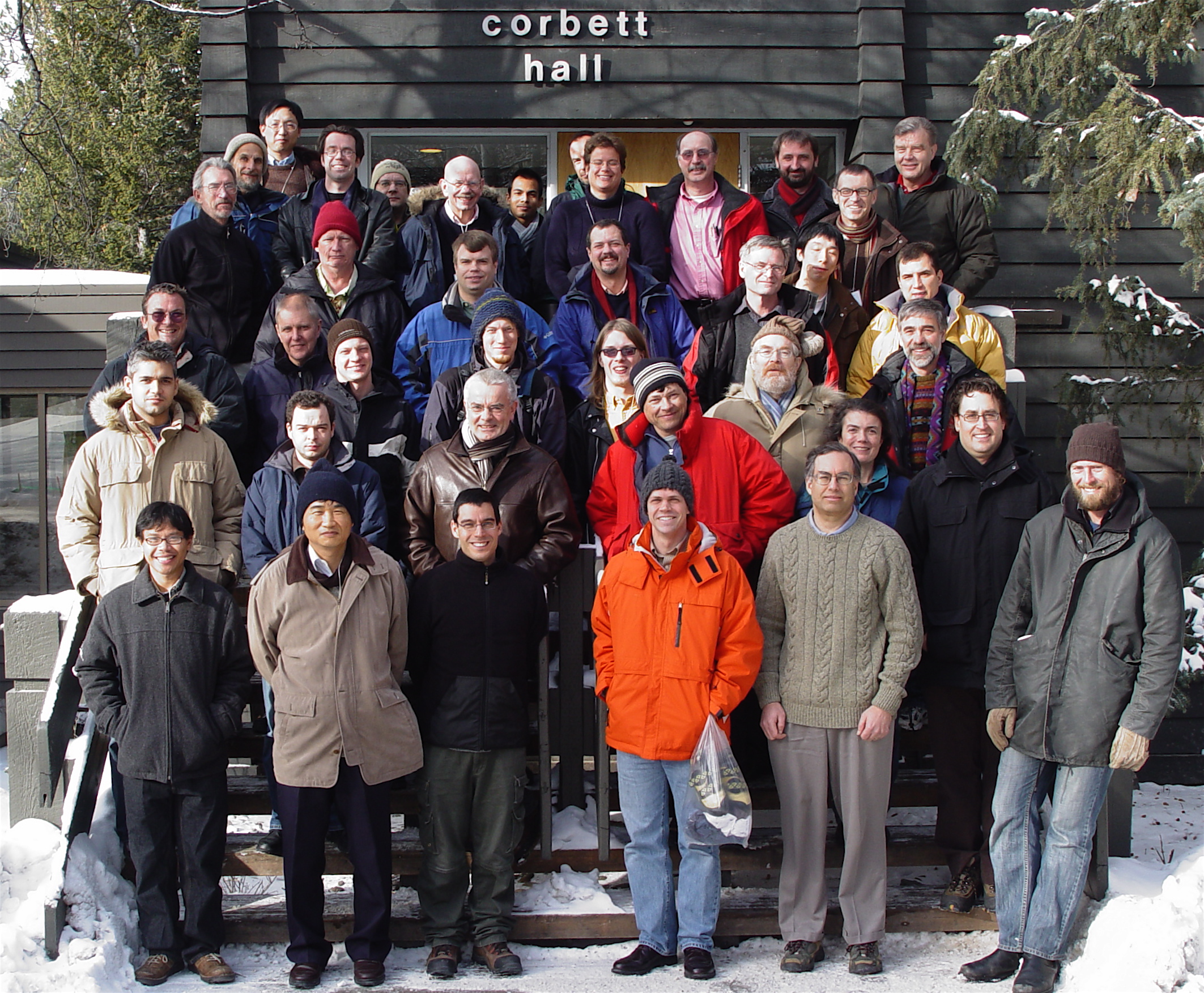
08w5034 C*-Algebras Associated to Discrete and Dynamical SystemsArriving Sunday, January 27 and departing Friday, February 1, 2008Organizers: Soren Eilers (University of Copenhagen), George Elliott (University of Toronto), Alex Kumjian (University of Nevada, Reno), David Pask (Wollongong University, Australia), Iain Raeburn (University of Wollongong - Australia), Andrew Toms (York University). Press Release: C*-algebras associated to discrete and dynamical systems ObjectivesEvidently, the goal of this workshop is to connect researchers who are working on the various types of C$^*$-algebras associated to discrete and dynamical structures. The branches of this subject have, despite their common roots in Bratteli diagrams and Cuntz-Krieger algebras, diverged both mathematically and geographically. But they have much to offer each other in terms of techniques and philosophy, if only the principals can be brought under one roof. A BIRS workshop will enable an exchange of ideas whose scale and range cannot be matched by small collaborations. Here is a sampling of the questions which could be considered at such a workshop, but would be diffcult to consider otherwise: begin{itemize} item When can a given C$^*$-algebra be modeled as the C$^*$-algebra of more than one type of discrete or dynamical structure? item Can one translate well known properties of one type of structure into properties of another through their C$^*$-algebras? For instance, can flow equivalence be viewed as a property of graphs? Or can it at least suggest the investigation of graph properties not previously considered, and which might entail important properties of the graph C$^*$-algebra? item At what level of generality can we model classifiable C$^*$-algebras using discrete and dynamical structures? item Can tools for computing $mathrm{K}$-theory in one branch of the subject be applied in others? item Is it possible to construct, in the spirit of Ro rdam and Toms, a C$^*$-algebra from a discrete or dynamical system which is not amenable to classification via $mathrm{K}$-theory? item What kind of noncommutative geometry can arise in such algebras? Can they give essentially new examples of spectral triples? item Can discrete models for certain classes of C$^*$-algebras be used to establish semiprojectivity for such, generalising the work of Spielberg? end{itemize} The workshop will also have the advantage of bringing together researchers who concentrate on one type of C$^*$-algebra, be it graph, $k$-graph, dynamical system, shift space, etc., allowing rapid progress on outstanding projects in each branch of the subject. These branches typically consist of 5-10 researchers, and so one could expect several of them to attend in their entirety. Some of the projects here include: begin{itemize} item Can C$^*$-algebra techniques be used to obtain good descriptions of flow equivalence classes of general shift spaces? item Can simple AH algebras be modeled by topological $k$-graphs in complete generality? item What do the C$^*$-algebras of multiply generated dynamical systems look like? end{itemize} A major goal of the proposed workshop is to involve young mathematicians. Graph algebras and the C$^*$-algebras of discrete structures have proved especially well-suited to the task of exposing young mathematicians to problems of current interest in operator algebras; the ``cost of admission'' to operator algebras defined using discrete structures is really quite low, with easy-to-understand definitions and a wealth of examples. Our list of proposed participants will show that our subject is very youthful indeed. We expect the requested timing of the workshop to be fortuitous for several post-doctoral fellows and advanced graduate students working in the area. The meeting will also be timely from other points of view. Two recent conferences indicate that there is much current international interest in our subject area, but these meetings were too narrowly focused to achieve our aims. The CBMS conference at Iowa in 2004, for example, was centred on a series of introductory lectures, and its goal was primarily educational; a meeting on graph algebras and ring theory at Malaga 2006 was only on the fringes of C$^*$-algebra theory. Our workshop will improve dramatically upon these conferences, and sustain a high level of research activity for a subject very much in vogue. On another note, there will be a Thematic Program on Operator Algebras at the Fields Institute from July to December, 2007. A BIRS workshop in the spring, combined with the planned noncommutative geometry activity at Fields and the annual Canadian Operator Symposium, would encourage international researchers participating in the Fields program to stay on into early 2008, with the obvious collaborative benefits. Finally, we aim to be easy on your scheduling: we would not only be amenable to an ``off-season'' meeting, but actually prefer it. This meeting will help anchor future research in the theory and application of C$^*$-algebras associated to discrete and dynamical structures. It will bring young mathematicians into contact with an active frontier in mathematics, and give postdoctoral fellows and advanced graduate students international exposure at a crucial time in their careers. |
|
2006 Banff International Research Station for Mathematical Innovation and Discovery
|
|
|