banner

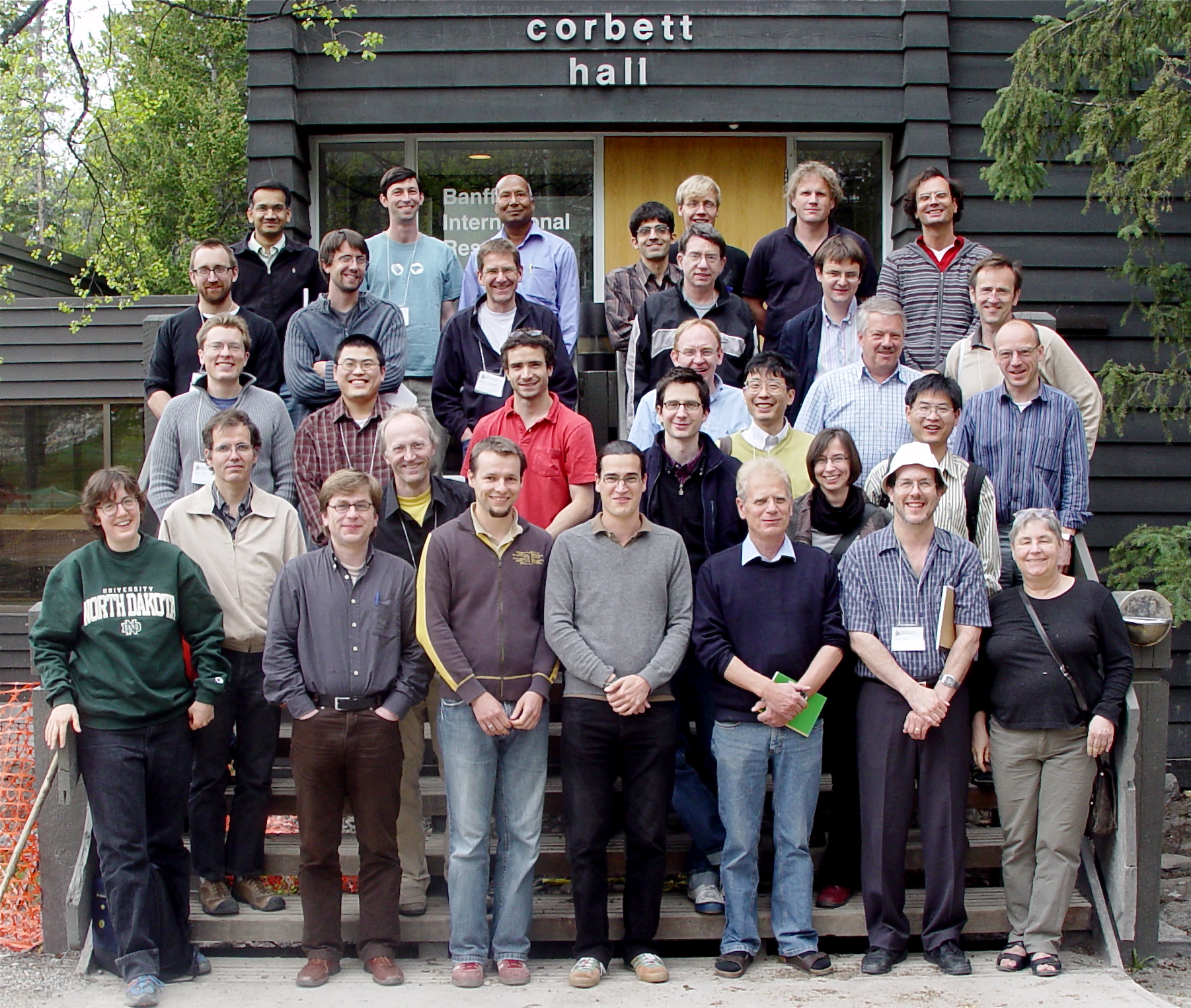
08w5056 Locally Symmetric Spaces

Arriving Sunday, May 18 and departing Friday, May 23, 2008

Organizers: Stephen Kudla (University of Toronto), Juergen Rohlfs (Katholische Universitaet Eichstaett), Leslie Saper (Duke University), Birgit Speh (Cornell University).

Confirmed Participants

Press Release: Locally Symmetric Spaces

Information for Participants

Schedule and Abstracts (PDF file)

Final Report (PDF file)


Objectives


In September 2003, J. Rohlfs and B. Speh organized a very successful workshop on locally symmetric spaces at Oberwolfach. The current workshop is intended to be a sequel to the Oberwolfach workshop with a greater range of topics. One goal of having this workshop at BIRS with an expanded list of organizers is to attract a more diverse group of mathematicians and in particular to encourage the attendance at the workshop of younger North American mathematicians.

Locally symmetric spaces are important in geometry, analysis, and number theory, and their study uses techniques from all these areas. We envision that the talks at the workshop will likewise cover such a wide range of topics and techniques. There has been substantial progress within each of these fields and some interactions between mathematicians from these different areas. Another goal of this workshop is to bring together specialists with different backgrounds in order to facilitate and increase these interactions, as well as to stimulate joint research.

The main topics to be considered are:

- Geometry of compactifications of locally symmetric spaces

- Differential geometric and topological properties and invariants

- Applications of locally symmetric spaces to arithmetic problems

- Spectral geometry and analysis on locally symmetric spaces

Several developments in different fields over the past few years make this an opportune time to have another workshop. We describe some of them. To fix notation, we let $G$ be a semisimple connected algebraic group defined over $mathbb Q$, $G(mathbb R)$ the set of real points, and $K$ a maximal compact subgroup of $G(mathbb R)$. Then $X = G(mathbb R)/K$ is a symmetric space. Let $Gamma subset G(mathbb Q)$ be a torsion free subgroup of finite index. Then $Gamma backslash X$ is a locally symmetric space.

In many cases of interest, $Gamma backslash X$ is noncompact and various compactifications (often singular) have been introduced to address different problems in geometry and number theory. The construction and relationship between various compactifications has become more clear through the work of several mathematicians, particularly Borel, Goresky, Ji, and Zucker.

Various types of cohomology associated to these compactifications are important in number theory, in particular Langlands's program. One goal here is to show that the Hasse-Weil zeta function of the Baily-Borel compactification (which is an algebraic variety defined over a number field) may be expressed as the product of automorphic $L$-functions. Towards this goal, the relation between the $L^2$-cohomology and the intersection cohomology of the Baily-Borel compactification was conjectured by Zucker and was resolved by Looijenga and Saper-Stern. One then needs to restrict intersection cohomology to a stratum of the Baily-Borel compactification and calculate the local trace of Frobenius and Hecke operators on it; in some cases this is considered in the work of Morel in the 'etale setting.

In order to avoid difficulties associated with the singularities of the Baily-Borel compactification, Goresky-Harder-MacPherson have established a relation between its intersection cohomology and the weighted cohomology of the (less singular) reductive Borel-Serre compactification. This was used by Goresky-MacPherson to prove a topological trace formula for Hecke operators. Independently an analogous relation between the intersection cohomology of the Baily-Borel compactification and the intersection cohomology of the reductive Borel-Serre compactification was conjectured by Rapoport and later established by Saper. More recently the relation between the space of $L^2$-harmonic forms and the intersection cohomology of the reductive Borel-Serre compactification was determined by Saper in a general context. The presence of the reductive Borel-Serre compactification in recent work shows its ubiquity.

Other connections to number theory also play an important role in the study of locally symmetric spaces. This can be seen for example in the work of Ash, Bruinier, Clozel, Emerton, Hanamura, Harder, Kudla, Mahnkopf, Rapoport, Rohlfs, Schwermer and Speh. Conjectures of Langlands, Tate, Beilinson and others are the driving force behind these developments which involve Hecke eigen-functions, $L$-functions, special values of $L$-functions, special points of varieties, modular symbols, mixed motives, Chow groups, and $K$-theory.

A topological problem concerning locally symmetric spaces which has received a fair bit of attention is the problem to determine if a cycle class of a locally symmetric subvariety is a nontrivial cohomology class; see for example the work of Bergeron, Clozel, Rohlfs-Speh, Speh-Venkataramana, and Venkataramana. This problem is related on the one hand to the difficult problem of determining the restriction to a semisimple subgroup $H$ of an irreducible representations of $G$ as in the work of Kobayashi-Oda and on the other hand to the arithmetic problem of period integrals with respect to $H$ of automorphic representations where special values of $L$-functions also play a role. Another interesting and important problem, where similar techniques are useful, are nonvanishing results for cup products of cohomology classes such as those of Bergeron and Venkataramana.

Important geometric invariants of locally symmetric spaces which have been considered are the analytic torsion and the related length spectrum of closed geodesics, as well as the special values of the geometric theta functions; in particular we note the work of Deitmar, Juhl, and Rohlfs-Speh. In this context, invariants of non-arithmetic subgroups are also of great interest as in the work of Bunke, Olbricht, and Leuzinger.

One of the main problems in analysis on locally symmetric spaces is the study of the Laplace operator on the space $Gamma backslash X$. A very well-known spectral problem is to obtain a lower bound on the spectrum of the Laplacian. For $GL_n$, the Ramanujan conjecture is equivalent to such a bound. For $n=2$, the best bound is due to Shahidi and Kim. In the general case, substantial work has been done by P. Sarnak and his collaborators. The techniques used here are $L$-functions and the lifting of automorphic representations.

Another interesting analytic problem is to understand scattering theory on symmetric spaces and locally symmetric spaces. This is the subject of on-going work by Mazzeo-Vasy which uses micro-local analysis and compactification theory.

A final source of interesting analytic problems is connected to the Arthur-Selberg trace formula. Particularly notable here is the recent work of W. M"uller on the spectral side of the Arthur-Selberg trace formula and his results about Weyl's law for the cuspidal spectrum.

The study of measures on $Gamma backslash X$ and $Gamma backslash G$ which are invariant under subgroups $H$ of $G$ was begun with the work of M. Ratner and recently culminated in the unique quantum ergodicity theorem of E. Lindenstrauss.

We expect advances in all the above mentioned areas during the next few years. A goal of the workshop will give an opportunity for young researchers to learn more about the different aspects of the field, the different methodologies, and the many open problems. Another goal will be to stimulate and capitalize on new developments through interactions of researchers from different areas. For example, a new emerging idea is the use of methods from ergodic theory to attack analytic problems on locally symmetric spaces. For another example, a breakthrough concerning the fundamental lemma would lead to significant applications of the Selberg trace formula.
  2006 Banff International Research Station for Mathematical Innovation and Discovery
Banff from Norquay PIMS Logo   MSRI Logo   MITACS Logo   IM UNAM Logo