Sparse Random Structures: Analysis and Computation (10w5033)
Organizers
Emmanuel Candès (Stanford University)
Alan Edelman (Massachusetts Institute of Technology)
John Gilbert (University of California, Santa Barbara)
Raj Rao Nadakuditi (University of Michigan)
Roland Speicher (Queen's University)
Balint Virag (University of Toronto)
Description
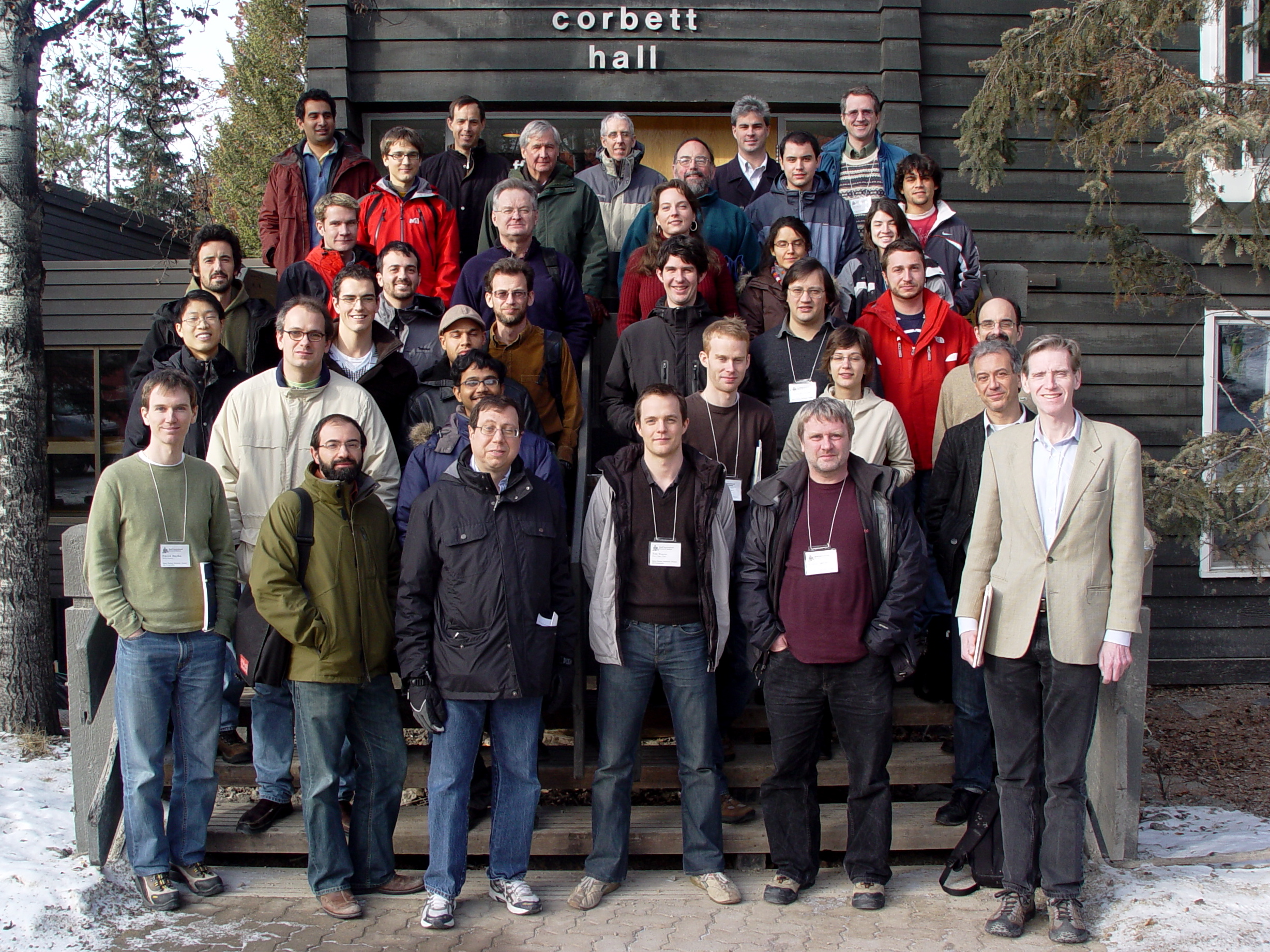
The Banff International Research Station will host the "Sparse Random Structures: Analysis and Computation" workshop from January 24th to January 29th, 2010.
This interdisciplinary workshop is intended to bring together experts
who are likely to combine the mathematical pieces necessary for
understanding modern discrete structures such as the internet, social
networks, physical networks, and compressible data. The motivation for
workshop is to bring together and stimulate interaction between the
research communities that have contributed to the body of literature
associated with random matrix theory as well as
all of the users of this theory represented by the applications above.
The research communities actively developing random matrix theory
include the communities in mathematical multivariate
statistics,operator algebras, combinatorics, symmetric spaces,
stochastic analysis , number theory, orthogonal polynomials, Riemann-Hilbert problems, random graphs, Painleve equations and special
functions, random walks and growth processes, Integrable systems and many others. While there has been work for decades, the interest in applying these techniques to discrete structures is blossoming at this time.
The Banff International Research Station for Mathematical Innovation and Discovery (BIRS) is a collaborative Canada-US-Mexico venture that provides an environment for creative interaction as well as the exchange of ideas, knowledge, and methods within the Mathematical Sciences, with related disciplines and with industry. The research station is located at The Banff Centre in Alberta and is supported by Canada's Natural Science and Engineering Research Council (NSERC), the US National Science Foundation (NSF), Alberta's Advanced Education and Technology, and Mexico's Consejo Nacional de Ciencia y Tecnología (CONACYT).