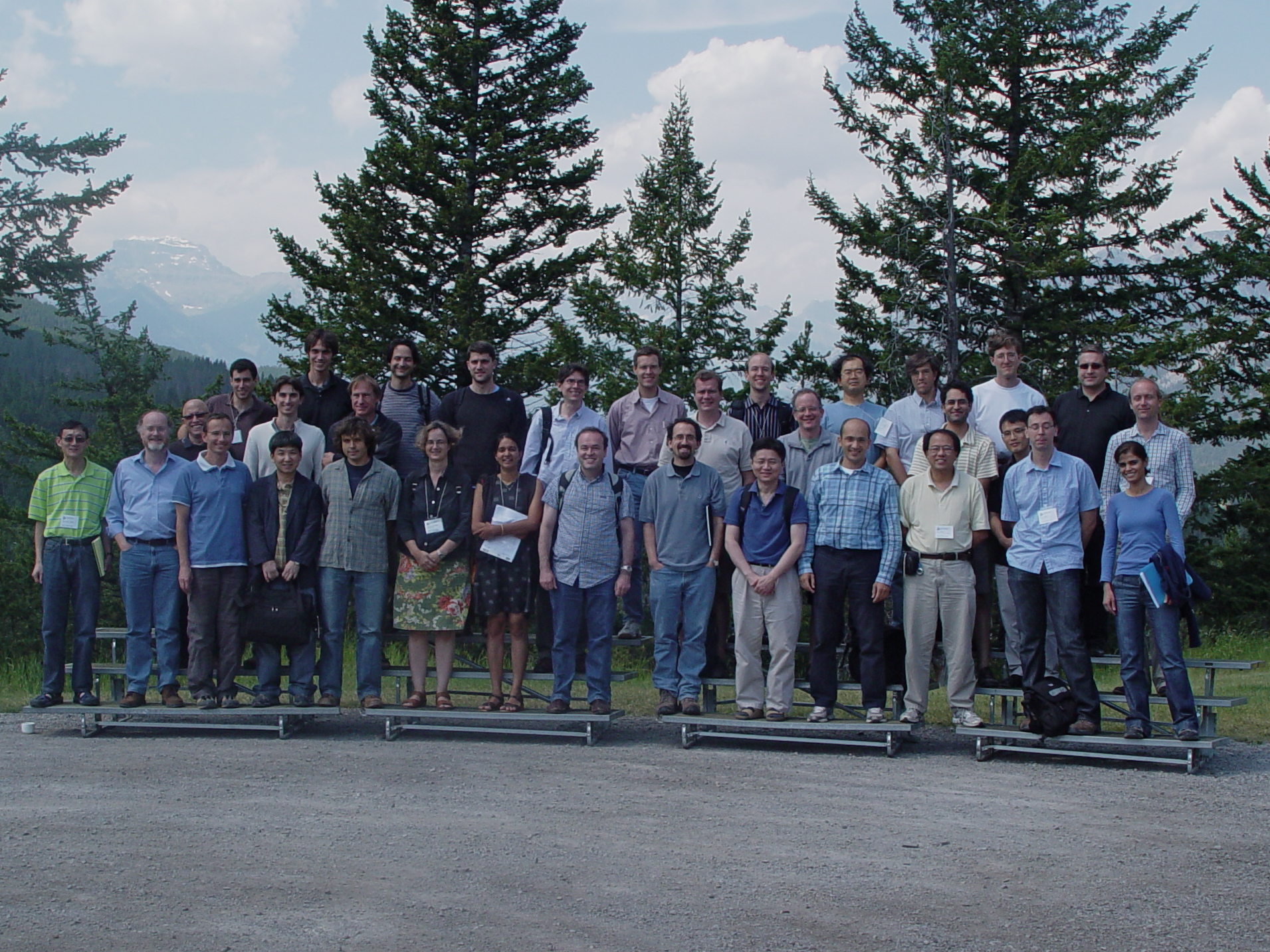
Properties of microscopic objects, such as atoms and molecules, are governed by the peculiar laws of quantum physics. In the quantum world particles often behave as waves, and wave phenomena, such as light, acquire particle-like attributes. In some cases, this quantum behavior manifests itself in macroscopic objects and affects (and improves!) our everyday lives; lasers and solid-state electronic devices stand as standard examples. This workshop to be held at the Banff International Research Station on July 20 - 25, 2008 is concerned with exploring quantum phenomena in systems that include solids, liquids, and gases, which arise when very large numbers of quantum particles interact very strongly. Unusual things then happen: in some situations interacting systems can behave as if their elementary constituents (electrons, for example) splinter into new particles. This phenomenon is called ''fractionalization''. Fractions of the electron have fascinating properties and are of great interest to fundamental science. For example, in a scenario when the electron splinters into particles called non-abelian anyons, these particles have a remarkable property that when one particle is taken along a loop around another, it transforms into a particle of another type. Interestingly, this bizarre property of non-abelian anyons plays a key role in a proposed practical application of fractionalization to quantum computation. Research outlined in this proposal deals with theoretical descriptions of systems where these fascinating phenomena are thought to occur. These include high-temperature cuprate superconductors, ultra-cold atom gases and artificially engineered semiconductor structures. Besides contributing to resolving the underlying intellectual challenges the aim of the proposed research is to help develop practical applications of these remarkable phenomena in the area of quantum computation and information.
The Banff International Research Station for Mathematical Innovation and Discovery (BIRS) is a collaborative Canada-US-Mexico venture that provides an environment for creative interaction as well as the exchange of ideas, knowledge, and methods within the Mathematical Sciences, with related disciplines and with industry. The research station is located at The Banff Centre in Alberta and is supported by Canada's Natural Science and Engineering Research Council (NSERC), the US National Science Foundation (NSF), Alberta's Advanced Education and Technology, and Mexico's Consejo Nacional de Ciencia y Tecnología (CONACYT).