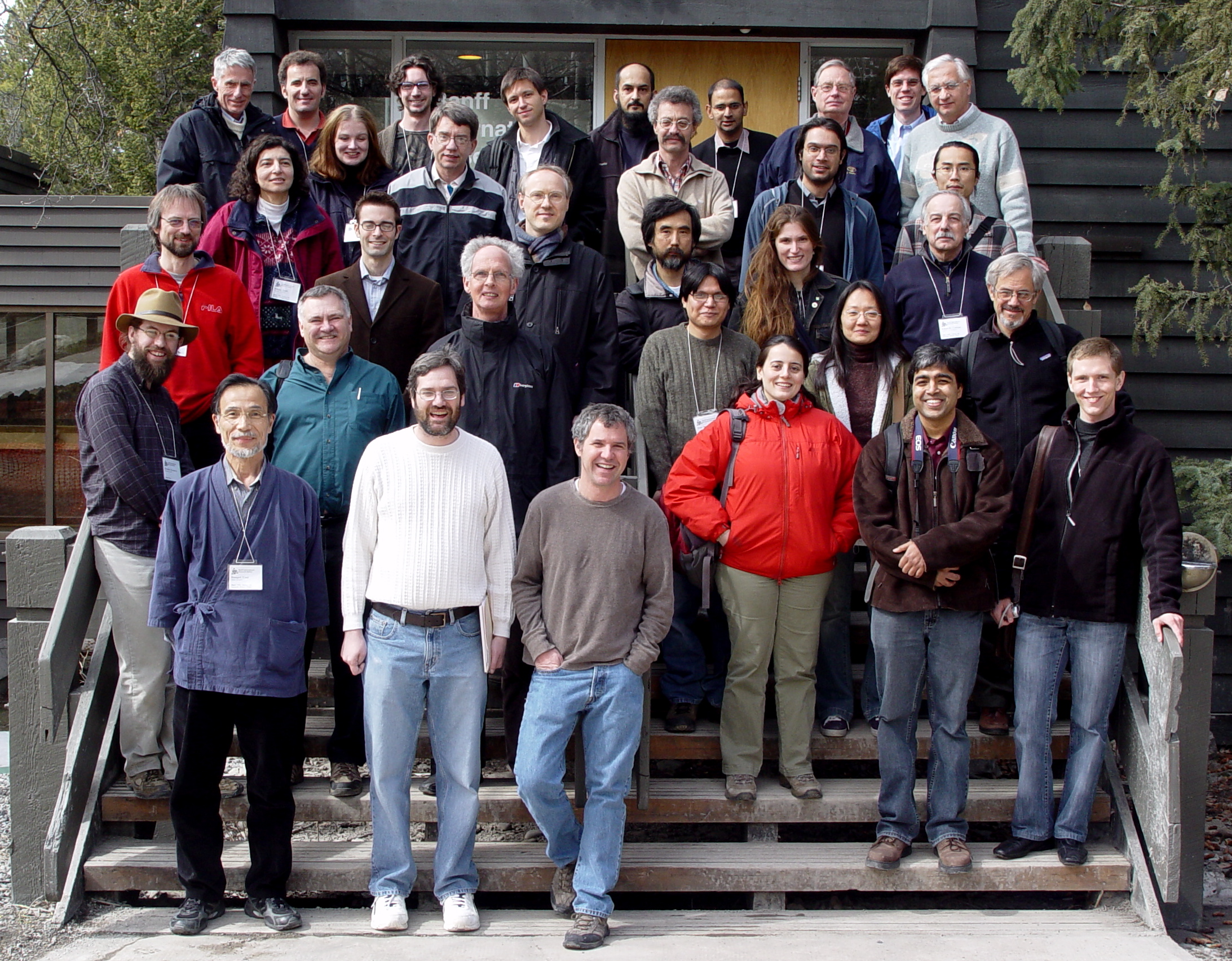
Hodge Theory (08w5106)

Arriving Sunday, April 6 and departing Friday April 11, 2008

Organizers

Patrick Brosnan (University of British Columbia)
Ludmil Katzarkov (University of Miami)
Mark Green (University of California, Los Angeles)
Gregory Pearlstein (Michigan State University)

Objectives

Title:

Objectives:

We propose the following two topics as the main ones for the
conference:

(1) Recent results related to the Hodge conjecture and
algebraic cycles.
(2) Recent results concerning the asymptotics of variations
of mixed Hodge structure.

In 1920, Lefschetz proved that every integral Hodge class of
type (1,1) on a smooth projective surface could be represented
via the fundamental class of an algebraic cycle. In his 1950
ICM address, Hodge conjectured that every integral (p,p) class
on as smooth projective variety was the fundamental class of
a codimension p algebraic cycle. This conjecture was later amended
by the work of Atiyah and Hirzebruch who showed that one must use
rational rather than integral coefficients. However, other than that,
it has remained open ever since.

Efforts to prove the Hodge conjecture by extending Lefschetz
approach to the (1,1)-theorem using normal functions informed
the initial theory of the variations of Hodge structures and
their degenerations by Griffiths school in the 1970\'s. However,
it was eventually discovered that progress on the Hodge conjecture
via this route is blocked by the failure of Jacobi inversion for for
higher codimension cycles.

Recently work of Phillip Griffiths, Mark Green, Richard Thomas,
Herb Clemens and others has shown that obstacle can be avoided
by replacing Lefschetz pencils with families of hyperplane
sections of sufficiently high degree.

Working from a completely different view point, Kazuya Kato,
Sampei Usui and others have completed Griffiths dream of
constructing good, Hodge theoretic partial compactifications
of the arithmetic quotients of Griffiths period domains by
marrying the original work of Griffiths school on degenerations
of Hodge structure with the new theory of log geometry.

One of the primary goals of this conference is to bring
together researchers working on applications of Hodge theory
to algebraic geometry, such as Griffiths and Green, with
researchers working on topics internal to Hodge theory,
such as Kato and Usui\'s work on compactifications of period
domains. In particular, while there are conferences fairly
regularly on the subject of algebraic cycles and also on the
applications of Hodge theory to such subjects as Gromov-Witten
theory (e.g., the conference on Calabi-Yau varieties and Mirror
Symmetry at Banff in 2003), conferences on subjects internal to
Hodge theory have been rather rare. The last one in North America
was the conference on Hodge theory and Log geometry at Japanese
American Mathematical Institute at Johns Hopkins University in
Baltimore. However, as illustrated above, there is a great need for
conferences in this field because the theory is experiencing
renewed progress on many fronts.

This conference will also have a large component emphasizing the training of graduate students and postdocs working in the area. We will reserve several
slots for younger mathematicians getting started in the area. We also
feel that it is important to include women and minorities.