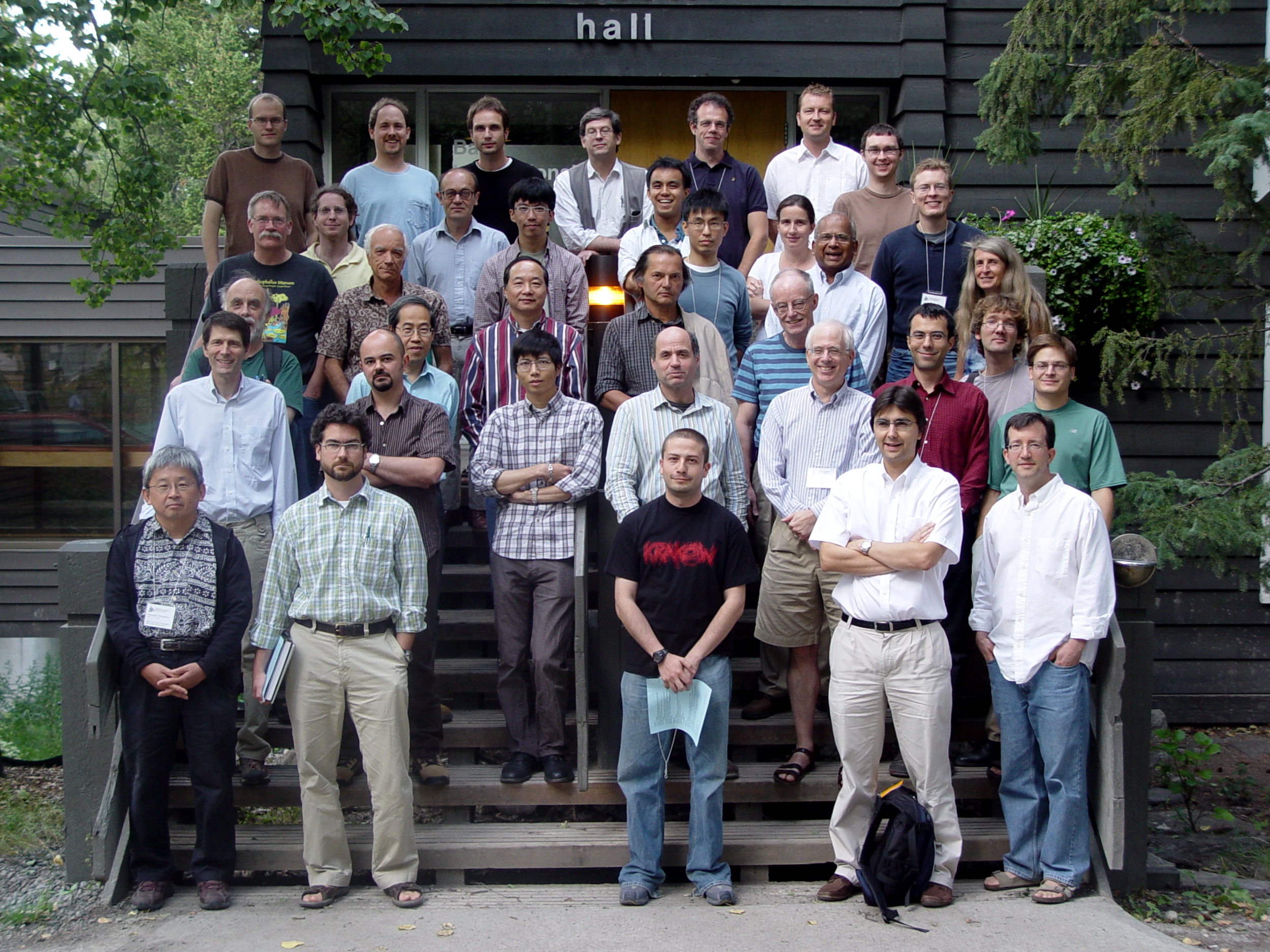
banner

08w5040 The stable trace formula, automorphic forms, and Galois representations

Arriving Sunday, August 17 and departing Friday, August 22, 2008

Organizers: James Arthur (University of Toronto), Michael Harris (Universite de Paris 7), Eric Urban (Columbia University), Vinayak Vatsal (University of British Columbia).

Confirmed Participants

Press Release: The stable trace formula, automorphic forms, and Galois representations

Information for Participants

Schedule (PDF file)

Mailing List

Final Report (PDF file)

Workshop Videos


Objectives


A generation of number theorists has grown up studying the theory of elliptic modular forms. The arithmetic, geometric, and analytic techniques required to understand automorphic forms on $GL(2)$ have become widely familiar, and can be learned from a variety of excellent texts. In contrast, the theory of automorphic forms on other groups, and specifically the arithmetic theory of automorphic forms on Shimura varieties, remains the province of a small number of specialists. This, we believe, is less due to the intrinsic difficulty of the subject than to the fact that it has developed primarily as a dialogue among experts. Moreover, with the exception of the volume ``The zeta functions of Picard modular surfaces" published by the CRM in Montreal in 1992, which treats in depth the case of the group $U(3)$, articles on the stable trace formula have invariably treated the subject in complete generality. This undoubtedly contributed to the rapid development of the field, but made the literature much less accessible to colleagues with backgrounds in number theory or arithmetic geometry rather than Lie theory.

It has long been apparent that a full understanding of elliptic modular forms requires the development of an arithmetic theory of automorphic forms on groups other than $GL(2)$. The recent work of Skinner and Urban, among others, on generalizations of the Iwasawa Main Conjecture, and the recent proof by Clozel, Harris, Shepherd-Barron, and Taylor of the Sato-Tate Conjecture for elliptic curves over $Bbb{Q}$ with non-integral $j$-invariant, have shown that this is not only necessary but is also possible, even with techniques presently available. The primary goal of the proposed workshop is to contribute to creating a situation where number theorists will be able to make use of the most recent developments in the theory of automorphic forms on higher-dimensional groups with no less ease than they have hitherto done with the $GL(2)$-theory. We expect that the forthcoming books of Arthur and of the Paris automorphic forms seminar, emphasizing the specific cases of orthogonal and symplectic groups and unitary groups, respectively, will help provide a transition between the $GL(2)$-theory and the general theory.

The Paris project expects to produce four books, devoted, respectively, to I. The stable trace formula and the Fundamental Lemma ; II. Zeta functions of Shimura varieties ; III. $p$-adic families of automorphic forms and Galois representations; and IV. Arithmetic applications. The first three books should concentrate essentially on automorphic forms on unitary groups and the related theory of general linear groups. Their provisional tables of contents are appended below. Volume IV, on the other hand, remains almost completely open. The second goal of the proposed workshop is to encourage number theorists to mine the developed theory for applications. One obvious line of applications is to use deformations of non-tempered cohomology classes to construct infinite subgroups of Selmer groups, as in the work of Skinner-Urban and Bella"i{}che-Chenevier; indeed Chenevier has already spoken in the Paris seminar on his work with Bella"i{}che generalizing their previous work to arbitrary dimension, conditional on the instances of the Arthur multiplicity conjectures expected to be proved in the first two volumes. Other possible applications are to the Arakelov theory of Shimura varieties and relations to derivatives of $L$-functions, as in Kudla's program; the construction of Euler systems in the cohomology of Shimura varieties; or ergodic properties of special cycles on Shimura varieties, as considered from various points of view by Vatsal and Cornut, Clozel-Ullmo, and Jiang-Li-Zhang.

Moreover, we expect the theory of the stable trace formula to make considerable progress between now and the time of the workshop. Ng^o and others have been developing a program to prove the endoscopic Fundamental Lemma for groups other than $U(n)$, using geometric methods related to the Hitchin fibration. Arthur's book will undoubtedly stimulate work on twisted versions of the Fundamental Lemma; the first steps have been taken by Waldspurger, who has reduced the Fundamental Lemma for twisted endoscopy to what he calls standard and non-standard Fundamental Lemmas in which no twisting is apparent. Finally, the full strength of Arthur's stabilization of the invariant trace formula requires a variant of the Fundamental Lemma for weighted orbital integrals, which requires a completely new set of geometric insights; this is the subject of work in progress of Chaudouard and Laumon.

With regard to the main application of the Paris project's first three books -- the construction of Galois representations attached to cohomological automorphic representations of GL(n) over CM fields, under a duality hypothesis -- considerable progress has been made during the past two years. Under a series of simplifying hypotheses that suffice for the construction of Galois representations, a simple version of the stable trace formula for unitary groups now seems within reach, using only the version of the Fundamental Lemma proved by Laumon-Ng^o; this is the subject of work in progress of Moeglin and Labesse. As for the analysis of the zeta functions of unitary Shimura varieties, S. W. Shin, in his thesis work under the direction of Richard Taylor at Harvard, is in the process of developing a synthesis of the work of Kottwitz and Harris-Taylor which will allow him to apply the techniques of the latter in situations where endoscopy is non-trivial (or alternatively, to apply Kottwitz' techniques in situations of bad reduction). Harris has sketched a strategy for obtaining all the expected Galois representations from these results, using p-adic continuity in the setting of eigenvarieties of higher dimension constructed by Chenevier.

For these reasons we propose a two-part workshop, to be divided into two weeks. The first week would be similar to a summer school and would address the first two goals mentioned above. It would be directed at graduate students working in the field of automorphic forms as well as at number theorists wishing to gain familiarity with the techniques and results afforded by the stable trace formula. The contents would be based on the forthcoming books of Arthur and the first two volumes of the Paris automorphic forms seminar, versions of which should exist by the summer of 2008, when the workshop should take place. The second week would be a research conference on questions related to the contents of the books. Progress in the stabilization of the trace formula and the twisted trace formula will feature prominently, but we also hope to present new results on the construction of $p$-adic families of automorphic forms and related Galois representations, as in Volume III of the Paris seminar, and perhaps even some arithmetic applications as promised in Volume IV.
  2006 Banff International Research Station for Mathematical Innovation and Discovery
Banff from Norquay PIMS Logo   MSRI Logo   MITACS Logo   IM UNAM Logo