![]() |
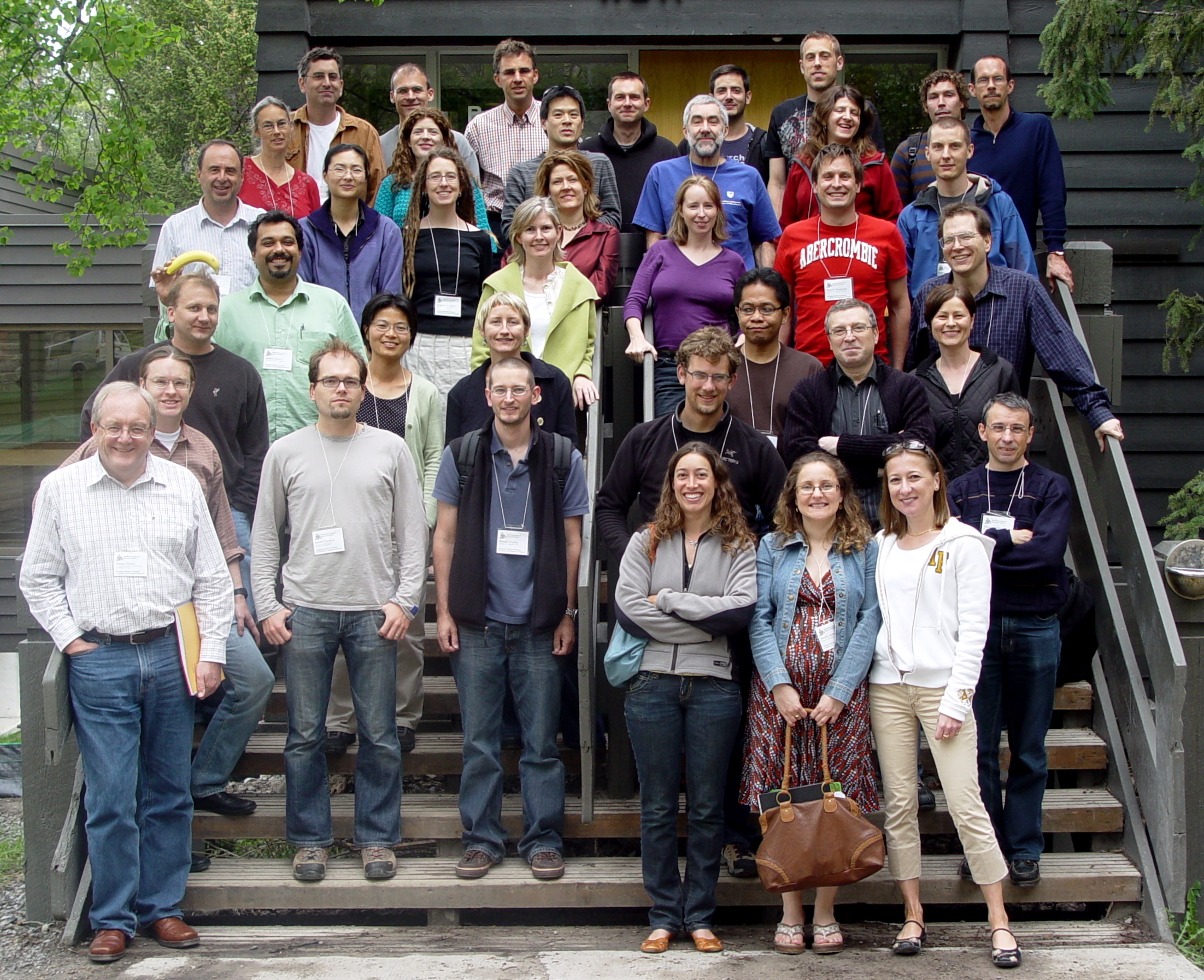
08w5062 Emerging Statistical Challenges in Genome and Translational ResearchArriving Sunday, June 1 and departing Friday, June 6, 2008Organizers: Jennifer Bryan (University of British Columbia), Sandrine Dudoit (University of California, Berkeley), Jane Fridlyand (Genentech Inc.), Darlene Goldstein (Ecole Polytechnique Federale de Lausanne), Sunduz Keles (University of Wisconsin, Madison), Katherine S. Pollard (University of California, Davis). Press Release: Emerging Statistical Challenges in Genome and Translational Research New! Emerging Statistical Challenges in Genome and Translational Research Wiki & Blog ObjectivesThe primary objectives of this workshop are (1) to address emerging statistical problems in the analysis and combination of diverse datasets arising from genome-scale assays applied in clinical and molecular genetic research; (2) to facilitate meaningful interactions between the experimental biologists and research-oriented clinicians who produce genome-scale data and the statisticians who develop and implement appropriate analytical methodology. Substantive collaborations between these groups are vital for transforming the massive amount of data produced by new technologies into important biological discoveries and translational research. A secondary aim is to honor and celebrate the achievements and ongoing contributions to this field of Professor Terry Speed, who turns 65 in 2008. We believe that an appropriate recognition is to carry forward his first-rate example of forging productive statistical-biological hands-on collaborations, and that this workshop provides an effective means of doing so. The workshop is intended to foster deeper connections between the life science and statistical research communities and to be a forum for (1) the dissemination of cutting-edge biotechnical and methodological developments and (2) the identification of open data analysis problems. The challenges include not only analyzing genotypes, gene and protein expression and DNA-protein interaction data, but also relating these to phenotypic data, such as clinical outcomes, and further relating all of these to existing databases containing different types of meta-data. We anticipate that this workshop will enable statisticians to articulate theoretically grounded statistical formulations of existing and emerging computational biological and clinical problems; create an exceptional opportunity for exchanging ideas between the communities; and help to shape the future of this dynamic field. Input from life scientists is absolutely crucial for development of relevant statistical methodologies. We therefore target areas that are relatively new to statisticians, as well as areas that have already been greatly influenced by statistical approaches. The five targeted areas for the workshop include: classification of patients based on genetic and genomic data, computational population genetics, pharmacogenomics, emerging technologies and data integration. We expect that the interaction between statisticians and biologists will lead to major advances in the analysis and integration of genome-scale data sets and in translational research. In addition, this relatively new and rapidly developing field enjoys an excellent representation of both young researchers and women. Relevance: It is now well accepted that the capacity to generate genome-wide data has far outpaced the ability to analyze and interpret it. The rapid development of new high-throughput technologies allows biological investigations on an ever-growing scale. Statistical genomics has adapted well to these changes, due to the great interest of statisticians in the methodological challenges inherent in a quickly evolving domain. Addressing the new statistical demands has clear relevance for continued progress in biological and biomedical research predicated on genome-scale assays. Importance: Genome-scale data are rising in prominence and are rapidly becoming critical to the study of human disease, most strikingly in cancer. Yet without sound methodology, accompanied by computationally feasible implementations, we risk missing, or misinterpreting, important information contained in these data. This workshop will help to enable transformation of the vast data resources emanating from multiple, diverse types of high-throughput assays into realizable health benefits, including improved diagnostics, prognostication, risk assessment and individualized treatment. Timeliness: There are several well-established computational biology conferences where the primary quantitative discipline is computer science, not statistical science. These meetings are often focused more narrowly on databases, algorithmic aspects, or specific software, and contain a rather weaker interdisciplinary component. Likewise, even though major statistical conferences often have sessions on computational biology, the audience is almost exclusively statisticians. Opportunities for true interdisciplinary interaction are few. Yet in this field, rapid communication between biologists, clinicians and statisticians is absolutely vital. Our aim is to organize a more fully interdisciplinary workshop to address the challenges posed by the enormous need for quantitative data integration and modeling in biology. Although the field is very broad, our intent is to focus on the statistical, mathematical, and computing aspects without losing sight of the underlying biology. To this end, biologists have an intrinsic role to fulfill. A workshop that specifically brings life scientists and statisticians together would certainly be an important development in the field, and BIRS provides an unbeatable environment. |
|
2006 Banff International Research Station for Mathematical Innovation and Discovery
|
|
|