Combinatorial Game Theory (08w5075)
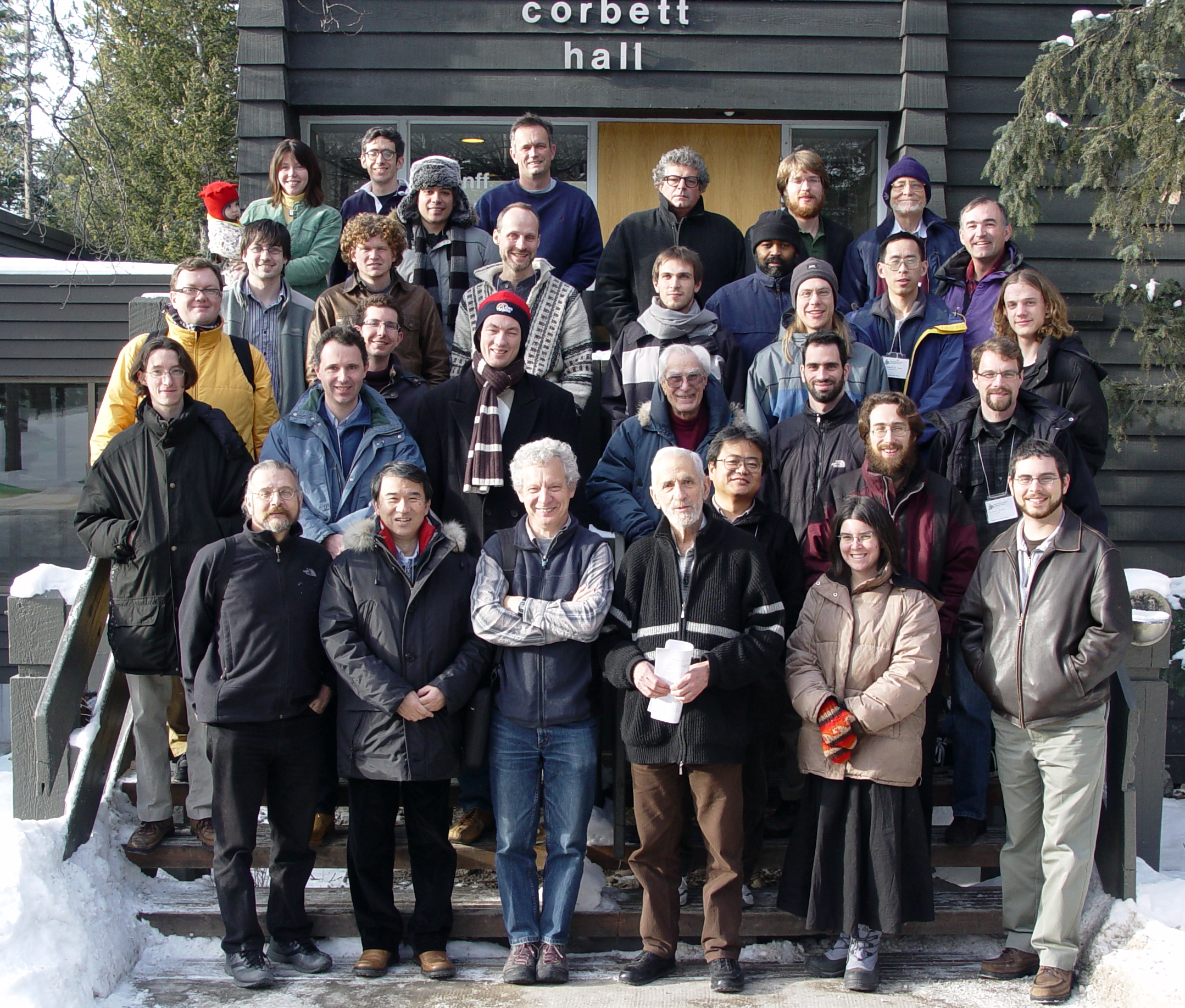
Organizers
Michael Albert (University of Otago)
Elwyn Berlekamp (University of California, Berkeley)
Ezra Miller (University of Minnesota)
Martin Müller (University of Alberta)
Richard Nowakowski (Dalhousie University)
David Wolfe (Gustavus Adolphus College)
Description
some interest in games, many are fascinated by them, and for some
they are an obsession. Games with no chance elements such as chess,
checkers and go have always had a particular intellectual attraction.
Combinatorial game theory, developed largely since the 1970's, is
the mathematical study of games of this type.
Chess and go are far too complex to be completely understood using
combinatoral game theory, but tools developed as part of the subject
such as the idea of "game-theoretic value" have provided powerful
methods for understanding particular problems in these and other games
as well as general high-level principles for playing specific games.
Most recently, computers and algorithms have become more significant
in the area. In particular, the prospect of fusing the theoretical
methods of combinatorial game theory to the powerful search techniques
used in traditional game playing programs is an exciting one.
The Banff International Research Station for Mathematical Innovation and Discovery (BIRS) is a collaborative Canada-US-Mexico venture that provides an environment for creative interaction as well as the exchange of ideas, knowledge, and methods within the Mathematical Sciences, with related disciplines and with industry. The research station is located at The Banff Centre in Alberta and is supported by Canada's Natural Science and Engineering Research Council (NSERC), the US National Science Foundation (NSF), Alberta's Advanced Education and Technology, and Mexico's Consejo Nacional de Ciencia y Tecnología (CONACYT).