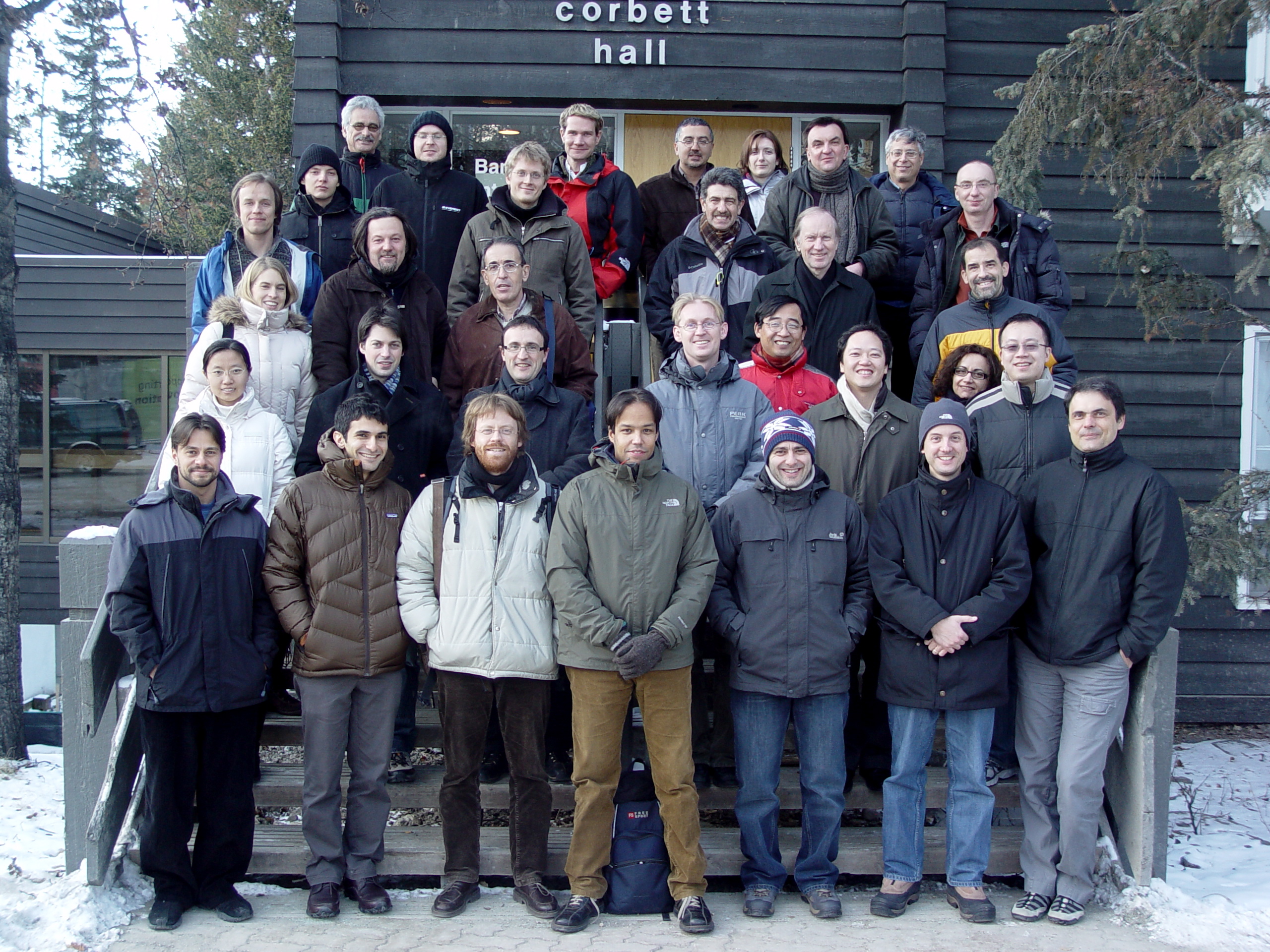
![]() |
09w5109 Numerical Analysis of Multiscale ComputationsArriving Sunday, December 6 and departing Friday, December 11, 2009Organizers: Bjorn Engquist (University of Texas at Austin), Olof Runborg (Royal Institute of Technology, Sweden), Steve Ruuth (Simon Fraser University), Richard Tsai (University of Texas at Austin). Press Release: Numerical Analysis of Multiscale Computations ObjectivesIn early 2007, BIRS sponsored our workshop on Numerical Analysis of Multiscale Computations. This workshop successfully facilitated further communications and collaborations of the participant researchers. Following that workshop, there has been a series of further events with expanded frontier: Cambridge University hosted a workshop on highly oscillatory problems. A two-day meeting took place in Princeton University that concentrated on multiscale aspects of molecular simulations and analysis. Several plenary talks as well as minisymposia focussed on various aspects of multiscale computations in ICIAM this year. We observed that new techniques were being introduced, some prevously brought-up problems being resolved, while some important common problems remain. Based on our previous success and our aspiration to push research forward in this important field, we propose to organize a new workshop at BIRS in 2009. This workshop is designed to be both a follow-up workshop for the previous participants and the previously discussed topics, as well as a new one with an expanded horizon. This time we will have a full size workshop with 40 persons. There was a realization at the previous workshop that multiscale problems are most often also multi-disciplinary, and input from experts in other areas is necessary. To understand where and how mathematics can help and improve the existing computational techniques used in the applied fields, it is important to be able to connect and relate to the physics and the modeling behind the problems. Thus, although the focus on the workshop will be on mathematics, we therefore also plan to invite a few leading scientists in physics, biology and chemistry to reflect on our work and discuss problems where new mathematics is needed. In order to solve multiscale problems of practical interests and to bring the impacts to the fields, we thus propose to bring computational scientists, analysts and scientists in applied fields together for a brain storming workshop at Banff. The workshop will be mutually beneficial for the participants. On the one hand, the analysts will be informed of new multiscale methodologies directly from the computational scientists and discover new mathematical problems that are crucial to the applications from experts in the field; on the other hand, the computational people will be exposed to new mathematical tools and ideas that are developed by the analysts. Most importantly, these groups of people will be able to have a more direct interaction and communication during this workshop and determine a set of important problems for building a theoretically sound and computationally feasible multiscale approach. We set the main themes to be: 1. Coarse models and coarse variables In the typical situation, a fine scale model for the high-dimensional microscopic variables is known, but it is too expensive to simulate. To reduce the computational cost we want instead to compute a number of coarse variables, using a coarse model. Finding such variables and a corresponding model are two major difficulties. The fine and coarse models can be of different types. PDEs or ODEs are commonly used, but in many applications, stochastic modeling is more appropriate. For instance, molecular dynamics (ODEs) can be a fine scale model of fluids, while a coarse scale model could be Navier--Stokes (a PDE). Similarly, Monte--Carlo methods can be used either as a valid method for the coarse scale system or used in a fine scale to evaluate coarse scale quantities, while some other type of computational model is used in the complement scale. From a practical point of view, we would like to be able to find reasonable coarse models and variables in a systematic way. In the new class of numerical methods it is often sufficient to find a tentative, incomplete, coarse model. Numerical simulation of the fine scale model can then be used to reconstruct the missing parts (see below), but can numerical methods also be used to automate how we find the tentative coarse model and the coarse variables? Another non-trivial issue is whether a coarse system is properly closed, i.e. whether a certain set of coarse variables are enough to describe the coarse dynamics that is consistent with the fine scale system, and if not, what additional auxilliary coarse variables are needed to close the coarse system. We note that it is sometimes also possible to solve for the coarse variables without any direct reference to a coarse model at all. We are interested in developing such direct numerical procedures that consistently drive the coarse scale evolution by using snapshots of fine scale solutions. As an example, the Fermi-Pasta-Ulam problem is to study the adiabatic energy transfer in a system of interlaced linear stiff springs and ``soft'' nonlinear ones. The adiabatic energy transfer in the system is an important phenomenon that only becomes observable when the energies of the right springs in the original system is explictly computed. Each spring in the system oscillates at similar fast time scales, and it is not obvious what coarse model (and variables) should be used to consistenly compute the energy transfer in the system. 2. Convergence, accuracy and complexity One of the main goals of developing multiscale methods is to significantly reduce the complexity of finding accurate numerical solutions for phenomena that involve wide ranges of scales. A challange in developing multiscale methods is the question about convergence. Conventional convergence theory roughly says that when the mesh size goes to zero, the computed approximations converge to the solution of the problem. In the multiscale setting, this may have to be modified so that both the mesh size and the parameter for the smallest scale in the problem goes to zero together in one limiting process instead of two nested limits. Therefore, we would like to find out: Under what conditions and in what sense do the multiscale approaches converge, while still having a significantly smaller complexity than that of direct simulation of the fine scale model? What is the accuracy and the stability properties of the methods? 3. Coupling of models At the heart of the new multiscale approaches is the coupling of the coarse and the fine models. There are two main coupling scenarios: ``top down'' and ``bottom up''. In the first case, a tentative coarse model is known but (a) certain data, such as constants or coefficients in the equations, are not available; or (b) the coarse model is not valid in parts of the domain. In the second case, a fine scale model exists, but cannot be computed in the entire domain of interest. Certain "up-scaling" is needed but there may not be a readily available, even tentative, analytical form of the macroscale model. In both these cases one needs to couple to the fine scale model and use it to supplement the macroscale simulations. The challenges of coupling between different models in a multiscale computation can be typically divided into three issues: (1) finding a suitable initial and boundary condition for the fine scale domains, that correctly reflects macroscale information; (2) evaluating the macroscopic information from fine scale calculations; (3) identification of subdomains in which macroscale model are not sufficient and a fine scale model is required. If certain notion of homogeneity in the macro domain exists, periodic boundary conditions for the fine scale simulations are appropriate choice. Generally speaking, microscale simulations feedback to the macro model through Dircihlet or Neumann type conditions. One of the goal of this workshop is to discuss if there is a systematic way and theory for issues raised above or novel couplings from new applications. 4. New challenges Here we invite scientists from physics, biology and chemistry to discuss problems in their fields. The aim is to see if the mathematics of multiscale problems developed so far can have an impact on their problems, as well as if novel mathematical modeling of the presented problems is needed. Often, analyzing good model problems can be very effective in advancing the solution to the practical problems, as one can attack the essential difficulties without being distracted by other less relevant factors. The development of shock capturing schemes for conservation laws is one such example. The model problem, here Burgers' equation, played an important role in the advancement of numerical computations for conservation laws. Therefore, we set one of the aims of this workshop to identify new challenges and their corresponding model problems. In this effort, it is crucial to interact with scientists who have deep insights into the physics of the underlying problem and how it is modeled. These aspects pose challenging computational and analytical problems. Item 1 has been addressed traditionally by either applying empirical rules based on physics, or by rigorous analytical approaches such as homogenization or methods from mathematical physics on much simplified settings. Some initial work has been done on Item 2 for some classes of methods, but many open questions remain. Much numerical simulations has been done along the lines of 3, but the analysis of the methods is largely missing. Despite considerable progress in the past decades, the mathematics of multiscale modeling and computation is still not completely developed. The wide variety of applications and methods developed in different fields of science call for some generality, so that the difficult questions raised above may be answered (even if partially) through some unifying framework. Indeed, with the accumulation of knowledge and experience by researches, the field of multiscale modeling and simulation has matured enough to admit a systematic mathematical analysis. The first step towards a general framework goes through careful study and analysis of model problems. On the other hand, the mathematics of multiscale models is important for the more pragmatic aspect of providing tools for the construction of efficient and robust methods applicable in other branches of science. In lay man's words, how does an engineer, faced with a practical problem, develop and apply a reliable multiscale scheme? Convergence, complexity and the choice of model play a crucial role in these issues. The workshop themes were chosen accordingly. A full answer to the above questions as well as those posed as the objectives of the workshop is still far from our reach. The importance of the workshop is in facilitating an open discussion between experts in the field in order to clarify the important issues and point out possible directions where solutions can be sought. |
|
2006 Banff International Research Station for Mathematical Innovation and Discovery
|
|
|