Whittaker Functions, Crystal Bases, and Quantum Groups (10w5096)
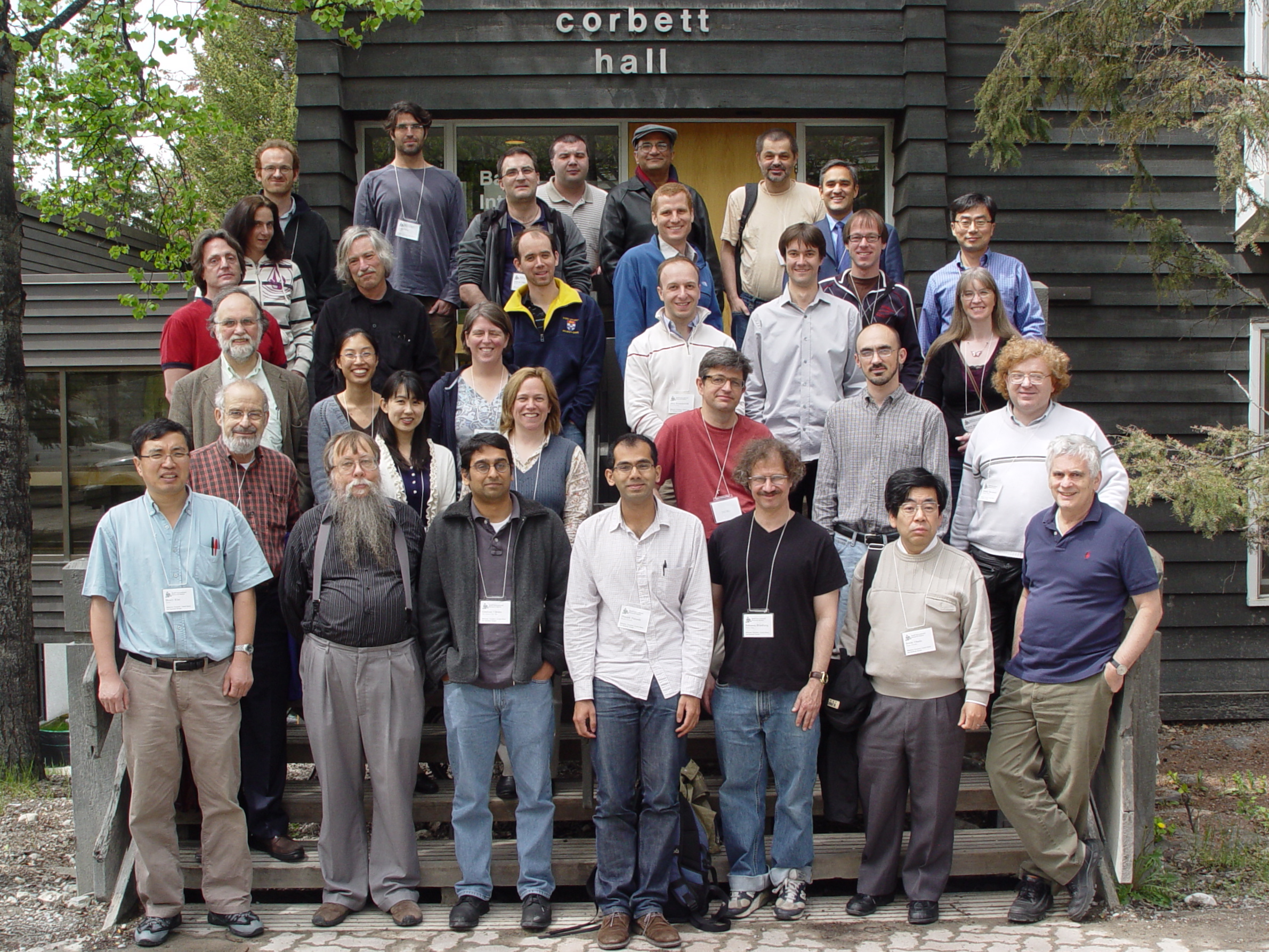
Organizers
Ben Brubaker (University of Minnesota)
Daniel Bump (Stanford University)
Gautam Chinta (City University of New York)
Paul Gunnells (University of Massachusetts)
Description
The Banff International Research Station will host the "Whittaker Functions, Crystal Bases, and Quantum Groups" workshop from June 6 to 11, 2010.
This workshop plans to focus on intriguing relationships between two
fields of mathematics, number theory and representation theory, and
some connections to mathematical physics. Number theory is one of the
oldest branches of mathematics. It studies properties of the whole
numbers and fractions as well as more exotic constructions, and today
finds many applications in computer science and cryptography.
Representation theory, a more recent development, is a comprehensive
tool to understand deeper symmetries in mathematical phenomena, and
today plays an indispensable role in many fields of mathematics and
physics.
Although these branches of mathematics sound wildly different, it
turns out there are many fascinating relationships between them. This
workshop plans to focus on one such relation embodied in Whittaker
functions. These are special and highly symmetric functions that have
traditionally appeared when one applies representation theory to
number theory as in the theory of automorphic forms. Recently new
connections between number theory and representation theory via these
functions have been uncovered, connections that link number theory
with exciting constructions in representation theory called crystal
bases and quantum groups. This workshop will investigate these
connections by bringing together a group of researchers drawn from
several fields, including physics, with the hope of building new
bridges between these subjects.
The Banff International Research Station for Mathematical Innovation and Discovery (BIRS) is a collaborative Canada-US-Mexico venture that provides an environment for creative interaction as well as the exchange of ideas, knowledge, and methods within the Mathematical Sciences, with related disciplines and with industry. The research station is located at The Banff Centre in Alberta and is supported by Canada's Natural Science and Engineering Research Council (NSERC), the US National Science Foundation (NSF), Alberta's Advanced Education and Technology, and Mexico's Consejo Nacional de Ciencia y Tecnología (CONACYT).