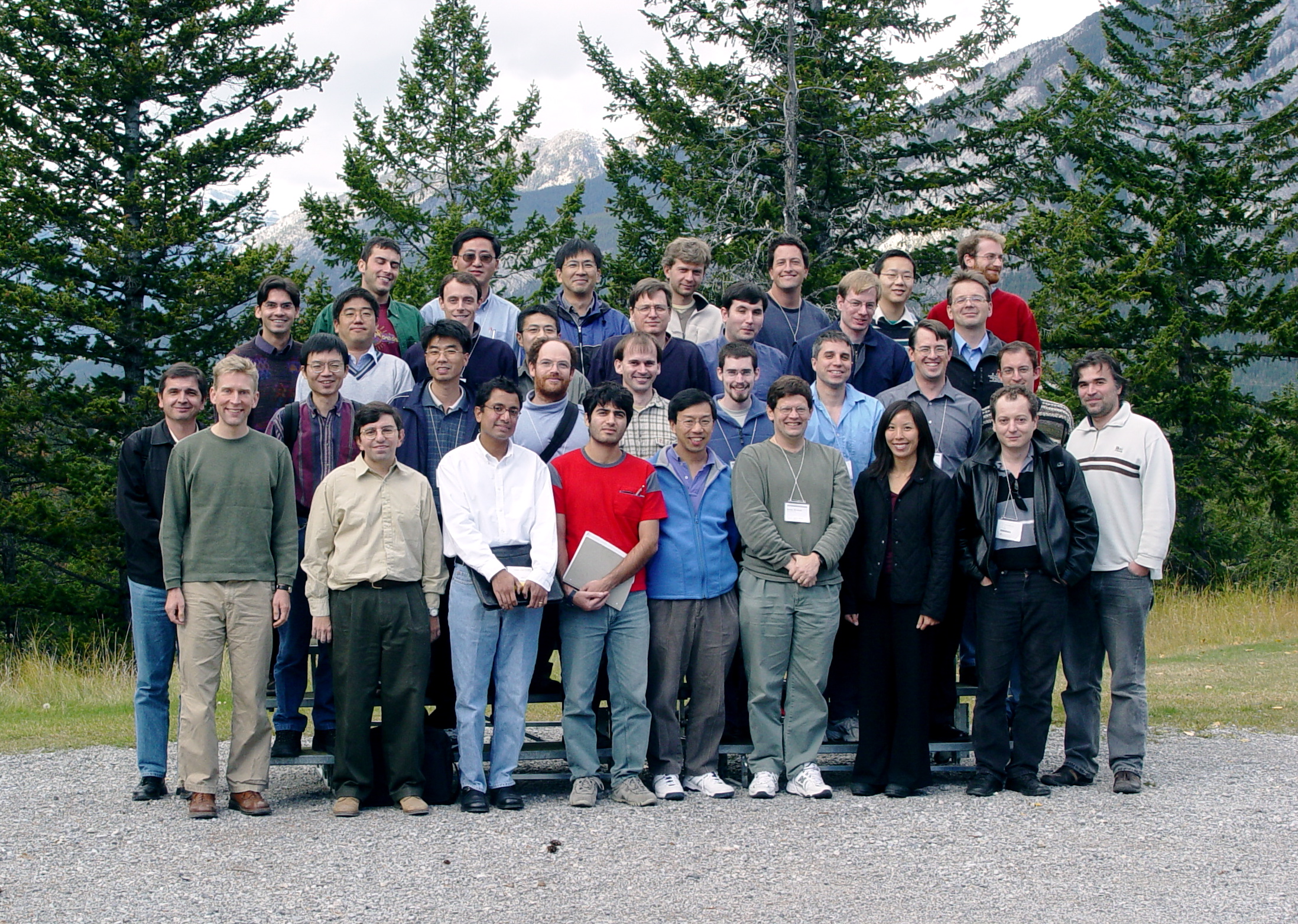
Progress in algebraic geometry inspired by physics (05w5081)

Arriving Saturday, October 8 and departing Thursday October 13, 2005

Organizers

Objectives


Our main goal, as for any successful workshop, is to foster lively
interaction between the participants, leading to original ideas and new
directions in research. Having said that, we also have a particular
agenda: to bring together and set up discussion among several different
groups whose expertise could lead to notable advances in algebraic
geometry inspired by physics.


First, there are workers in algebraic geometry trained in the last 20
years, since the influence of string theory became a familiar part of the
geometric landscape. They are immersed in problems of a physical origin,
though they are not so often familiar with physics itself. A large number,
for example, work in Gromov-Witten theory, which traces its lineage to the
sigma-models of conformal field theory. While expert in algebraic geometry
and in the details of problems of physical origin, they could benefit from
taking a broader perspective. S. Katz frequently expresses his surprise
that the younger generation of algebraic geometers is more familiar with
the newfangled subject of quantum cohomology than with variation of Hodge
structure, which is his generation's bread and butter. But in mirror
symmetry, one is the A-model, and the other is the B-model. For a complete
understanding of mirror symmetry, one needs to know both.


This brings us to our second group, those trained in gauge theory, Lie
theory, and algebraic geometry before the string revolutions. This
includes those whose study of Lie groups led them to algebraic problems on
homogeneous spaces; those from the Atiyah school, which incorporated gauge
theory into algebraic and differential geometry; and those classically
trained in algebraic geometry itself. Their own research may not treat
problems motivated by physics, but they have much to teach those of us who
do about our own subject.


Next, there are a select few in cognate mathematical fields that are of
particular relevance to the interaction between algebraic geometry and
physics. For example, many of the structures of current interest in
algebraic geometry, like moduli spaces of holomorphic curves, or orbifold
cohomology, are analogues of broader constructions in symplectic geometry.
The presence of a few leading symplectic geometers will enable
participants to see these problems illuminated from a new angle. Likewise,
a few experts in algebraic topology may help shed light on the deep
connections that Floer homology should provide between stringy geometry
and the topology of loop spaces.


Finally, there are the physicists themselves. While we do not intend to
hold a workshop in string theory, which would be a very different event,
we feel that the presence of a few outstanding researchers in quantum
field theory and string theory would greatly enrich a meeting of
mathematicians looking for physical motivation. They can tell us how to
cut through mathematical details to the physical heart of the matter: what
space of fields to use, what Lagrangian, what stationary phase
computation. As M.F. Atiyah insists, the impact of physics on mathematics
will be much greater if mathematicians engage with physics as deeply as
possible, not only as a source of problems and formulas, but as a source
of methods that we try our best to convert into rigorous mathematical
arguments. Atiyah's own notion of a topological quantum field theory is an
outstanding example of this. Inviting a few physicists might allow similar
ideas to germinate at the workshop.


All of these groups will have much to teach each other. But we do not wish
to suggest that this will be a meeting of a merely instructional or
expository nature. Just the opposite: we expect to stimulate research
developments of the highest order, and the most current interest. The
achievements described in our overview of the subject area are remarkable
examples of the intellectual ferment that have resulted, on very recent
occasions, when the precision of mathematics is fertilized by the power of
physics. We do not know what the future holds, and we suspect it will
already be very different in two years. Just today, for example, we
learned of a conjectural relationship between the Gromov-Witten theory of
toric threefolds and certain models of 3-dimensional crystals in
statistical mechanics. But we are confident that by 2005 the boundary
between physics and algebraic geometry will be even busier and more
productive. We are looking forward to the Banff workshop with excitement.