Recent trends in higher dimensional geometry (06w5024)
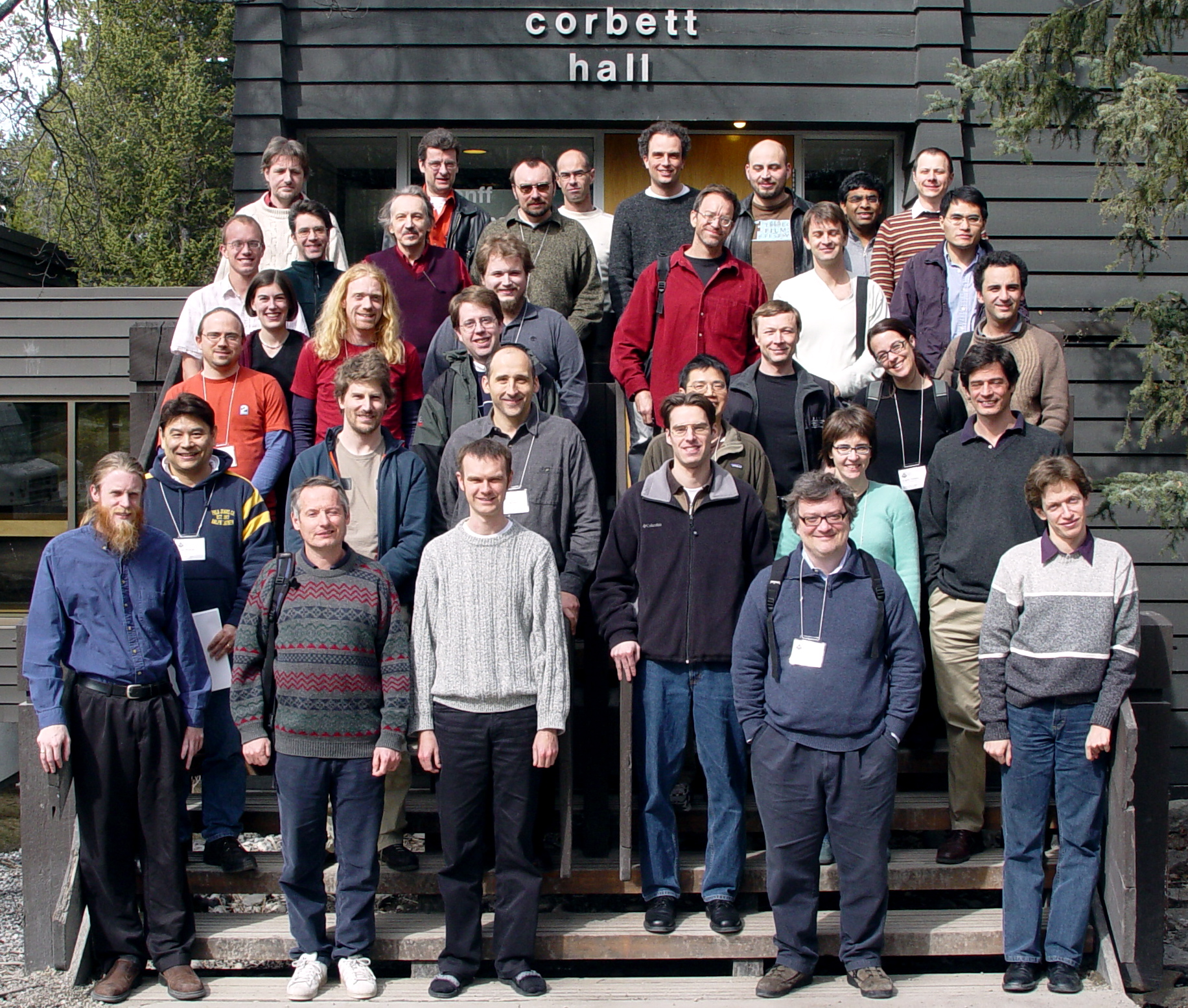
Arriving Saturday, April 1 and departing Thursday April 6, 2006

Organizers

James McKernan (University of California, Santa Barbara)
Xi Chen (University of Alberta)
Alessio Corti (University of Cambridge)
Colin Ingalls (University of New Brunswick)
Sandor Kovacs (University of Washington)
Miles Reid (University of Warwick)

Objectives

Recent trends in higher dimensional geometry


The scientific program committee consists of:
<ul>
<li> Dr. Xi Chen, University of Alberta </li>
<li> Dr. Alessio Corti, University of Cambridge </li>
<li> Dr. Colin Ingalls, University of New Brunswick </li>
<li> Dr. James M$^c$Kernan, University of California at Santa Barbara </li>
<li> Dr. S'andor Kov'acs, University of Washington </li>
<li> Dr. Miles Reid, University of Warwick. </li>
</ul>

We will bring together the top researchers working in the areas of higher dimensional geometry and closely related areas, focusing on recent developments in higher dimensional geometry.

[A] Birational Classification of Algebraic Varieties; the minimal model program in dimension four and higher; classification of threefolds using the methods of Corti and Sarkisov; rigidity of Mori fibrations; derived categories and birational classification of Fano varieties and Calabi-Yau varieties.

[B] Moduli spaces; existence of moduli spaces of surfaces and higher dimensions; moduli spaces of abelian varieties; the cone of curves of the moduli space of curves.

[C] Jet spaces and motivic integration; log canonical threshold and the log discrepancy; adjunction and inversion of adjunction; semi-continuity of the log discrepancy.

[D] Noncommutative Mori Theory; classification of division rings of dimensions two and three, finite over their centres; noncommutative conic bundles.

Objectives

The workshop has two objectives. Firstly to bring together groups of people working in the closely related areas mentioned in A, B, C and D above, to promote collaboration between the top researchers in these areas. Secondly to have a series of lectures on recent topics of common interest.

There has been a lot of interesting work in the areas mentioned in A, B, C and D above. One of the most interesting in [A] is Shokurov's recent work on fourfold flips. The Minimal model program (MMP) lies at the very heart of higher dimensional algebraic geometry. The most important remaining step of the MMP is to prove the existence of flips. Already in dimension three, this is highly nontrivial and was proved by Mori back in the eighties. However, Mori proved the existence of threefold flips using a case-by-case argument and his proof is very hard to generalise to higher dimensions. Recently, Shokurov produced a proof for the existence of fourfold flips using a completely different and more conceptual approach. The new techniques and concepts introduced in his paper have provided a framework for the future development of the field. Unfortunately Shokurov's recent proof is extremely long and technical. For this reason, there was a six week seminar arranged at the Isaac Newton Institute, January-March 2002, and as a result of this seminar a book should be appearing within the next year or so, whose purpose is to make Shokurov's work as widely available as possible. A workshop at Banff would therefore present an ideal opportunity for the dissemination of these ideas at a time when this book would be first available.

One of the most fundamental problems in algebraic geometry is to prove the existence of moduli spaces. There has been a lot of recent progress in this field, most notably in three separate directions. Firstly Hassett and Kov'acs have proved that the moduli spaces of log surfaces is projective, thereby completing a program of work that stretches back more than ten years. Secondly there has been a lot of recent progress due to Alexeev and Nakamura on finding a geometrically meaningful compactification of the moduli spaces of principally polarised abelian varieties, a problem that goes back to the work of
Mumford. Finally Alexeev and Brion have produced some very interesting work on moduli of affine schemes.

There has also been a tremendous amount of recent activity on derived categories and non-commutative geometry. The original works in this direction include the Mukai transformations among K3 surfaces, giving an equivalence of derived categories between different K3 surfaces, and Beilinson's derived equivalence of projective spaces with finite dimensional noncommutative algebras.

The derived category of projective bundles and blow ups were described by Bondall and Orlov. More recent results include Bridgeland, King and Reid's work which uses a derived equivalence to show the existence of crepant resolutions of some quotient three-fold singularities, and Bridgeland's result on the derived equivalence of three-fold flops.

Noncommutative algebras appear naturally in this setting. Van den Bergh has shown that flops are derived equivalent to a noncommutative algebra. Mori fibre spaces give a semi-orthogonal decomposition of the derived category. In the case of conic bundles the category perpendicular to the base is a derived category of modules over a noncommutative algebra. Also the derived equivalence used by Bridgeland, King and Reid can be interpreted as a derived equivalence between a noncommutative algebra and the crepant resolution. Further Artin, de Jong, Chan, Ingalls have used noncommutative algebras and to extend the theory of minimal standard conic bundles to higher dimensional varieties which are generically projective space bundles over a surface. Clearly a conference at Banff would present an excellent opportunity for collaboration between this newly emerging area of noncommutative geometry and birational geometry.

Plan of the workshop

We plan to have up to four one hour talks daily. We also plan to have some expository talks on some of the more exciting and recent developments in the area of higher dimensional geometry. At least one month in advance of this workshop, we will solicit from all participants problems and topics that they would like to be discussed. The scientific committee will then choose the most appropriate topics to be discussed during this workshop.