Evolutionary Game Dynamics (06w5051)
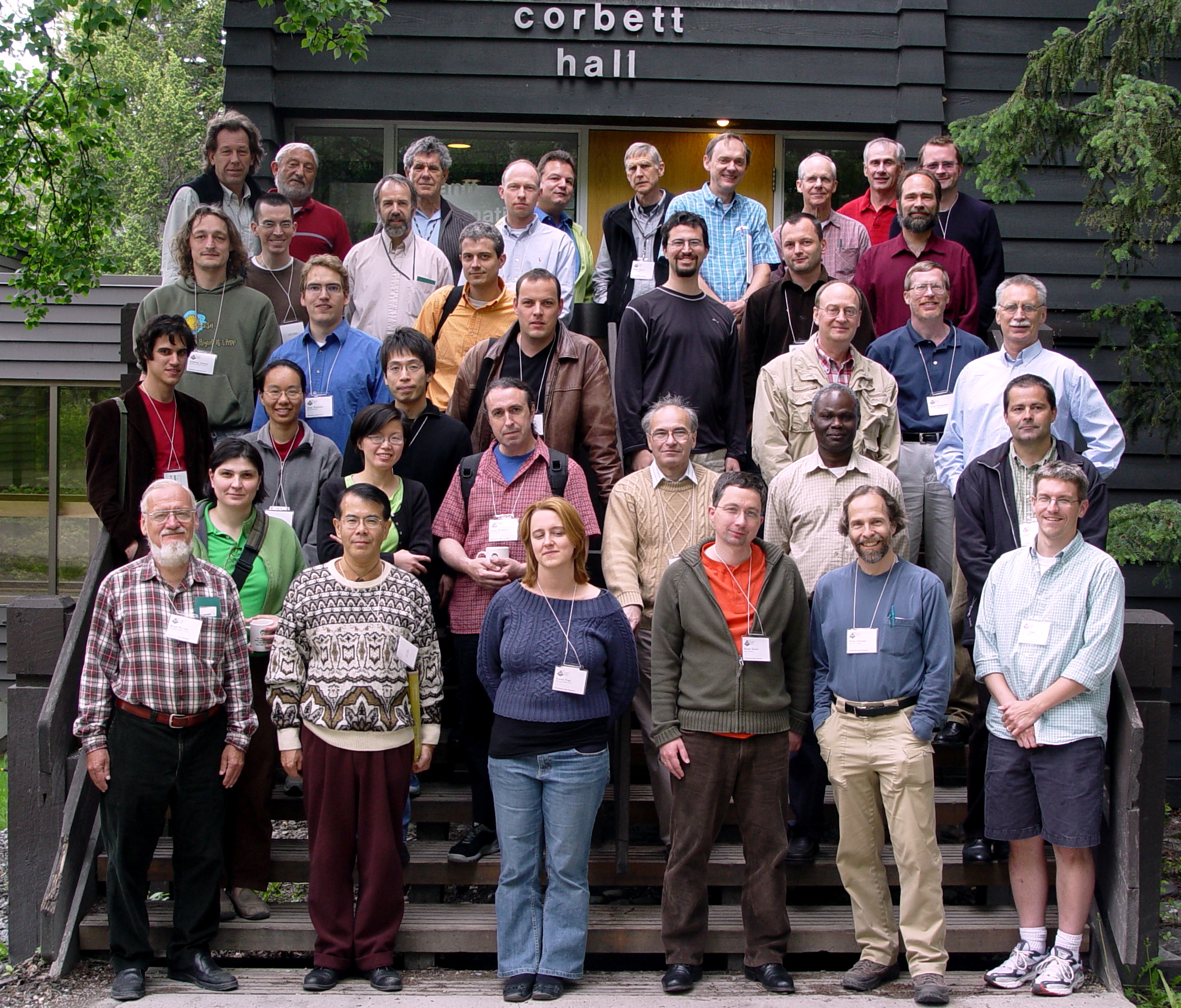
Arriving Saturday, June 10 and departing Thursday June 15, 2006

Organizers

Karl Sigmund (University of Vienna)
Ross Cressman (Wilfrid Laurier University)
Christine Taylor (Harvard University)

Objectives

The aim of this workshop would be to bring together people with different modelling approaches and to allow them to appraise the state of the art in the neighboring fields. This seems all the more useful as evolutionary games have been approached within several different disciplines with very different traditions and also different channels of communication (journals, conferences etc). We mention
here classical, economy-based game theory versus biology-driven evolutionary models; probabilistic reasoning based on finite population models versus ordinary differential equations assuming infinite, well mixed populations; equilibrium concepts versus complex attractors; long-term versus short-term evolution; frequency-dependent population genetics versus learning models based on imitation, or endogenous aspiration levels; etc.

To give some specific examples, extensive-form games have for decades been analysed entirely by classical game theory techniques based on rationality assumptions, but have recently been exhaustively studied in a monograph (by Cressman) on evolutionary games; classical stochastic processes used in genetics, as for instance the Moran process, have provided the basis for an entirely new analysis of evolutionary dynamics in games in finite populations (Nowak, Taylor, Imhof), using concepts such as substitution and fixation. There are surprising relations between different types of deterministic game dynamics, as for instance between the orbits of the best-reply dynamics and the time-averages of solutions of the replicator dynamics (Hofbauer); non-linear payoff functions are increasingly well understood, for instance through adaptive dynamics (Doebeli, Dieckmann); the phase-transitions in spatial games attract more and more investigators wielding the tool-box of statistical mechanics and power laws (Hauert, Szabo); etc.

The main focus of the workshop would be on mathematical methodology. However, since most of the new methods have been devised by applying them to very concrete examples from biology or experimental games, it will be important to also have one or two lectures a day concentrating on new applications, which can range from bacterial genetics to e-commerce. Such new directions will enhance our understanding of evolutionary methods that predict individual behavour modelled by game interactions.