Advances in Computational Scattering (06w5065)
Organizers
David Nicholls (University of Illinois at Chicago)
Nilima Nigam (Simon Fraser University)
Fernando Reitich (University of Minnesota)
Description
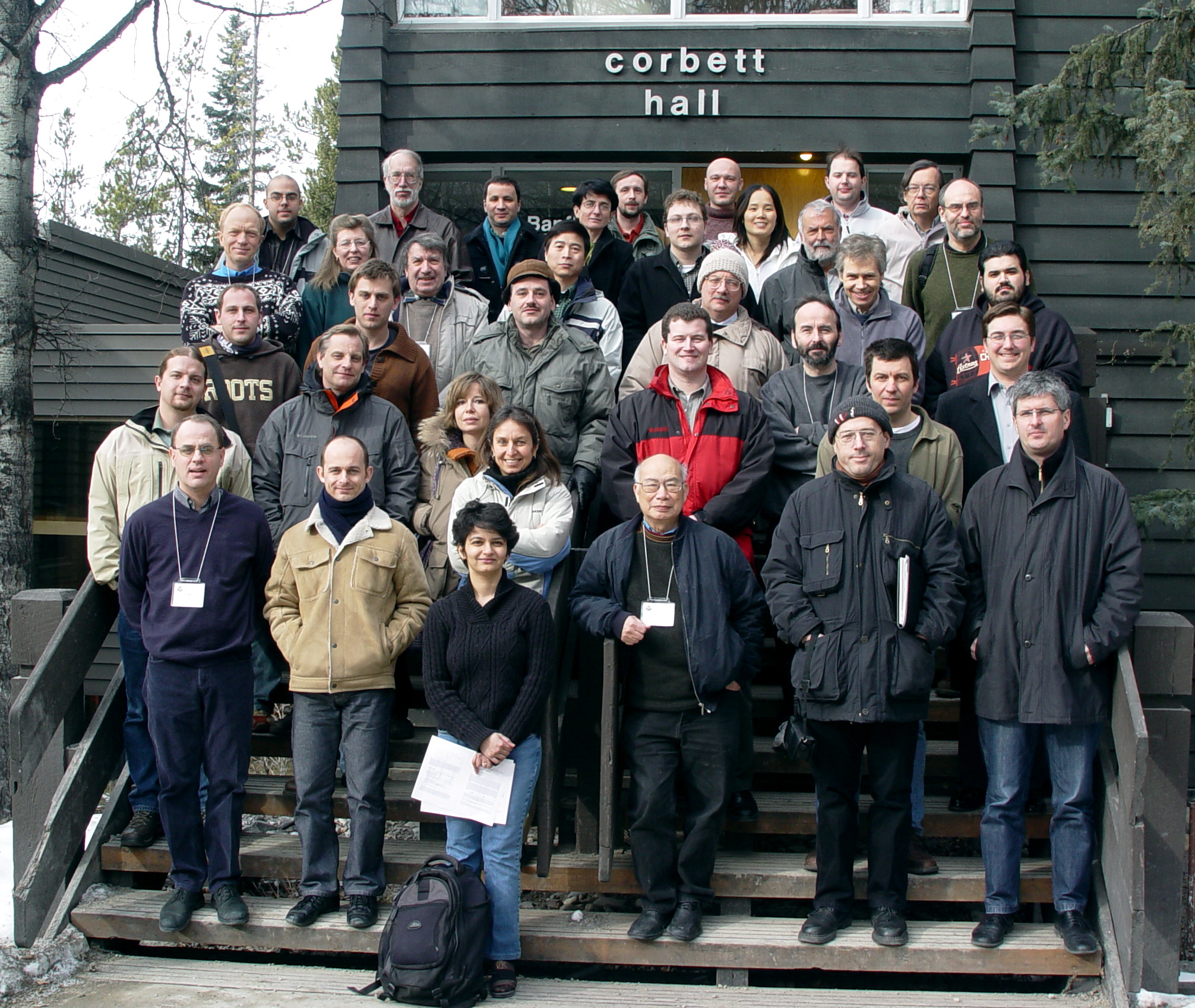
About 40 of the most prominent and active mathematicians in the field of "computational scattering" are participating in a workshop at the Banff International Research Station (BIRS) during the period of February 18-23, 2006. Scattering is the study of the interaction of waves with obstacles. These obstacles could be anything from gratings, to tumours, to ships; the waves could be electromagnetic, elastic, or acoustic. Think of sound waves in an auditorium, or radar waves bouncing off airplanes. The study of scattering problems has a very long and illustrious history, but only a limited number of exterior scattering problems can be solved analytically. Nowadays, research on wave scattering has been dramatically enriched by the numerical modeling and simulations made possible by modern computers.
The meeting is being organized by David P. Nicholls of U. Illinois at Chicago, Nilima Nigam at McGill, and Fernando Reitich at U. Minnesota, Twin Cities. Mingling with more seasoned senior researchers, a contingent of graduate students and young postdoctoral fellows form a key component of this workshop. Besides discussing the state-of-the-art in the field, the participants will examine the central challenges, and will map out the most interesting and relevant future research directions.
The Banff International Research Station for Mathematical Innovation and Discovery (BIRS) is a collaborative Canada-US-Mexico venture that provides an environment for creative interaction as well as the exchange of ideas, knowledge, and methods within the Mathematical Sciences, with related disciplines and with industry. The research station is located at The Banff Centre in Alberta and is administered by the Pacific Institute for the Mathematical Sciences, which itself is a collaborative venture between the major universities in Alberta, BC and Washington State.
The meeting is being organized by David P. Nicholls of U. Illinois at Chicago, Nilima Nigam at McGill, and Fernando Reitich at U. Minnesota, Twin Cities. Mingling with more seasoned senior researchers, a contingent of graduate students and young postdoctoral fellows form a key component of this workshop. Besides discussing the state-of-the-art in the field, the participants will examine the central challenges, and will map out the most interesting and relevant future research directions.
The Banff International Research Station for Mathematical Innovation and Discovery (BIRS) is a collaborative Canada-US-Mexico venture that provides an environment for creative interaction as well as the exchange of ideas, knowledge, and methods within the Mathematical Sciences, with related disciplines and with industry. The research station is located at The Banff Centre in Alberta and is administered by the Pacific Institute for the Mathematical Sciences, which itself is a collaborative venture between the major universities in Alberta, BC and Washington State.