Inverse Problems and Applications (06w5092)
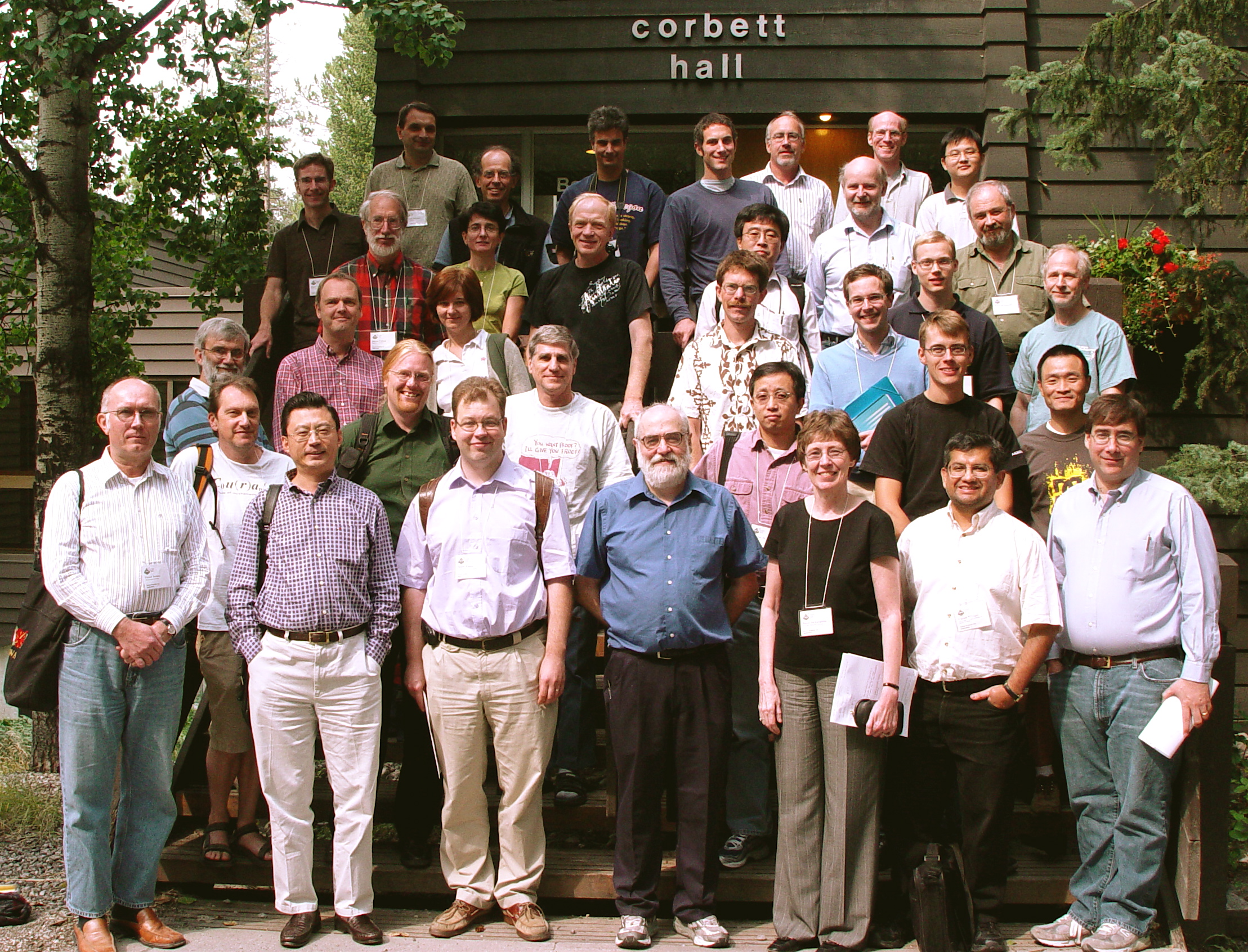
Organizers
Gunther Uhlmann (University of Washington)
Gary Margrave (University of Calgary)
Objectives
The field of inverse problems is broad and diverse. We briefly describe below a few of the research areas of focus of the conference, but the divisions are clearly artificial. Most of the problems we outline arise from a physical situation modeled by a partial differential equation. The inverse problem is to determine some coefficient(s) of the equation given some information about the solutions. Analysis of such problems brings together diverse areas of mathematics such as complex analysis, differential geometry, harmonic analysis, integral geometry, microlocal analysis, numerical analysis, optimization, partial differential equations, probability, statistics etc.
a) Inverse boundary problems
In this class of problems the unknown coefficients of the partial differential equation represent internal parameters of a medium and the known information contain boundary measurements of the solutions. A prototypical example, which has received a lot of attention in recent years, is Electrical Impedance Tomography (EIT). In this non-invasive inverse method, one attempts to determine the conductivity of a medium by making voltage and current measurements at the boundary. This problem arose in the early part of the century in exploration geophysics; more recently it has been proposed as a diagnostic tool in medicine. It also arises in non-destructive evaluation of materials, where the problems of particular interest are crack and corrosion identification and the determination of conductivities of high contrast and discontinuous conductivities. A key step in some of the mathematical developments has been the construction of {sl complex geometrical optics solutions} for the Schr"odinger equation by Sylvester and Uhlmann, following the pioneering work of Calder'on. This solutions have been used recently by Astala and P"aiv"arinta to solve this problem in the two dimensional case for bounded measurable
conductivities. Other physically interesting inverse boundary value problems involve the determination of electromagnetic parameters by measuring the boundary components of the electric and magnetic field. This problem was solved in by Ola, P"aiv"arinta and Somersalo by extending the use of complex geometrical optics solutions to this case. Nakamura and Uhlmann developed a general method to construct complex geometrical optics solutions for any first order perturbations of the Laplacian which was applied to solve an inverse boundary problem arising in the mechanics of materials. The question is whether one can determine the elastic parameters of a body by making displacement and traction measurements at the boundary. It is not an understatement to say that X-Ray Tomography revolutionized the practice of many parts of medicine. Ignoring the algorithmic aspects, the mathematics of X-ray tomography has traditionally been viewed as a special branch of integral geometry. In recent years, another viewpoint has developed in which it is seen as an inverse boundary value problem for a special (Boltzmann) transport equation. This context also includes single emission tomography and the newer technique of {bf Optical Tomography}, which is based on boundary measurements of near-infrared light transmitted through a body. A probabilistic approach to optical tomography goes under the name Diffuse Tomography.
b) Inverse scattering problems
The setting for inverse scattering is as follows. A wave field is generated far away from a target having unknown physical properties and propagates through the region containing the target. It is assumed that the interaction mechanisms of the wave field with the target are qualitatively known. The scattered field is measured, and from this data one attempts to determine the properties of the scatterer. A basic example arises in quantum mechanics. The problem is to determine a potential (two body particle) in the Schr"odinger equation from scattering information. This problem was completely solved in the one-dimensional case by using the Gelfand-Levitan method. Gardner, Miura and Kruskal made the striking discovery that one can solve the non-linear KdV equation by using the inverse scattering method for the associated Schr"odinger equation. This gave great impetus to the study of the inverse quantum scattering method. By using the $overline partial$ method, several other non-linear evolution equations have been solved in two dimensions. The complex geometrical optics solutions mentioned preciously sections were used to solve in dimension three or higher the inverse scattering problem at a fixed energy by Novikov. We remark that the fixed energy problem in quantum scattering is closely related to EIT. The two dimensional inverse scattering problem at a fixed energy remains open. Other type of inverse scattering problems arise in applications. For instance in ultrasound we want to determine the sound speed of a medium from backscattering information. Similar problems can be formulated for electromagnetic or elastic parameters. Another very important type of inverse scattering problem deals with obstacle scattering. In this case there is an obstacle whose shape one tries to recover from scattering information, assuming different boundary conditions on the obstacle. This is a closely related to the problem of target identification from radar measurements. Kirsch has obtained a very interesting characterization of the obstacle in terms of spectral data of the scattering operator (far field operator) which has led to a convergence result of a numerical method proposed by Colton and Kirsch. An important new area of research in inverse scattering is the case of random media.
c) Reflection seismology
Although we include this under a separate heading it can also be considered as an inverse boundary value problem. One of the most important tasks in seismology is estimation of the index of refraction, or velocity, of waves in the Earth, from seismic data measured at the Earth's surface (seismogram). This can be viewed as an inverse boundary value problem for the wave equation. Very little is known about this non-linear problem. The linearized problem is known as the {sl seismic migration} problem. The map sending the parameter perturbation of the velocity to the seismogram perturbation is a {sl Fourier Integral operator}. Beylkin recognized this operator as a generalized Radon transform. The assumption of no caustics is rather artificial and B. White has shown that they almost always present. Some progress has been made in understanding the inverse seismic problem in the case where caustics are present, but the general picture remains unclear.