Numerical Methods for Degenerate Elliptic Equations and Applications (06w5095)
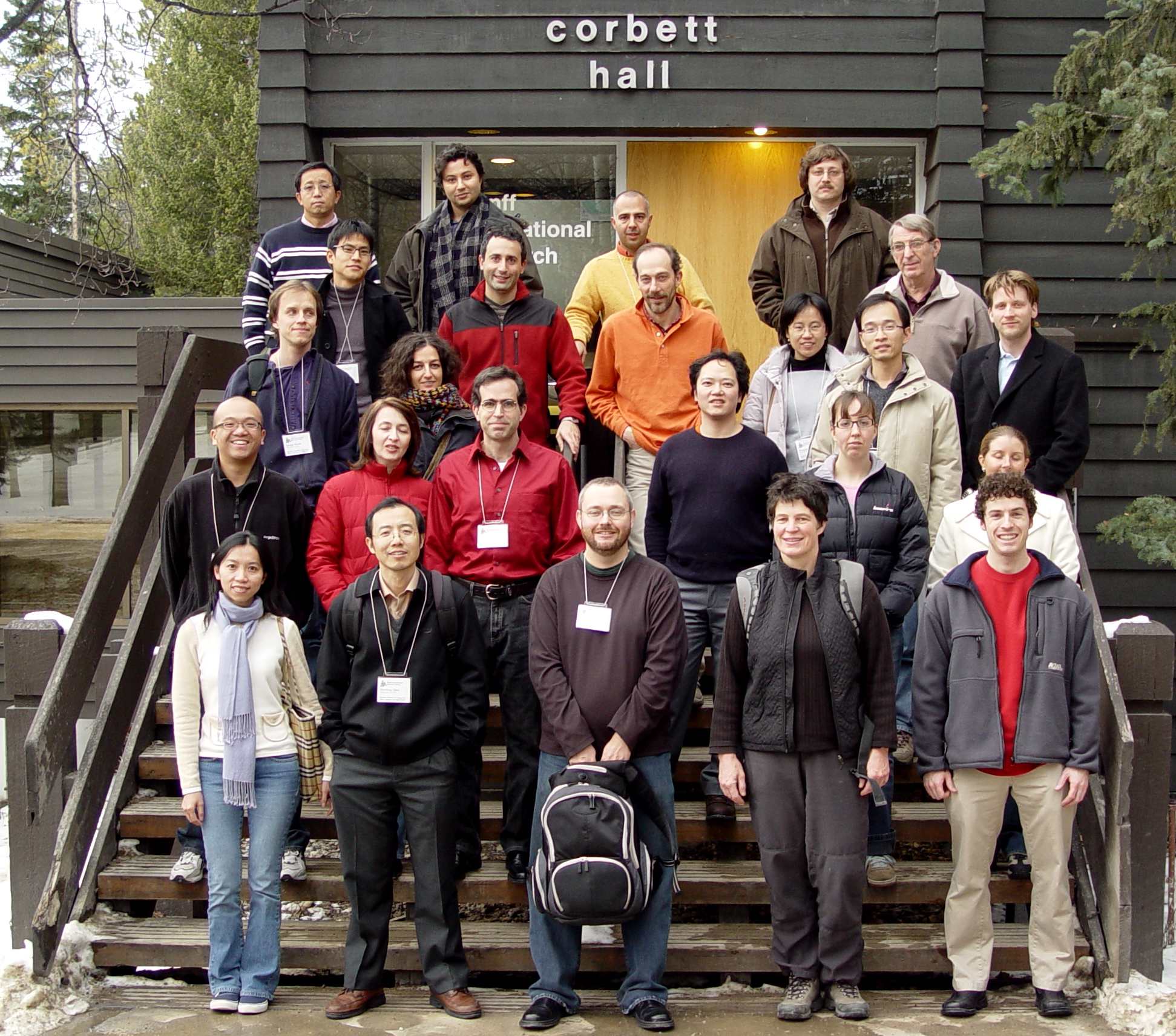
Organizers
Adam Oberman (Simon Fraser University)
Ian Mitchell (University of British Columbia)
Panagiotis Souganidis (University of Chicago)

Doron Levy (Stanford University)
Objectives
*Relevance*
Degenerate elliptic partial differential equations occur widely in many branches of applied math and engineering. The theory of viscosity solutions has been enormously successful in addressing the problems of existence, uniqueness and stability of solutions for this class of equations under minimal regularity requirements. Until recently, however, there has been much less success constructing solutions for many practical examples.
The development of techniques for effectively computing solutions to degenerate elliptic equations could have an huge impact in these application areas.
What stands in the way of developing effective computational techniques? The biggest obstacle is the high dimensionality of the domains on which practical problems must be solved. For example, the Hamilton-Jacobi-Bellman equations for optimal flight trajectories evolve on an underlying space of at least six dimensions. Stochastic control problems from mathematical finance may have twenty dimensions. New techniques need to be developed which overcome this obstacle.
*Timeliness*
This is an exciting time for numerical methods for degenerate elliptic PDEs. As computing power increases, application area researchers have been developing techniques specific to their problems. Recognition of the common elements in these algorithms has the potential to transfer knowledge between fields and develop more general methods.
Numerical analysts have in the past borrowed techniques from conservation laws to solve Hamilton-Jacobi equations. But new methods which address the class of degenerate elliptic equations directly have opened the way to solving more and more equations, including second order, fully nonlinear equations.
This conference aims to bring together specialists from these different areas with the goals of exchanging knowledge about and improving upon the many different algorithms. It will connect experts in numerics with application area specialists and viscosity solution theoreticians.
*Importance*.
We mention a selection of applications, many of which will be touched upon by the conference. The theory of viscosity solutions appears in atmospheric and ocean studies, economics, mathematical ecology, statistical mechanics, optimal control, game theory, mathematical finance, and many other fields of science and engineering. Putting this theory into practice requires development of rigorous computationally effective methods comprehensive enough to include all these applications and simple enough to be adopted and adapted by non-specialists in the application fields.
Level Set Methods: Level set methods have enjoyed great success tracking the motion of interfaces in low dimensional spaces for fields such as combustion, fluid dynamics, phase transitions, etc. Flexible, high-order, dimension-by-dimension numerical schemes have been developed and have proven very effective.
Optimal control: Even when the linearity assumption is questionable, linear models are relied upon because problems with linear dynamics have exact solutions. This limitation is accepted because there are few practical solution methods for nonlinear control problems. But it has been known for decades that the Hamilton-Jacobi-Bellman equation solves the problem! Why aren't engineers using the Bellman equation? Because present methods are just too costly to utilize in the high dimensional spaces of interest. Nevertheless, there is much active research in accurate and/or scalable solutions to this equation.
Stochastic Control and Mathematical Finance: Many problems from mathematical finance lead to degenerate elliptic equations; for example, optimal portfolio selection and asset pricing. While the simplest problems may have exact solutions, more general problems require numerical approximation. Large collections of PDEs appear with similar properties which demand flexible, robust solution techniques. Often these problems have a high dimensional underlying space; for example, bond pricing may have 20 dimensions.
Robotics and Machine Learning: On the flip side, the robotics and machine learning literature is filled with investigations of policy search algorithms and reinforcement learning. Although not often formulated as such, the goal of such methods is approximation of a value function, a value function which is usually the solution of a Hamilton-Jacobi-Bellman equation. While the discretization of the underlying space is often coarse and lacks convergence arguments, these algorithms have been demonstrated in dimensions far beyond those that level set methods have achieved.
Image Processing: A digital image can be regarded as a function defined in two dimensions. Image transforms can be interpreted as operators on this space of functions. A large class of image transforms can be interpreted as short time solutions of degenerate elliptic PDEs. Applications appear in medical image processing (which includes volumetric images such as those from MRI), digital photography, and computer vision.
*Conclusion*
We propose to gather together applied mathematicians and numerical analysts with expertise in the field of viscosity solutions, and to add a collection of carefully chosen application area experts whose research is impacted by viscosity solutions. The success of level set methods has demonstrated to the mathematical community the unmet demand for accurate numerical approximation of these equations, but has only touched on a narrow class of problems. As witness to the broader need, engineers and scientists are developing problem specific solutions all the time. Theoreticians and numerical analysts are developing new solutions techniques which will benefit from contact with applied researches and their real world problems. Bringing these groups together can foster advances not only through modification of existing numerically proven algorithms to attack other problems, but also through analysis and formalization of existing problem specific algorithms. New and improved solution techniques for degenerate elliptic equations have a large potential to impact the wide variety of fields mentioned above, and many beyond.