Recent Developments in Elliptic and Degenerate Elliptic Partial Differential Equations, Systems and Geometric Measure Theory (08w5061)
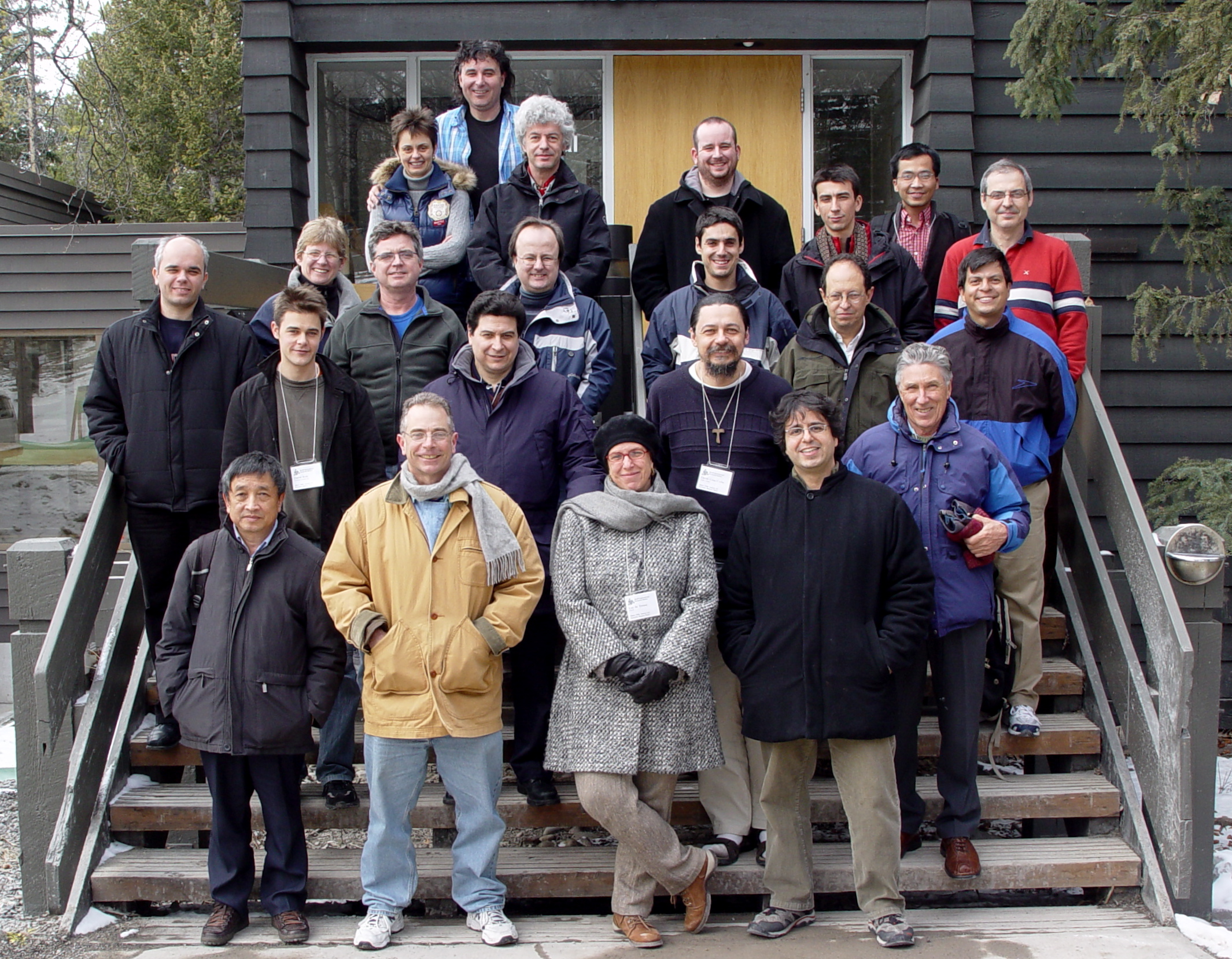
Arriving Sunday, March 30 and departing Friday April 4, 2008

Organizers

Cristian Rios (University of Calgary)
Marius Mitrea (University of Missouri, Columbia)
David Cruz-Uribe (Trinity College)
Steven Hofmann (University of Missouri-Columbia)
Salvador Perez Esteva (Universidad Nacional Autonoma de Mexico)
Eric Sawyer (McMaster University)

Objectives

The proposed workshop is envisioned as a culmination of a flurry of fruitful, recent collaborative activities between mathematicians based at institutions in Canada, Mexico and the United States of America. The purpose and mission of this workshop fully concurs with the vision and objectives of the Pacific Rim Mathematical Association (PRIMA).

The workshop will focus on the exciting recent advances in the theory of Elliptic, and Parabolic Partial Differential Equations with rough coefficients as well as equations and systems which fail to be elliptic in a traditional sense, due to various sources of degeneracy. The proposed areas of focus have a broad impact, and they have been the scene of several major developments in the recent years. The timeliness of an workshop emphasizing the intricate connections between such developments in this interdisciplinary field, is therefore most opportune. Leading international researchers from related areas of expertise will gather to exchange scientific communications, ideas and suggestions that will boost and foster new developments and collaborations. This interaction will greatly promote each particular specialty by incorporating the enriching experience, approaches and ideas from other areas. Some of the topics to be discussed include:

- The mathematics of the Kato problem. Given an elliptic second order operator in divergence form $L$ with complex coefficients, the square root operator $sqrt{L}$ satisfies $||sqrt{L} f ||_{L^2} approx || nabla f ||_{L^2}$ for all $f$ in $H^1(R^n)$. The path originating from the very formulation of the conjecture and leading all the way to the recently obtained full solution of this major problem contains a wealth of innovative ideas and techniques, and opens new frontiers to explore. Some of the themes orbiting around the Kato problem are: Heat Kernels, Evolutionary Equations, Operator Theory, Semigroup Theory, Functional Analysis, Functional Calculus, Holomorphic Calculus, Singular Integrals and Calderon-Zygmund theory, Riesz Transforms, and Carleson measure criteria (T1/Tb) for the solvability of boundary problems.

- The degenerate Kato problem and related topics. It is natural to conjecture that the Kato square root problem could be generalized to operators with degenerate ellipticity, where the degeneracy is controlled by a weight in some Muckenhoupt class. Recent developments in this direction indicate that that a suitable “Weighted Kato Conjecture” might indeed hold for certain degenerate elliptic operators. The battery of related questions arising in the context of the classical Kato problem can be phrased in the more general context when certain types of degeneracies are allowed. In this workshop we propose to discuss the state of the art of this area and explore the aforementioned issues.

- Geometric measure theory and PDEs. The theory of uniformly rectifiable sets, and applications in elliptic and parabolic PDEs, and in the theory of quasiconformal mappings. Relationship between the geometry of a domain and the regularity of its harmonic measure. Free boundary regularity problems, singular sets. Following the ground-breaking work of Kenig-Toro on the regularity of the Poisson kernel in vanishing cord arc domains, and of David-Semmes on the singular integral operators and rectifiability, a naturally emerging direction is exploring the effectiveness of the method of layer potentials for BVPs in vanishing cord arc domains. Some of the participants in the workshop have already made substantial progress in this direction.

- A priori regularity of solutions of subelliptic systems of equations. The Dirichlet problem. Systems with Infinite-degenerated ellipticity. Nash-Moser techniques, Campanato and Schauder methods are techniques originally developed to obtain a priori estimates and interior regularity for elliptic problems. These paradigms have evolved into more sophisticated, broad ranging, and powerful methods. Some examples are the treatment of quasilinear subelliptic systems satisfying Hormander’s commutation condition (Xu and Zuily (1997)), and recent generalizations to systems of the subelliptic regularity theorem by P. Guan (1997).

- Applications to Monge-Ampere equations. The n-dimensional Partial Legendre Transform (PLT) (Rios-Sawyer-Wheeden Adv.Mat. 2005) converts the Monge-Ampere (MA) equation into a system of equations. This is the first PLT-based technique to be successfully implemented to treat equations of MA type in dimensions higher than two since Alexandrov first used the PLT in the plane over half a century to that purpose. In this workshop recent applications of this technique to subelliptic and infinite degenerate MA equations will be presented. One goal is to explore possible generalizations of this approach to treat other degenerate nonlinear equations.

The schedule will include an opening colloquium at an introductory level surveying the state of the art of some important areas in Elliptic and Degenerate Elliptic PDEs. The plenary talks will address specific topics and individual projects. The program will also allocate time for short communications in order to maximize the exposure opportunities for younger researchers participating in the workshop. This workshop will provide an excellent opportunity for researchers from related areas to work in concert and pave the way for integrating the recent developments in their respective fields in a coherent, unified body of results which, at its core, can be viewed as a far-reaching extension of the classical theory. The most prominent open problems and future directions for the areas described above will be discussed. For these reasons this event is very suitable for young researchers and advance graduate students, who will be encouraged to attend; and the timing of such an event is very appropriate and favorable to the progress of the different subjects.