Linear Algebraic Groups and Related Structures (09w5026)
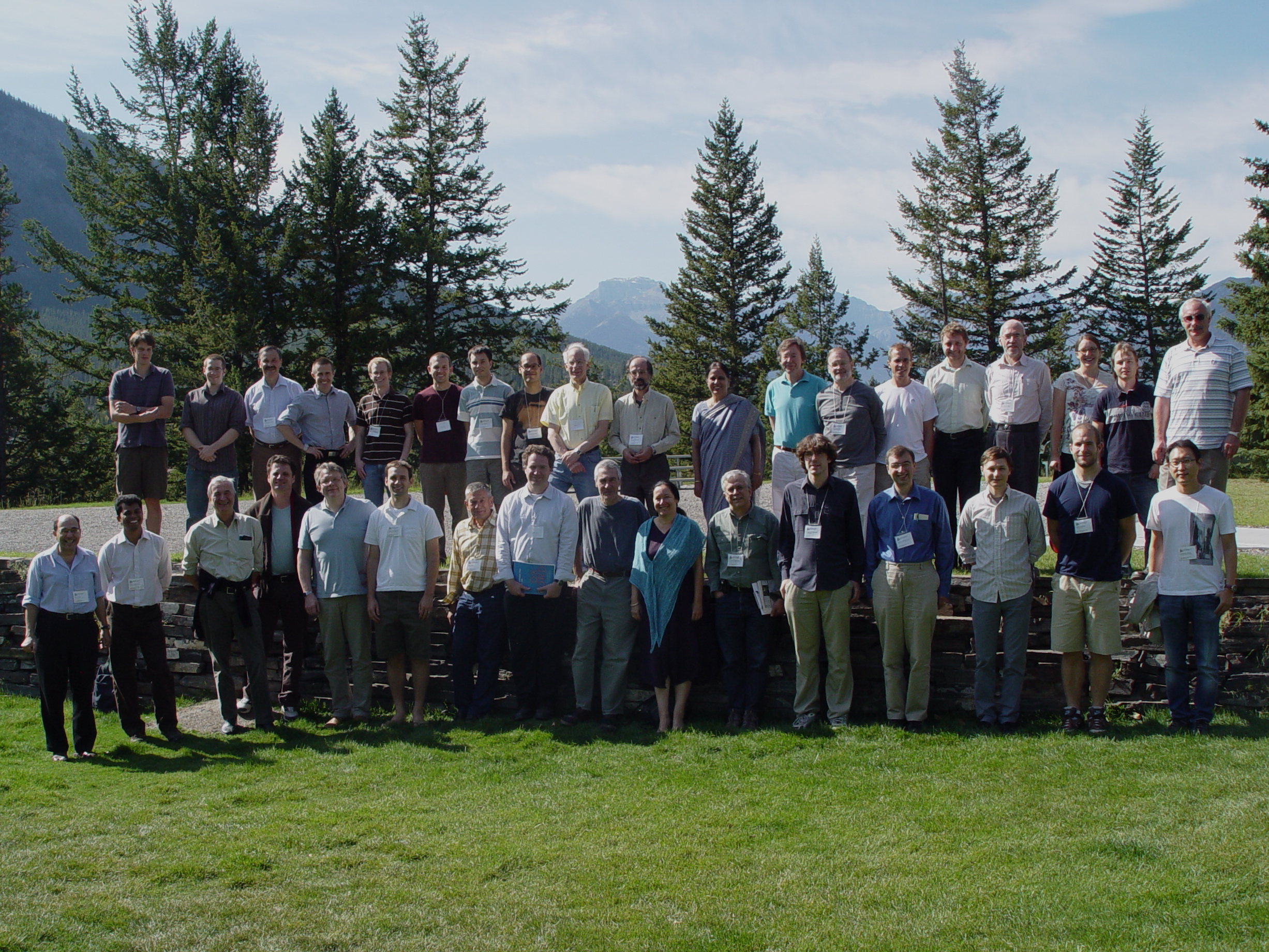
Organizers
Alexander Merkurjev (University of California Los Angeles)
Vladimir Chernousov (University of Alberta)
Zinovy Reichstein (University of British Columbia)
Ján Minác (University of Western Ontario)
Objectives
The purpose of this workshop is to provide a forum for
the experts in the field of algebraic groups and related areas,
to exchange ideas, disseminate new techniques and discuss recent
developments. The workshop will also be an opportunity for younger
researchers to learn about open problems and state of the art techniques
in this field.
We will now list a number of specific important recent
developments in this area. We expect these topics to be
at the center of the scientific activities at the workshop.
Note that the field of algebraic groups has been experiencing
rapid progress: many of the results mentioned below have been
obtained in the past year!
1. The Bloch-Kato conjecture.
In 1970 J. Milnor defined his $K$-theory $K_*(F)$ of
fields and asked if the ring
$K_*(F)/2K_*(F)$ is isomorphic to both the Galois cohomology ring
$H^*(F, mathbb{F}_2)$ and the graded Witt ring of quadratic forms.
This question, which became known as Milnor's conjecture, remained
the preeminent open problem in the algebraic
theory of quadratic forms for over 30 years.
After the initial breakthrough by Merkurjev,
who established this conjecture for degree $2$, several other
special cases were settled in the 1980s, but the general
case remained open until a complete solution was given by Voevodsky
around 2000. For this achievement Voevodsky received a Fields medal
in 2002. In 2003 Voevodsky announced a proof of the
more general Bloch-Kato conjecture. The Bloch-Kato conjecture
asks whether the natural map
$K_*(F)/ pK_*(F) to H^*_{text{et}}(F, {mu_p^{otimes}}^{*})$
is an isomorphism for every prime $p$, where $F$ is a field of characteristic
$ne p$. The case where $p = 2$ is covered by Milnor's conjecture;
the others cases required more delicate arguments
based on motivic cohomological operations
and a construction of norm varieties due to M. Rost.
The details are quite complicated, and some of them
have not been worked out until very recently.
This month (September 2007) all the details of the proof
have finally become available on the $K$-theory archive
and on the homepages of M. Rost and C. Weibel. The proof of
the Bloch-Kato conjecture is
one of the major achievements of contemporary mathematics.
This result and the techniques used in its proof
have already had numerous applications in the fields
of number theory, quadratic form theory, and Galois theory. They
are expected to have an even broader impact in the coming years.
2. Serre Conjecture II. J.-P. Serre conjectured that $H^1(K, G)
=0$ for any semisimple, simply connected algebraic groups $G$ over a
perfect field $k$ of cohomological dimension two.
E. Bayer-Fl"uckiger and R. Parimala proved this conjecture
for the classical groups; further results for groups of
exceptional type were obtained by V. Chernousov and Ph. Gille.
This year de Jong, He and Starr announced a proof of Serre's
Conjecture II in the case, where $K$ is the field
of an algebraic surface. For such $K$ the conjecture was
previously known to be true for every almost simple group,
except for those of type $E_8$; the case of $E_8$ remained
open for many years. The result of de Jong, He and Starr
represents major progress on this long-standing open problem.
The techniques used in their proof have not yet been fully absorbed
by the experts; it is hoped that they will have other applications.
3. The $u$-invariant.
In 1953 Kaplansky conjectured
that the maximal dimension of an anisotropic quadratic form $q$
over given field $F$ (called the $u$-invariant $u(F)$) has to be a
power of $2$ (of $infty$). In 1991 Merkurjev showed that for
every positive integer $n$ there exists a field $F$ such that
$u(F) = 2n$. This construction led to the study of index-reduction
formulas for division algebras and algebraic groups. The question
of whether $u(F)$ can be odd (and $> 1$) remained open, until
Izhboldin constructed a field $F$ of $u$-invariant $9$. (This
result appeared in print in 2001.) During the 2006 BIRS workshop
on Algebraic groups, quadratic forms and related topics, A. Vishik announced
a uniform construction of fields with all known $u$-invariants
and a construction of fields with $u$-invariants $2^r + 1$ for every $r ge 3$.
Prior to his work it was not known whether the $u$-invariant could assume
any odd value $> 9$.
Vishik's main tools are discrete invariants
of quadrics and a subtle analysis of the behavior
of Chow rings under field extensions. Also very recently
R. Parimala and V. Suresh succeeded in showing that
the $u$-invariant of function fields of $p$-adic curves
for $p > 2$ is $8$. This answers
a long-standing question in quadratic from theory.
The work of Parimala and Suresh is based on recent results
of D. Saltman on divisors on arithmetical surfaces and cyclic algebras
over $p$-adic curves.
4. Essential dimension.
The notion of essential dimension was introduced by J. Buhler and
Z. Reichstein in the late 1990s and subsequently refined by A. Merkurjev,
G. Berhuy and G. Favi. Informally speaking,
the essential dimension of an algebraic object is the minimal number
of independent parameters required to define its structure. Here
an "object" can be almost any algebraic structure one encounters:
a polynomial, a finite-dimensional algebra,
an algebraic variety, a morphism between algebraic varieties, etc.
Now suppose the objects under considertaion are $G$-torsors over a field.
The maximum possible value of the essential dimension over all such
torsors (for a fixed algebraic group $G$) is called the essential
dimension of $G$. This numbrical invariant $G$ arises in many natural
settings, in particular, in connection with several classical
problems in algebra.
In the past 10 years it has been studied by many mathematicians,
using a wide range of techniques.
There has been dramatic progress in this area over the past year.
Preprints by Florence, Brosnan-Reichstein-Vistoli and Karpenko-Merkurjev
have significantly improved many of the best previously known
bounds on the essential dimension of algebraic groups.
Florence computed exact values of the essential dimensions of all
finite cyclic $p$-groups over fields containing a primitive $p$th root
of unity, Brosnan-Reichstein-Vistoli found exponential (in $n$)
lower bounds on the essential dimension of $operatorname{Spin}_n$, and
Karpenko-Merkurjev computed the exact value of the essential dimension
of any finite $p$-group over a field containing a primitive $p$th root
of unity. Most of these developments resulted from the introduction
of stack-theoretic techniques, originally developed by P. Deligne,
D. Mumford and M. Artin, in connection with constructing
moduli spaces in algebraic geometry.
5. Canonical dimension. The canonical dimension
is another numerical invariant of an algebraic object.
Here, instead of the minimal number of independent
parameters required to define the object, we are interested
in the minimal number of independent parameters required to
split it, i.e., in the minimal possible
transcendence degree of a generic splitting field.
The notion of canonical dimension was introduced by
Berhuy and Reichstein; their paper also included
an application to the classical problem of finding
the smallest field of definition for a generic
hypersurface. In a subsequent paper Karpenko and
Merkurjev refined this notion and introduced a useful variant,
called canonical dimension at a prime $p$.
This quantity is a lower bound on the canonical dimension and
has the advantage of being more readily accessible via
Chow group techniques. Karpenko and Merkurjev
outlined a general approach to computing the canonical
$p$-dimension and implemented it for every simple classical
group and every prime $p$. For the remaining (exceptional)
groups their program was recently completed by
Zainoulline (his paper came out in 2007).
The latest developments in this area include
computations of the canonical dimensions
of some spinor groups by Karpenko and
of the canonical dimension of the group
$operatorname{PGL}_6$ by Colliot-Th'el`ene, Karpenko
and Merkurjev ($operatorname{PGL}_6$ is the first
known case where the canonical dimension and
the canonical $p$-dimension diverge.)
6. $K$-theory and Galois theory.
As an application of the Bloch-Kato conjecture, recently proved
by M. Rost and V. Voevodsky (see above), there is a now a
complete description of the $K$-theory of the integers,
modulo Vandiver's conjecture; see C. Weibel's homepage
and the $K$-theory archive. In another recent development
D. Benson, N. Lemire, J. Minac and J. Swallow found new restrictions on
pro-$p$ groups which are absolute Galois groups. In particular,
they have completely characterized certain small
quotients of absolute Galois pro-$p$ groups which
they call $T$-groups.
In yet another development, F. Pop completed a program initiated
by F. Bogomolov in the early 90s about recovering
the field structure from the structure of pro-$p$ quotients
of the absolute Galois groups.
7. Infinite dimensional Lie algebras.
Recently, P. Gille and A. Pianzola discovered an interesting connection
between the non-abelian Galois cohomology of Laurent
polynomial rings and extended affine Lie algebras. Informally
speaking, affine Lie algebras can be thought off as
higher nullity analogues of the affine
Kac-Moody Lie algebras. Though the algebras in question are in
general infinite dimensional over the base field (say the
complex numbers), they can be thought as being finite
over the centroid of the algebra, which turns out to be a Laurent
polynomial ring. In this setting the tools of the theory of reductive
group schemes developed by M. Demazure and A. Grothendieck can be applied.
% Once this point of view is taken, the language of torsors
% arises naturally.
This novel geometric approach has lead to unexpected interplays
between infinite dimensional Lie algebras and several important
topics in the theory of algebraic groups, such as the work of Raghunathan
and Ramanathan on torsors over the affine space, isotriviality
questions for Laurent polynomial rings, Azumaya algebras,
and Serre's Conjectures I and II.
8. Grothendieck's purity conjecture. J.-P. Serre and A.
Grothendieck conjectured that for a reductive group $G$ defined
over a local regular ring $R$ the natural mapping $H^1(R,G)to
H^1(K,G)$ where $K$ is the field of fractions of $R$ has trivial
kernel. The image of this map is conjectured to consist of
unramified classes. There has been significant progress towards
proving this conjecture (known as the purity conjecture)
in the last few years. It has been proven for the groups
of the form $SL(1,A)$ where $A$ is an Azumaya algebra over
$R$ (Colliot-Th'el,ene and Ojanguren), for many groups of
classical types $B_n,C_n,D_n$ (Panin, Ojanguren) and for groups of
type $G_2$ (Chernousov--Panin).