New Mathematical Challenges from Molecular Biology and Genetics (09w5062)
Description
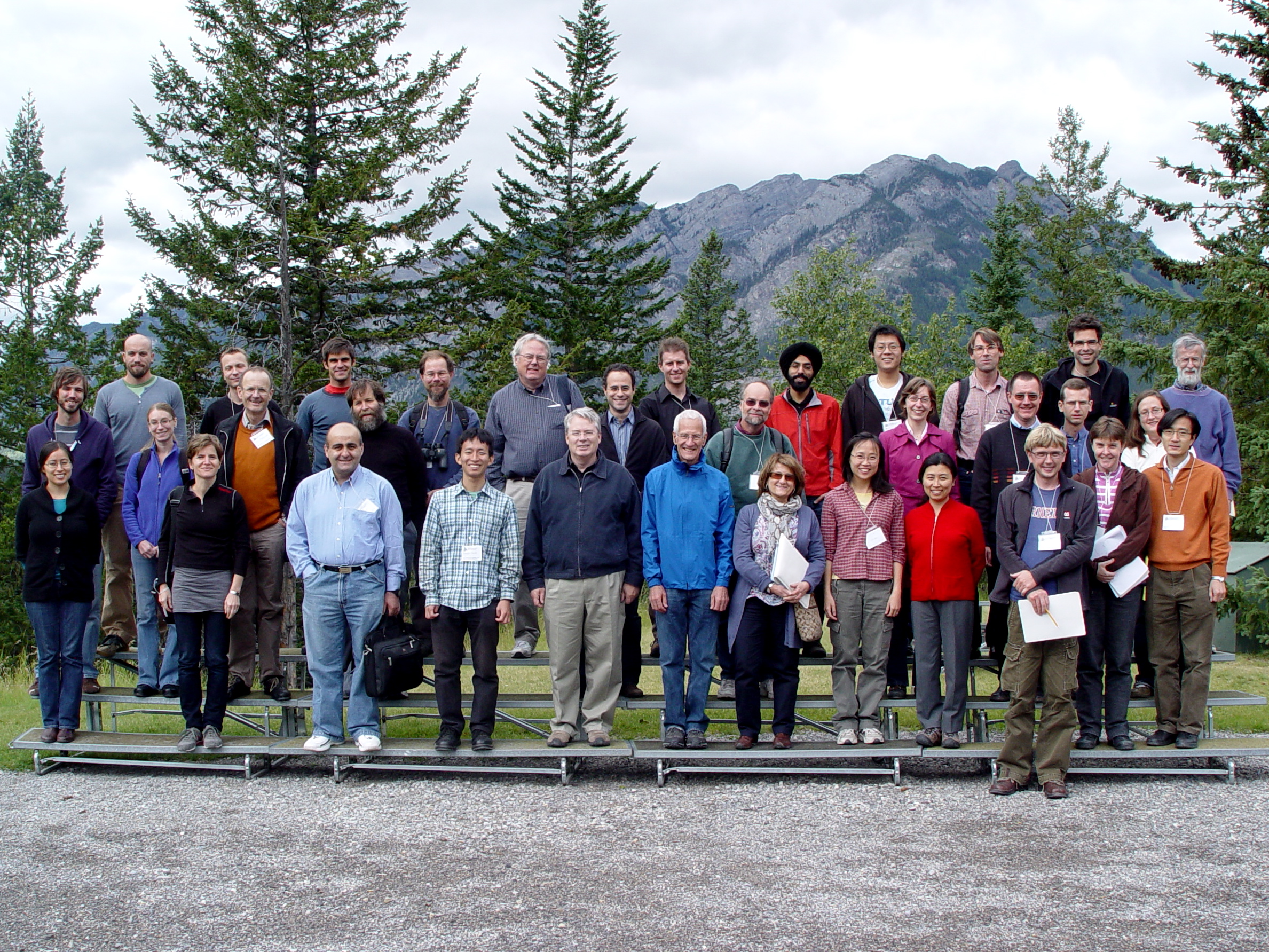
The Banff International Research Station will host the "New Mathematical Challenges from Molecular Biology and Genetics" workshop next week, September 6 - September 11, 2009.
Some of the earliest applications of mathematical probability were in population genetics where Fisher, Wright and Feller used random processes to model the distribution of allele types in a population undergoing change due to random mating, mutation and selection. The explosion of biological data
in the last decade presents a number of new opportunities for mathematical models to offer insights in the processes which shaped the observed patterns. It is important for Probabilists to learn about newly discovered genetic phenomena in order to design models and develop statistical methods to make biological inferences. It is equally important for Biologists to understand what recent probabilistic methodologies can be brought to bear on these questions. The greatest challenge is often to get a critical mass of both groups together in the same room for a meaningful exchange. This is the goal of the meeting.
Some of the earliest applications of mathematical probability were in population genetics where Fisher, Wright and Feller used random processes to model the distribution of allele types in a population undergoing change due to random mating, mutation and selection. The explosion of biological data
in the last decade presents a number of new opportunities for mathematical models to offer insights in the processes which shaped the observed patterns. It is important for Probabilists to learn about newly discovered genetic phenomena in order to design models and develop statistical methods to make biological inferences. It is equally important for Biologists to understand what recent probabilistic methodologies can be brought to bear on these questions. The greatest challenge is often to get a critical mass of both groups together in the same room for a meaningful exchange. This is the goal of the meeting.
The Banff International Research Station for Mathematical Innovation and Discovery (BIRS) is a collaborative Canada-US-Mexico venture that provides an environment for creative interaction as well as the exchange of ideas, knowledge, and methods within the Mathematical Sciences, with related disciplines and with industry. The research station is located at The Banff Centre in Alberta and is supported by Canada's Natural Science and Engineering Research Council (NSERC), the US National Science Foundation (NSF), Alberta's Advanced Education and Technology, and Mexico's Consejo Nacional de Ciencia y Tecnología (CONACYT).