Analysis of nonlinear wave equations and applications in engineering (09w5121)
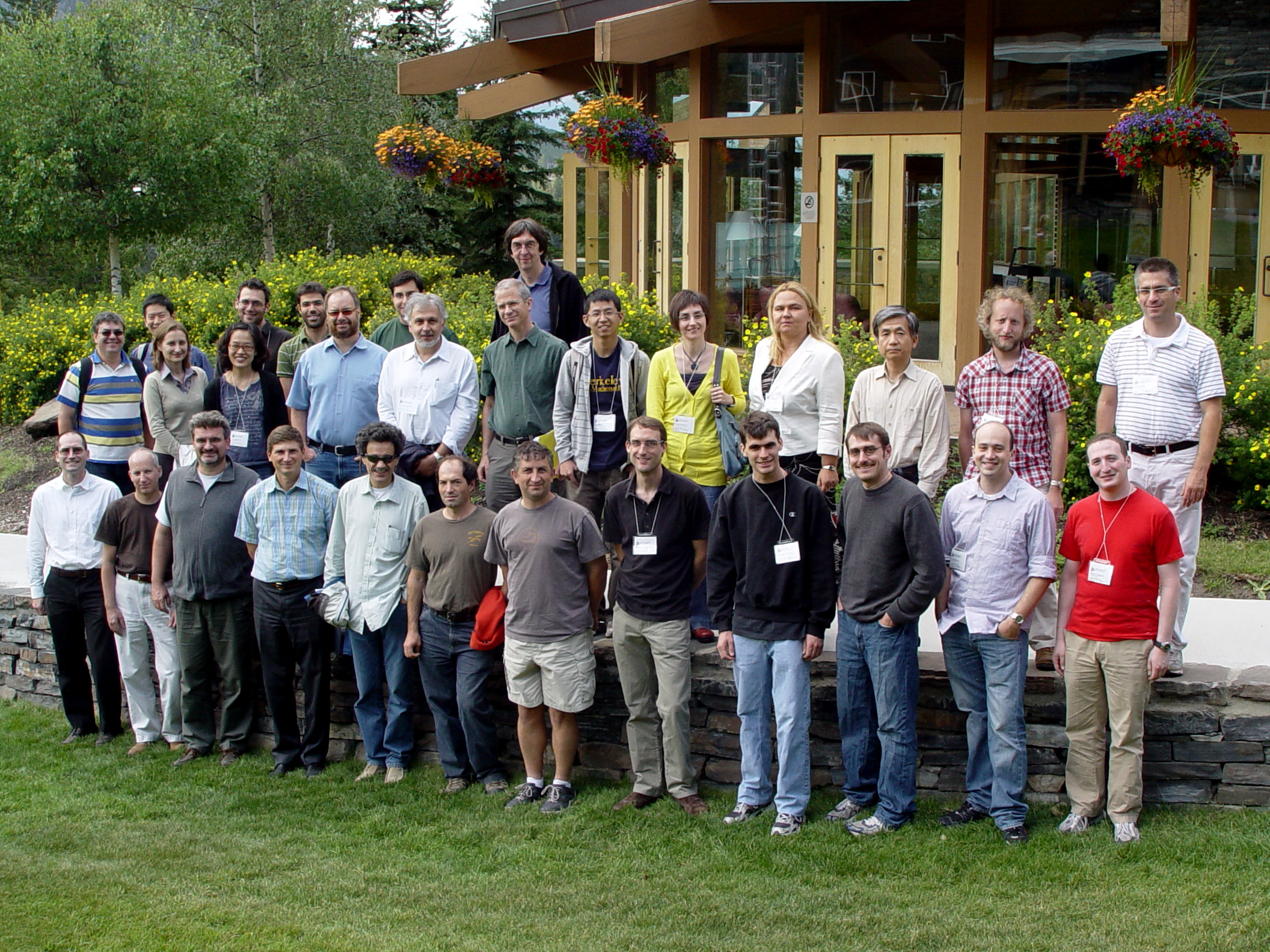
Organizers
James Colliander (University of British Columbia)
Michael Weinstein (Columbia University)
Vadim Zharnitsky (University of Illinois at Urbana-Champaign)
Description
Nonlinear dispersive equations are a class of mathematical equations (partial differential equations or PDEs) which are central to the description of such diverse physical models as light propagation in an optical wave guide, waves in a shallow water channel, confinement of Bose-Einstein condensate, etc ... Common themes in these models are a) Dispersion, or the spread of energy due to the dependence of the speed of signal propagation on wavelength (an effect responsible for the color-splitting of a prism) and b) Nonlinear self-focusing. For example, a sufficiently high concentration of optical energy in a glass medium may cause further intensified concentration, as if a focusing lens were present.
Such equations are not explicitly solvable in any simple sense, yet mathematical methods of analysis and computation are showing how to make these mathematical models into powerful predictive tools. The phenomena are very rich. For example, a balance of dispersion and nonlinearity results in coherent structures: solitons, vortices, very long-lived meta-stable states (localized waves which propagate with little or no distortion). Such structures are important for applications such as optical communication, where solitons can carry information, and are interesting physically because of their particle-like behavior.
This workshop will bring together researchers working on the analysis of nonlinear dispersive equations and coherent structures in important application areas. The goal of the workshop is to develop an agenda of outstanding problems in applications which can be solved or approached with the tools of modern analysis. Further progress on these problems will contribute to a better mathematical theory of optical communication, photonic crystals and other new technologies.
The Banff International Research Station for Mathematical Innovation and Discovery (BIRS) is a collaborative Canada-US-Mexico venture that provides an environment for creative interaction as well as the exchange of ideas, knowledge, and methods within the Mathematical Sciences, with related disciplines and with industry. The research station is located at The Banff Centre in Alberta and is supported by Canada's Natural Science and Engineering Research Council (NSERC), the US National Science Foundation (NSF), Alberta's Advanced Education and Technology, and Mexico's Consejo Nacional de Ciencia y Tecnología (CONACYT).