Small scale hydrodynamics: microfluidics and thin films (10w5035)
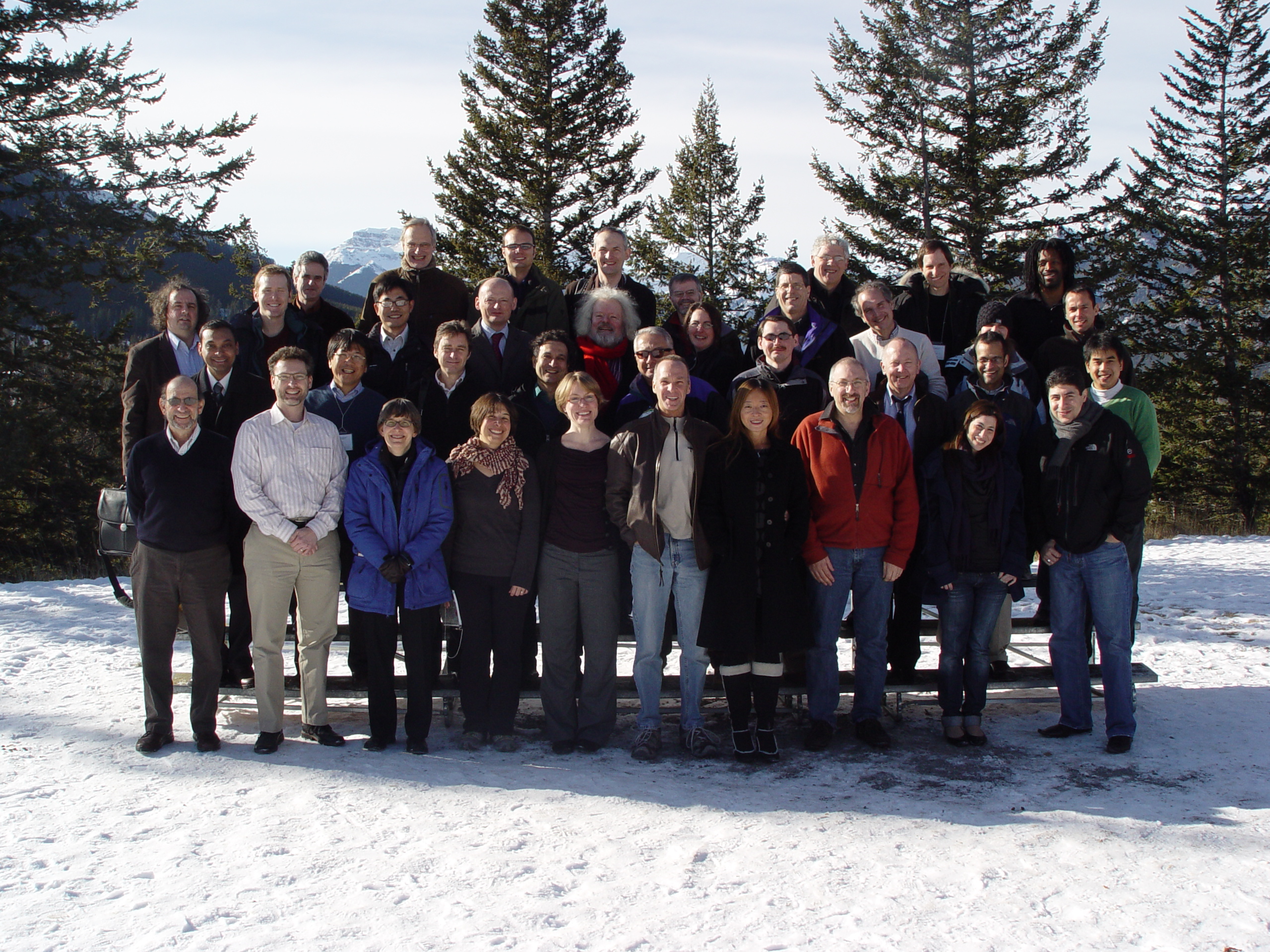
Organizers
Richard Craster (University of Alberta)
Demetrios Papageorgiou (Imperial College London)
G. M. Homsy (University of British Columbia)
Objectives
Scientists working on microfluidics, and thin films, often operate in
disparate and disconnected communities. The lead journals and
scientific meetings are often quite different and often have different
foci. The sheer pace of progress means that many ideas and avenues are
possibly being pursued in parallel. Additionally, there is the lost
opportunity for interdisciplinary approaches that enable quantum leaps
forward in understanding and development of both new devices and new
mathematical approaches. There is no obvious venue where
experimentalists, modellers, and applied mathematicians from the two
communities are brought into contact with the specific aim of
identifying areas ripe for synergistic advances. This workshop will
provide exactly this venue.
Hence, the main objective of this workshop is to bring together the
leading researchers in microfluidics and thin films from across
several disciplines in order to foster awareness and the
cross-disciplinary transfer of ideas. This is best achieved in a
workshop format. It is envisaged that the broad and interdisciplinary
nature of the participants will lead to a lively workshop
characterised by interaction and discussion.
This initial forum may also provide the necessary impetus for the
establishment of a regular biennial interdisciplinary workshop on
microfluidics, as has happened in other fields with which the
organizers are familiar. Future workshops would be held outside of
BIRS and hopefully would be self-supporting: the role of BIRS in
bringing together such a diverse group of participants will be a key
initial step. The proximity of the National Institute of
Nanotechnology (NINT) will be utilised and it is proposed that a
satellite meeting take place, post-workshop, in Edmonton. Staff from
NINT, see invitees, will participate in the main workshop and have
expressed their enthusiasm to do so.
A provisional program:
Since the objectives are to bring together a rather diverse group of
investigators in small scale hydrodynamics and microfluidics
respectively, we have put significant thought into the scheduling of
presentations in order to achieve that goal. We have purposely mixed
the two communities in a given session so as to avoid a 'phase
separation' whereby one community dominates a particular session or
day at the expense of the other. We have also planned a free
afternoon midweek so that participants can meet informally and have
time to digest the information presented in the first 2 1/2 days.
Day One. Microfluidics: Experiments and Observations.
The purpose is to open the workshop with experimentalists talking
about phenomena that they do and, more importantly, do not
understand. This then provides challenges for the theoreticians and
modellers to discuss and focus upon. The focus of this day will be
upon applications and experiments, in particular covering
i) Electrokinetic effects
ii) Microfluidic devices
iii) Bio-microfluidics
iv) Micro-mixing
v) Chemical reactions
vi) Self-assembly.
Day Two.
A discussion of the models available, their successes and failures.
The mathematical techniques that are available to give predictions
and further understanding will be outlined. Both applications and fundamental
phenomena will be discussed.
The talks will cover:
i) Electrohydrodynamics.
ii) Instabilities.
iii) Jet and droplet breakup.
iv) Mixing on the microscale.
v) Rheological models of complex fluids.
vi) Singularity formation: rupture and breakup.
Day Three (Morning).
Mathematical analysis and numerical simulations: Analysis has a role
to play in distinguishing those models that are well- or
ill-posed. Uniqueness and existence, also singularity formation near
rupture or breakup is important. Accurate numerical simulations are
vital to augment the modelling and recent advances will be discussed.
The coverage here will be of:
i) Dewetting models I.
ii) Contact line dynamics.
iii) Direct numerical simulations.
(Afternoon)
This will be free for one-on-one and informal
discussions. This will allow time for participants to consider the
material presented so far. The free afternoon will be followed by a
relatively early dinner, a poster session, and an informal evening
session which will invite short impromtu presentations and
video/multimedia presentation.
Day Four (Morning) Surfaces:
The interactions between fluids and surfaces are often a key element
in applications. Recent advances in surface treatments have allowed
the ability to tailor a surface to a particular application, and to
create fundamentally new surface phases. The nanoengineering of
structured surfaces created by electric fields and the patterning of
substrates by dewetting phenomena are closely related to
microfluidics.
i) Structured surfaces.
ii) Pattern formation.
iii) Thin film dynamics.
iv) Dewetting models II.
(Afternoon)
Discussion on opportunities for synergism, interdisciplinary work, and
future interactions. It is essential that active discussion and
interaction between the participants takes place. The afternoon
session is set aside for focussed discussion groups which will be
self-organised based on the topics that have most excited the
participants. Suggestions at this stage are: electrokinetics,
interfacial instabilities, modelling microfluidic devices,
superhydrophobic surfaces.
Each discussion group will be chaired by a speaker from one of the
earlier days and initiated by a short summary/ presentation. The
purpose being to identify open problems, experimental and theoretical
issues and to create an atmosphere for scientific discussion.
Day Five. Emerging Applications, Summary Session and Workshop
Conclusion. The session will take over from the discussion groups of
the previous day. Three of the senior, well-established, participants
will be invited to give longer plenary style talks which lay down
their vision of where their piece of the subject is, or should be,
going. Thereby closing off the workshop on a forward looking note, a
brief summary session will also discuss future meetings and
interactions.
The organisers have considerable experience in organising meetings and
workshops: RVC co-organised the recent Euromech workshop on thin films
and jet breakup, (Euromech 490 in 2007) and has organised or
co-organised sessions at the European Geophysical Union on Fluid
Mechanics. GMH has organized a number of national and international
meetings, including 3 one - week long IUTAM Symposia and recently, a
two week long NSF-sponsored PASI (Panamerican Advanced Study
Institute) in Argentina. In addition, he has served on a number of
Scientific Organizing Committees, including the European Coating Flow
Symposium (twice), 2 Euromech meetings, (including two on thin film
hydrodynamics), and Eurotherm 84 (Belgium, 2009), in addition to
chairing many NSF and NASA review panels. DTP has organized or
co-organized several international conferences including an
AMS-IMA-SIAM Summer Research Conference, all five Frontier in Applied
and Computational Mathematics Conferences from 2004-08. In addition he
has organized or co-organized several fluid dynamics sessions at the
annual meeting of the AIChE and SIAM.
Invitees: We have aimed for an approximately 50/50 split between
scientists who are explicitly in Mathematics departments and those
scientists from other disciplines. They represent many of the world's
leading or emerging experts in their respective fields, and the
majority of them have already indicated an interest in attending the
workshop (the stars indicate acceptance). In line with the BIRS
guidelines and objectives, we have made a special effort to invite
women and younger colleagues, denoted by (W) and (Y) respectively.