Inverse Transport Theory and Tomography (10w5063)
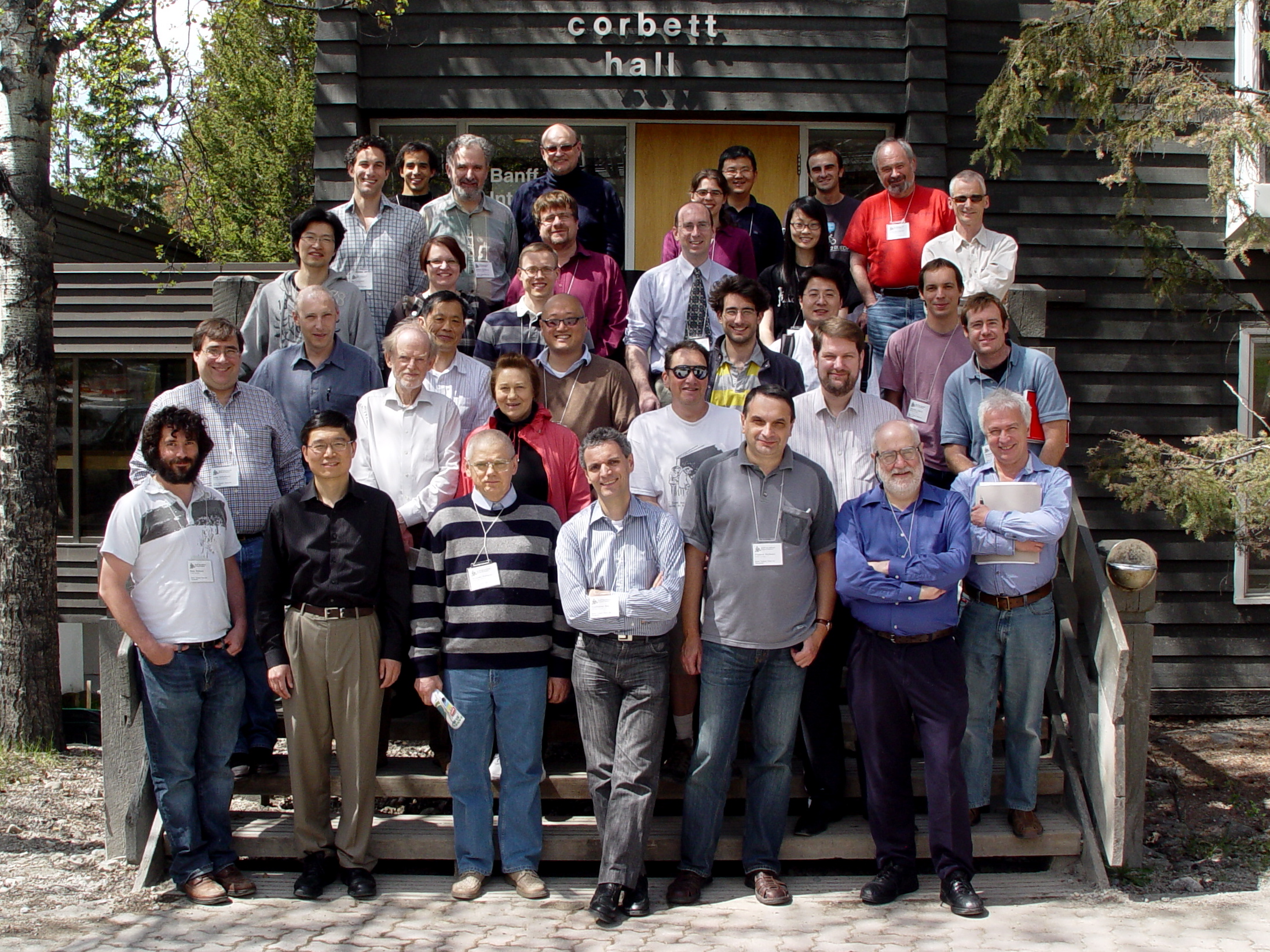
Organizers
Plamen Stefanov (Purdue University)
Guillaume Bal (Columbia University)
Gunther Uhlmann (University of Washington)
Objectives
The purpose of this workshop is to bring together specialists in the
general area of inverse transport theory. Inverse transport
encompasses many theoretical and practical areas. In case of no
scattering, inverse transport includes e.g. classical tomography, with
its applications in medical and geophysical imaging. In the presence
of particle scattering, applications include optical tomography
(propagation of photons through human tissues) and radiation through
the atmosphere (which includes the important problem in global warming
of radiation through clouds). In the presence of highly scattering
media, inverse transport includes the inverse theory of diffusion
equations, as it is used in optical tomography and in electrical
impedance tomography. We plan to invite pure and applied
mathematicians and scientists in other fields working on those
problems.
Inverse transport theory studies the following problem. Consider
particles, such as photons for concreteness, sent through a medium
that can absorb and scatter them. The mathematical model is to study
a density function of particles of the type $u(x,theta)$, where $xin
mathbf{R}^n$, $thetain {S}^{n-1}$, that solves the transport
equation
begin{equation} label{1}
thetacdotnabla +sigma(x) u
- int_{S^{n-1}} k(x,theta,theta')u(x,theta'), dtheta'=f
end{equation}
in some domain $Omega$ with appropriate boundary conditions. Here
$sigma(x,theta)$ models the absorption of the medium, and the scattering
(collision) kernel $k(x,theta,theta')$ is the rate at which
particles at $x$ change their velocity from $theta'$ to $theta$.
The possibly vanishing source term is denoted by $f(x,v)$. Inverse
transport then consists in reconstructing the optical parameters
$sigma(x)$ and $k(x,theta,theta')$ from measurements of
$u(x,theta)$, typically at the domain's boundary. The theory of
reconstructions of $sigma(x)$ and $k(x,theta,theta')$ from full
measurements of solutions $u$ on $partialOmegatimes S^{n-1}$ is
well developed cite{S-IO-03}. In most applications, however, full
measurements are hardly available and many inverse problems related
to (ref{1}) remain open.
In the non-scattering regime, the classical X-ray tomography problem
is to reconstruct a function, say with compact support, from its line
integrals
[
(Xf)(x,omega) = int_{-infty}^infty f(x+somega), ds, quad xin
mathbf{R}^n, ; omegain S^{n-1}.
]
While this problem has an explicit solution, many practical questions
still remain, like the most effective numerical inversions, limited
angle reconstructions, etc. A more realistic model is to account for
some absorption of the medium. This leads to the attenuated X-ray
transform
[
(X_sigma f)(x,omega) = int_{-infty}^infty w(x+somega ,omega)
f(x+somega), ds, quad xin mathbf{R}^n, ; omegain S^{n-1},
]
where $w(x,omega) = int_{-infty}^0sigma(x+tomega), dt$ is the
total absorption along the ray ${x+tomega; ; tle0}$, and $sigma$
is the absorption coefficient. It has been proved recently by
Bugkheim and Novikov that $X_sigma$ is injective with an explicit
formula for the inverse.
In fact, the inversion of $X_sigma$ is a partial case of the inverse
problem for the transport equation (ref{1}) when $k=0$. Despite that,
the inversion of the attenuated X-ray transform has been treated with
different methods including complex analysis, and microlocal methods.
The results for that partial case are much more complete. We refer to
cite{BT-SIMA-07,FSU-08} for some recent work on the subject. We feel
that the relationship between complex analysis and microlocal methods
could be pushed further and we plan to invite speakers to talk about
recent work in this area.
In the high scattering regime, i.e., when $sigma$ and $k$ are large
and reasonable assumptions are satisfied, the transport equation
(ref{1}) is well-approximated by a diffusion equation, which takes
the form
begin{equation}
label{eq:3}
-nablacdot D(x) nabla U + sigma_a U =0,
end{equation}
where $D$ and $sigma_a$ are typically scalar-valued functions.
Mathematically, this is a diffusion equation, which in the case
of vanishing absorption, is an example of the well-studied elliptic problem
begin{equation} label{2}
sum_{i,j}partial_i sigma_{ij}partial_j u=0 quad mbox{in $Omega$},
end{equation}
where $sigma_{ij}(x)$ is positive definite. Then we are lead to the
inverse problem of recovering $sigma$ from the knowledge of the
Dirichlet-to-Neumann map
[
Lambda :f to sigmafrac{partial u}{partial f}bigg|_{partialOmega},
]
where $u$ is the solution of (ref{2}) with boundary data $u=f$. That
inverse problem is known as Electric Impedance Tomography, where
$sigma$ is a unknown conductivity (anisotropic in general), $u$ is
the voltage, and $Lambda$ is the voltage to current map. It was first
proposed by Calder'on in cite{calderon80}, and has seen a tremendous
progress since then. Uniqueness of recovery and constructive
algorithms has been established by Sylvester and Uhlmann, and Nachmann
in dimensions $nge3$, and by Astala and Paivarinta for $n=2$. The
first of those works started the Complex Geometric Optics, and led to
progress in solving many other problems. Several teams used those
theoretical advances to develop numerical reconstructions and even
devices that do the reconstruction in real time. EIT has
promising applications in medical imaging for early detection of
cancer. Some of them, obtained by the group at RPI led by David
Isaacson, will be presented at the workshop. We also plan other talks
by both pure math and applied specialists in EIT.
As we have mentioned, the theory for (ref{2}) and (ref{eq:3}) is
well advanced. The inverse transport theory for (ref{1}) from
angularly measurements is much less advanced. By angular measurement,
we mean e.g. measurements of the particle current at the boundary:
begin{equation}
label{4}
J(x) = int_{S^{n-1}} u(x,v) vcdot n(x) dmu(v),
end{equation}
where $n(x)$ is the outward unit normal to $Omega$ at
$xinpartialOmega$. In the diffusion approximation of transport,
$J(x)$ takes the form $sigmafrac{partial u}{partial
f}big|_{partialOmega}$. We thus see that angularly averaged
measurements in inverse transport theory are of the same kind as the
reconstruction of $sigma$ in (ref{2}) from the
Dirichlet-to-Neumann map. Moreover, the recent results obtained in
cite{BLM-IPI-08} show that the linearized inverse problem for
(ref{1}) from angularly averaged measurements is very similar to the
Calder'on problem. The same complex geometrical optics solutions are
being used. This surprising analogy should be explored further and we
expect that the interactions of specialists from inverse diffusion and
from inverse transport theory will provide further advances in this
area.
In media with variable, and possibly, anisotropic speed, the mathematical model is the transport equation on a Riemannian manifold. This links inverse transport with integral geometry on Riemannian manifolds. That link has been exploited by Sharafutdinov cite{Sh} and McDowall cite{Mc}, who will be among the speakers. In particular, energy methods, widely used on Riemannian manifolds, have been used in inverse transport.
-BLM-IPI-08
G.~Bal, I.~Langmore, and F.~Monard.
Inverse transport with isotropic sources and angularly averaged measurements.
Inverse Probl. Imaging, (1), pp. 23-42, 2008.
-BT-SIMA-07
G.~Bal and A.~Tamasan.
Inverse source problems in transport equations.
SIAM J. Math. Anal., 39(1):57--76, 2007.
-calderon80
A.P. Calderon.
On an inverse boundary value problem.
Seminar on Numerical Analysis and its Applications to Continuum
Physics, Soc. Brasileira de Matematica, Rio de Janeiro, pages 65--73, 1980.
- FSU-08
B.~Frigyik, P.~Stefanov, and G.~Uhlmann.
The x-ray transform for a generic family of curves and weights.
J. Geom. Anal., 18 , pp. 81-97, 2008.
-Mc
S. McDowall.
An inverse problem for the transport equation in the presence of a Riemannian metric.
Pac. J. Math., 216 (2004), no.1, 107--129.
-Sh
V.~Sharafutdinov.
The inverse problem of determining the source in the stationary transport equation on a Riemannian manifold.
J. Math. Sci. (New York)}, 96(4)(1999), 3430--3433.
-S-IO-03
P.~Stefanov.
Inverse Problems in Transport Theory; in: {em Inside Out: Inverse problems and applications}, volume~47 of
MSRI publications, Ed. G. Uhlmann.
Cambridge University Press, Cambridge, UK, 2003.