Geometric Scattering Theory and Applications (10w5106)
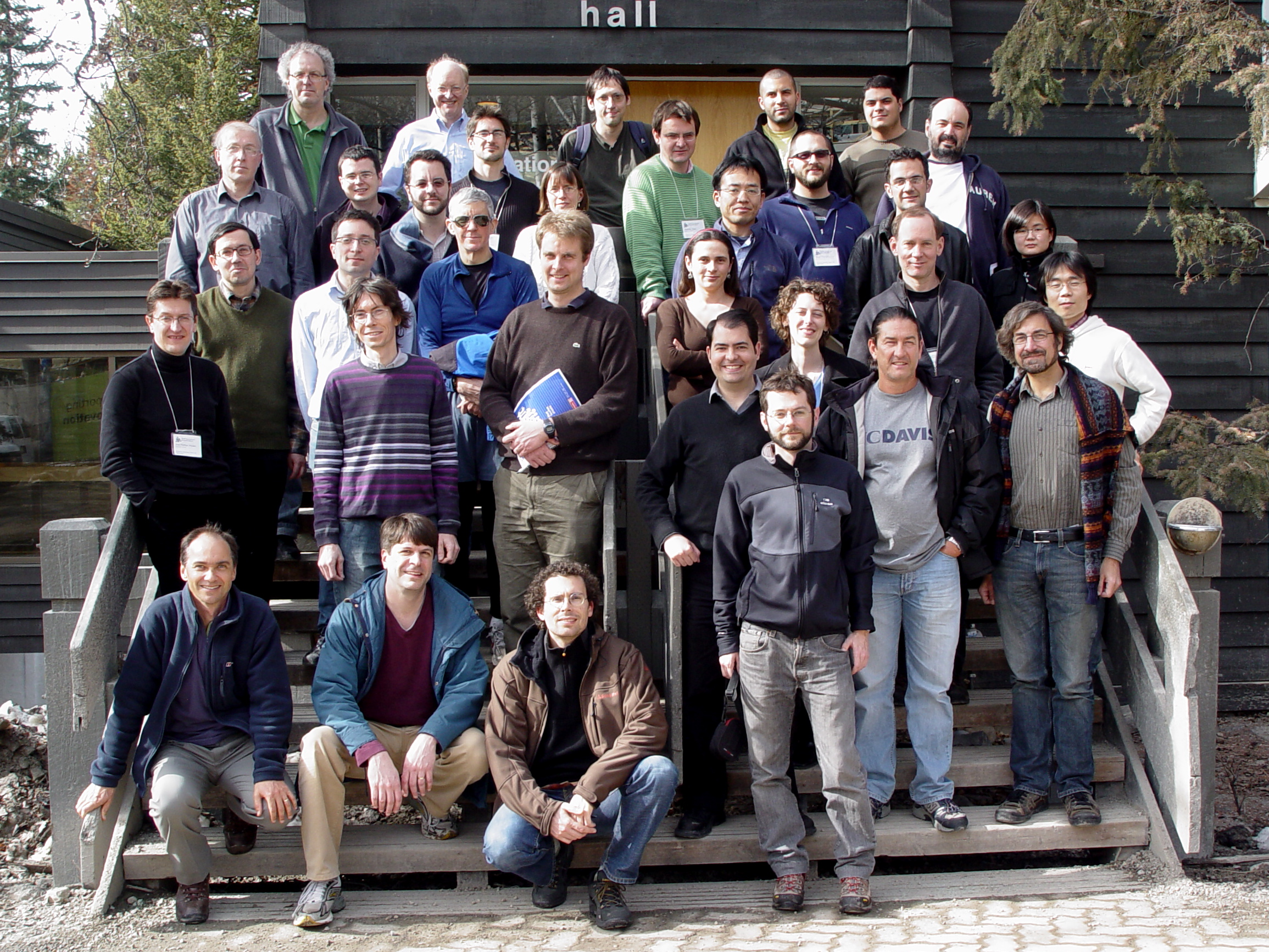
Organizers
Peter Perry (University of Kentucky)
Rafe Mazzeo (Stanford University)
Antonio Sa Barreto (Purdue University)
Peter Hislop (University of Kentucky)
Objectives
The goal of this workshop is to bring together researchers in geometric
scattering theory, conformal and CR geometry, and dynamics to make further
progress in building this dictionary between dynamics, scattering and fine
aspects of the geometry and analysis at infinity of this class of spaces.
Areas of focus will include:
begin{enumerate}
item Conformal and CR-Geometries: elucidating connections between scattering
theory, or other measurements of asymptotics of textquotedblleft
bulktextquotedblright quantities in the AdS/CFT correspondence, with
conformal and CR invariants.
item Trace formulae , spectral asymptotics, and resonances: extending
non-perturbative trace formulas to asymptotically hyperbolic manifolds,
complex hyperbolic manifolds, and other geometric settings
item Chaotic quantum scattering: elucidating further connections between
classical and quantum chaos in the setting of geometric scattering;
item Scattering theory in various spacetimes: scattering in Kerr and
Schwarzschild geometries, using techniques from geometric scattering to obtain
the space-time asymptotics of solutions to the wave equation on Schwarzschild
and Kerr models of black holes, and connections with other areas of geometric
scattering theory
end{enumerate}
The workshop program will be designed to highlight the recent work of young
researchers in the field, which will be accomplished by asking certain of them
to give 50 minute talks on their research. Of the remaining talks, three will
be designated as 50-minute survey talks, and the rest, by senior researchers,
will be 30 minutes. The daily program will consist of one 50-minute and one
30-minute talk in the morning, followed by a long midday break, and one
50-minute talk and two 30-minute talks in the afternoon. The long break from
11:15 until 4:00 is designed to allow participants to work and interact
informally. We will also hold two moderated open problem sessions during the
week to make sure that everyone, particularly the young researchers, have a
good sense of some of the most important open directions in the field.
Our proposed list of participants includes experts in microlocal analysis,
dynamics, CR-geometry, and scattering theory; we hope to provide an
environment in which broader connections can be established and in which
younger researchers can benefit from the perspective and experience of
accomplished senior researchers in these respective fields.
We now discuss the scientific rationale for our areas of focus in greater detail.
A central role in geometric scattering theory and its applications is played
by Poincar'{e}-Einstein spaces, which are asymptotically real hyperbolic, in
the AdS/CFT correspondence in string theory. The asymptotic geometry on the
boundary at infinity in this case is conformal geometry. There is now an
extensive dictionary between scattering theory for the Laplace operator on the
interior and various natural conformal quantities. In physics this is the
beginning of the Maldacena correspondence, but in mathematics, it has led to
some very surprising new ways to approach old problems in conformal geometry,
e.g. the Fefferman-Graham ambient metric construction to analyze scalar
conformal invariants, or the Graham-Zworski theory to relate the conformally
covariant GJMS operators on the boundary (which are higher order analogues of
the conformal Laplacian and Paneitz operator) to residues of the scattering
matrix. This setting also includes the various trace formulas on convex
cocompact hyperbolic manifolds which involve Selberg zeta functions to
spectral or scattering information. This is also interesting from a microlocal
point of view since these manifolds provide examples of chaotic quantum
scattering which can be analyzed in detail using techniques from dynamics. One
goal is to extend these relationships between dynamics of the geodesic flow
and scattering to more general spaces which do not have constant curvature.
There is an emerging parallel development for the complex case. Natural
examples of asymptotically complex hyperbolic spaces include the canonical
Bergman and K"ahler-Einstein metrics on strictly pseudoconvex domains. The
asymptotic geometry at infinity is now CR geometry. This was one of the
original motivations of the Fefferman-Graham program, but the connections with
scattering theory are quite recent. There should be similar stories for spaces
modeled on higher rank symmetric spaces of noncompact type, and these are also
now just beginning to be developed. One important task is for the geometric
scattering community to absorb the content of the more difficult trace
formulae in the higher rank setting, e.g. the Arthur trace formula, so as
to gain insight into how to find appropriate generalizations.
On the analytic side, efficient calculi of pseudodifferential operators
adapted to each of these geometries have made it possible to analyze the
resolvent of the Laplacian and the associated scattering operator in detail.
These theories have led to the definition of new renormalized traces and
determinants for resolvents, heat kernels, scattering operators, etc.; this
lies at the heart of some important new non-perturbative trace formulae , as
developed by Guillarmou and others. Conversely, there are many techniques from
dynamics to study geodesic flow and the associated (Ruelle-type) zeta
functions, and these have had an impact on geometric scattering by leading to
results new results concerning distribution of resonances, and new trace formulae .
As mentioned above, there is also a more algebraic side to this subject. Many
old questions in conformal and CR geometry have been resolved using ideas from
the Fefferman-Graham program, i.e. extending a complete asymptotically
symmetric Einstein metric. One recent example is Alexakis' tour de force
resolution of the Deser-Schwimmer conjecture about the structure of
conformally invariant scalar invariants. More broadly, and drawing significant
inspiration from representation theory, Juhl has developed a far-reaching
generalization of the Fefferman-Graham theory which has introduced a huge
panoply of new and interesting conformally invariant operators.
Complementing all of this are the many deep questions in nonlinear geometric
analysis about the existence and nature of these asymptotically symmetric
Einstein metrics and of the special submanifolds associated to these
geometries. This part of the subject has taken on a broad life of its own, and
for reasons of focus, should not be one of the main themes of this workshop.
Nonetheless, there are several important researchers working on the interface
of these two aspects of the subject who should be included.
Finally, as indicated earlier, another set of spaces amenable to treatment by
the techniques of geometric scattering theory are some interesting examples of
cosmological spacetimes such as the Schwarzschild, Kerr, de Sitter and anti de
Sitter spaces, and once again, other spaces which have the same asymptotic
structure as one of these at infinity. One of the key challenges in
mathematical relativity is to study the stability properties of these
spacetimes (as solutions of the Einstein equation), which motivates the study
of spaces which are perturbations of the exact solutions, and also gives great
urgency to the big problem of studying the asymptotic properties of solutions
of the wave equation on these spacetimes. There are already some important
results in this direction using techniques from geometric scattering, and this
is a very important direction of research.