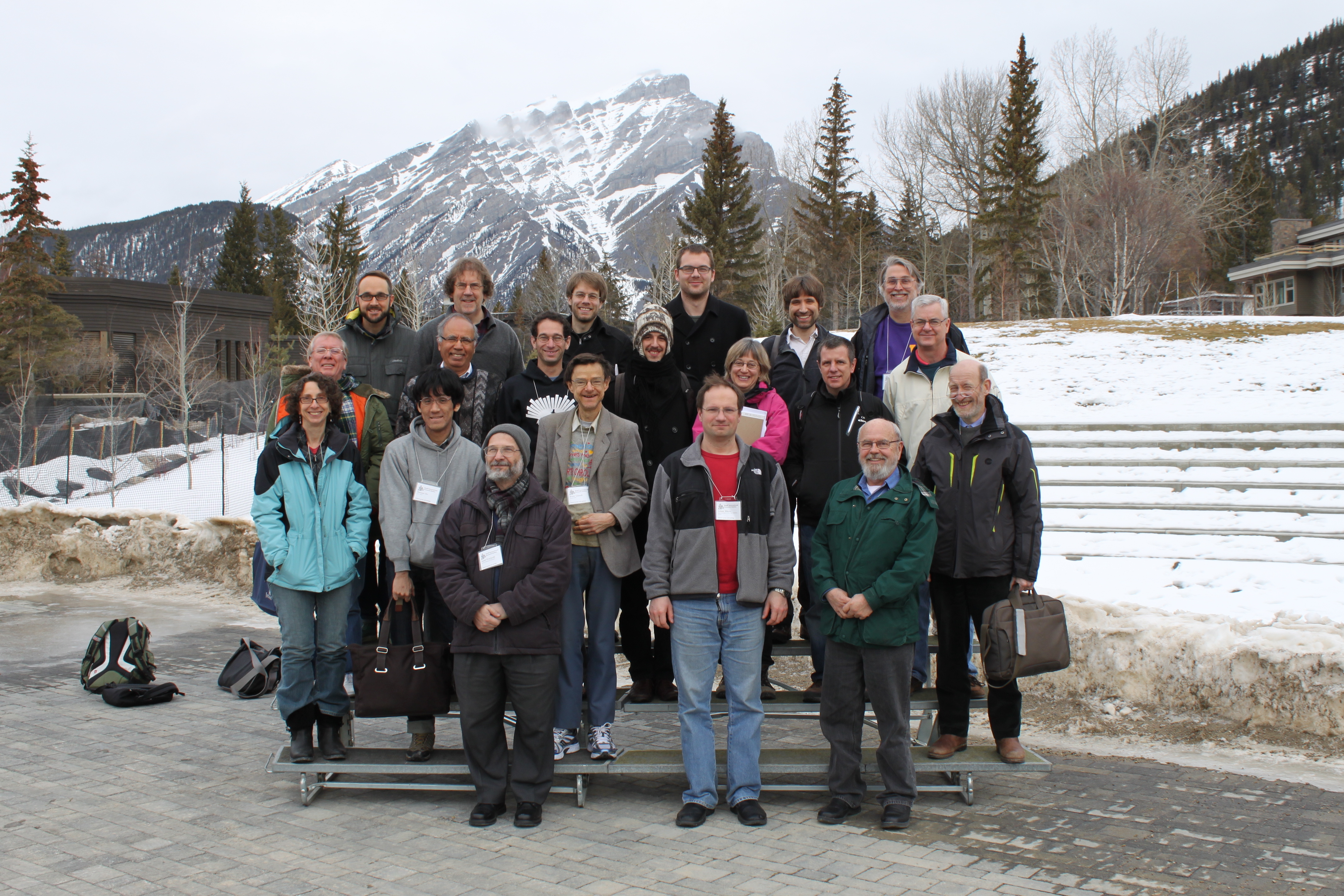
Ordered groups and topology (12w5009)
Organizers
Steven Boyer (Université du Quebec à Montréal)
Patrick Dehornoy (University of Caen)
Peter Linnell (Virginia Tech)
Akbar Rhemtulla (University of Alberta)
Dale Rolfsen (University of British Columbia)
Adam Sikora (State University of New York (SUNY) - Buffalo)
Objectives
If the elements of a group can be given a strict total ordering which is invariant under multiplication on the left, the group is said to be left-orderable. Left-orderable groups are also right-orderable, by a possibly different ordering, but if there is an ordering invariant on both sides, one calls the group orderable. For countable groups, left-orderability is equivalent to admitting an effective action on the real line by orientation preserving homeomorphisms.
The study of orderable groups has a long history, dating back to the nineteenth century. Steady progress in understanding orderable groups was made in the twentieth century by the work of many mathematicians, including such notables as O. Holder, A. A. Vinogradov and W. Rudin. They discovered that many interesting groups are orderable, including free groups, torsion-free abelian groups and fundamental groups of many important topological spaces, such as hyperbolic surfaces and complements of certain hyperplane arrangements. The existence of an ordering on a group implies strong algebraic properties: for example left-orderable groups are torsion-free and obey the zero-divisor conjecture of Kaplansky (still unsolved for torsion-free groups in general); roots of elements of orderable groups are unique, and group rings of orderable groups embed in skew-fields.
In recent years, the theory of orderable groups has attracted much broader interest, in large part due to discoveries of deep connections with topology and the dynamics of group actions on the circle and real line. It was shown by T. Farrell in 1976 that the universal covering of a space $X$ embeds in $X times I$, respecting the projections, exactly when the fundamental group of $X$ is left-orderable. A major breakthrough in the theory of Artin's braid groups was made in the 1990's when P. Dehornoy showed that the braid groups are left-orderable. This has had strong application in braid and knot theory and inspired discoveries that many other groups which arise in topology also have orderability properties. An important open question is whether the Artin groups of finite type, which generalize the braid groups, are also left-orderable. The answer hinges on the left-orderability of the Artin group of type $E_8$. It is known that right-angled Artin groups enjoy a 2-sided ordering. These groups have strong connections with topology and geometric group theory.
The fundamental groups of many 3-dimensional manifolds -- for example the fundamental group of complements of knots or links in the 3-sphere -- are left-orderable. Indeed, in the last few years orderability has proven a very useful tool in 3-manifold theory. For example, 3-manifolds which have particularly nice foliations must have left-orderable fundamental groups. Since many 3-manifold groups are NOT left-orderable, this shows they do not support these nice foliations. Orderability also provides an obstruction to the existence of nonzero degree maps between certain manifolds. Algorithms exist to test the orderability of groups, given generators and relations. A striking application of this, by Calegari and Dunfield, is that the hyperbolic 3-manifold of smallest volume (the so-called Weeks manifold) does not support nice foliations, because its group is not left-orderable. Roberts, Shareshian and Stein constructed an infinite family of 3-manifolds which do not support taut foliations, by showing that their groups cannot act effectively on the real line, or indeed any on (possibly non-hausdorff) one-dimensional manifold. In particular, the groups cannot be left-ordered.
Besides the contribution of algebra and orderings to topology, there is a new dynamic in the other direction: topology providing applications to algebra. If $G$ is a group, the set $LO(G)$ of all left-orderings on the group has a natural topology, defined by A. Sikora in 2004. Moreover, there is a natural (conjugation) action of $G$ on $LO(G)$ by homoemorphisms. This is the basis for a recent beautiful argument by D. Witte-Morris, showing that left-orderable amenable groups are locally indicable (meaning any nontrivial finitely generated subgroup has the integers as a quotient group). The argument involves a $G$-invariant measure on $LO(G)$ and the Poincar'e recurrence theorem. A classic result of Burns and Hale shows that all locally indicable groups are right-orderable, but G. Bergman showed that the converse does not hold in general. Another recent result using this topology is P. Linnell's theorem that the number of left-orderings of a group must be either finite or uncountable. By contrast, there exist groups which have a countably infinite number of (two-sided) orderings.
For many groups $G$ the structure of $LO(G)$, and the subspace $O(G)$ of two-sided orderings, is not known at this time. In general we know that these spaces are compact and totally disconnected, but their exact structure is known for only a few families of groups, for example finitely-generated abelian groups (for which the spaces are homeomorphic to Cantor sets). It was recently shown that if $G$ is a countable (nonabelian) free group, then $LO(G)$ is also a Cantor set. A stronger result, recently announced by A. Clay, is that there exists a left-ordering of the free group $G$ whose orbit under the $G$-action is actually dense in $LO(G)$. The structure of $O(G)$ is not known for free groups. Another recent surprise regarding the braid groups $B_n$ is that there exist orderings (constructed by Dubrovin and Dubrovina) which are isolated points in $LO(B_n)$, whereas Dehornoy's ordering is not isolated, and is in fact a limit point of the orbit of the D-D ordering. Another fascinating recent discovery, by A. Navas and C. Rivas, is that for the famous Thompson's group $F$, the space $O(F)$ consists of a Cantor set, plus four isolated points (the structure of $LO(F)$ is unknown).
Many questions dealing with algebraic and analytic properties of orderable groups have been with us for a long time. A few major ones have been answered recently in the works of Witte-Morris, V. Bludov, A. Glass and others -- there exist solvable orderable groups that can not be embedded in divisible orderable groups; necessary and sufficient conditions for a free product of two left-orderable groups with amalgamated subgroup to be left-orderable; existence of finitely presented orderable groups with insolvable word problem. In view of recent result obtained by Alexey Muranov for simple groups, one can now hope to get answers to the following: Are there simple orderable groups in which there is no bound on the number of commutators required to express every element of the group as a product of bounded number of commutators? Discussion, at BIRS meeting, of the present status of a list of open problems in Orderable, left-orderable and lattice orderable groups by Kopitov and Medvedev and a more recent list by Bludov and Glass would be productive.
Returning to applications of orderable groups to topology, there is very recent evidence of connections between the structure of Heegaard-Floer and similar homology theories and the orderability (or non-orderability) of fundamental groups of 3-manifolds constructed by surgery on knots and links. Ozsvath and Szabo define L-spaces to be 3-manifolds with trivial rational homology and HF homology as simple as possible.
It was shown by Boyer and Watson that the 3-dimensional Seifert fibred spaces which are L-spaces are exactly those whose fundamental group is NOT left-orderable. It would be remarkable if this is true more generally. The interplay of ordered group theory and the topology of manifolds (and structures on them, such as foliations, fibrations, contact structures) is a new and promising area of research. A workshop at BIRS will hopefully enhance our understanding and solve some of the many open questions regarding the interaction of topology and ordered algebraic structures.