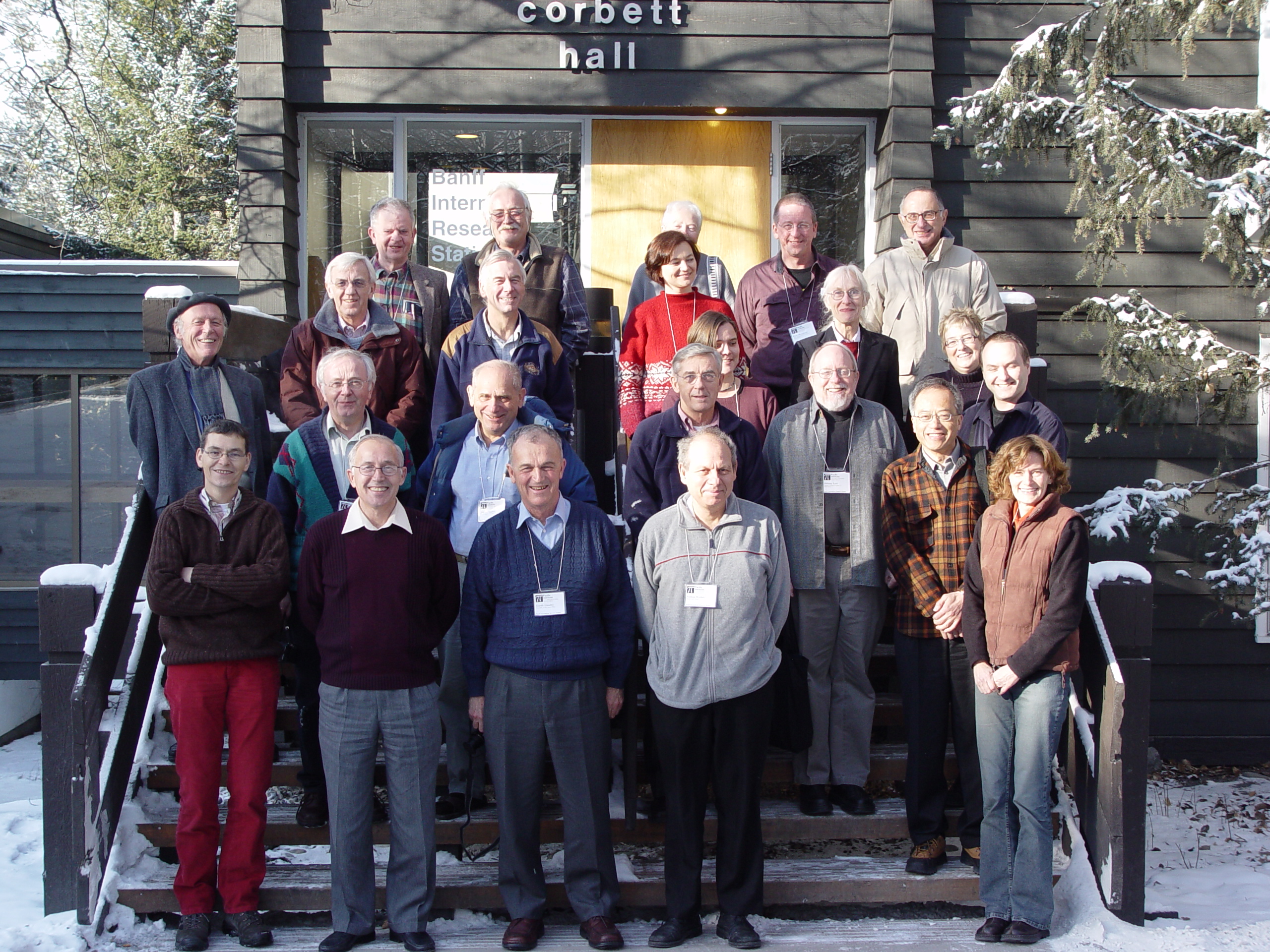
Numeracy and Beyond (04w5044)
Organizers
Tony Gardiner (University of Birmingham)
Klaus Hoechsmann (Pacific Institute for the Mathematical Sciences)
Bernard Madison (University of Arkansas)
Yarom Sagher (University of Illinois)
Yoram Sagher (Florida Atlantic University)
Guenter Toerner (University of Duisburg-Essen)
Objectives
This workshop is the second half of a two part workshop called Numeracy and Beyond.
Part I was held at PIMS, Vancouver, July 8 -11, 2003. If you visit that site, you will find two links,
labelled
"2003" and
"2004",
respectively, which lead you to information about past and future of this project.
It is not intended as a workshop of experts dispensing their wisdom, nor one of seekers stumbling in the
dark, but one of people with insight and experience in mathematics and its promulgation, soberly and realistically examining the following question: what level of
numeracy
might be required of average citizens in the
future,
and how would it relate to the more advanced needs of engineers or scientists? What, if anything, known to us or our
ancestors
would still be relevant?
Our first priority will be to identify key principles, which are simple, widely acceptable, practical, yet fundamental, which could guide teaching and learning, and be largely independent of the particular context. We shall try to produce a concise, coherent proceedings volume with about eight chapters and a well-rounded but not overwhelming bibliography, which mathematicians as well as teachers and educators might find useful.
Elementary
mathematics ought to be structured in such a way that its common sense roots are clearly visible, so that
teachers
will understand and enjoy it, even without advanced
training.
At the same time, it should be able to serve as a solid base for
higher
mathematics and an inspiration toward the
highest.
Such restructuring must be informed by the insights of both pedagogues
and
practitioners.
Much harm has been done to elementary education by the notion that human
computation
is necessarily stultifying and "uncreative". Like sports, mathematics could serve to equalize chances rather than accentuating differences. If it can ever be made school proof, it will probably be -- as in sports -- through a return to its rigorous but inherently attractive sources. These are mental -- affected, but not altered, by technology.
Vast resources are allocated to producing a citizenry capable of operating intelligently and responsibly in a society whose production and decision making are based increasingly on quantities and their
representations,
but this aim is seldom addressed in today's curricula, which strive instead for "higher" and more elusive goals. Overlaps between intended, implemented, and
assessed
curricula are progressively shrinking (as can be observed even at universities), perhaps mirroring those between the communities of mathematicians, teachers, and policy makers.
If our efforts cannot affect these mighty movements, they might at least contribute to various evacuation plans.