Recent progress on nonlinear elliptic and parabolic problems and related abstract methods (07w5004)
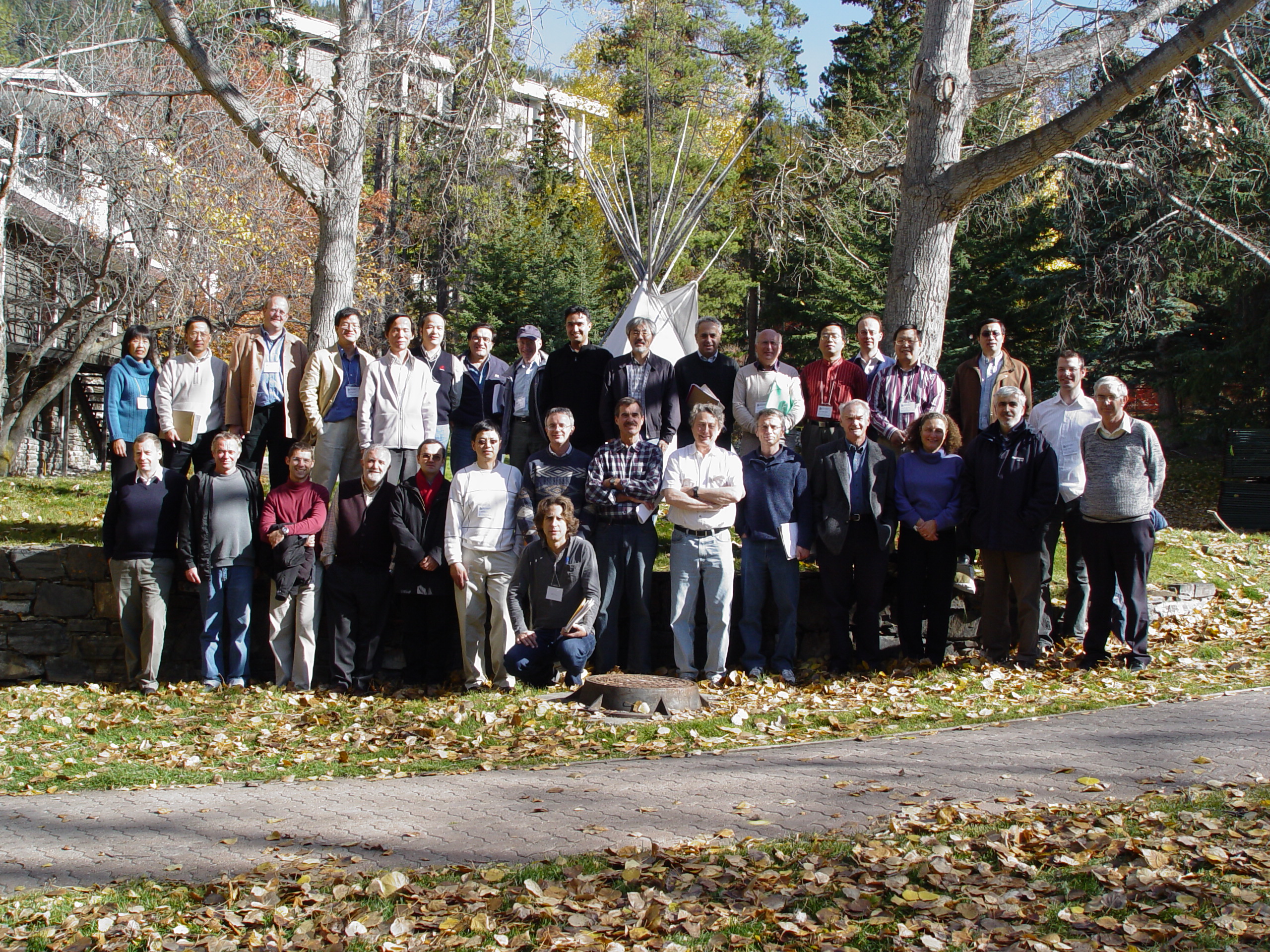
Organizers
Norman Dancer (University of Sydney)
Yihong Du (University of New England)
Konstantin Mischaikow (Rutgers University)
Peter Polacik (University of Minnesota)
Xiaoqiang Zhao (Memorial University of Newfoundland)
Description
Some of the international leaders working on a broad area of nonlinear analysis will meet at BIRS during October 7-12, 2007, to exchange new ideas and results, and to further progress research through new collaboration and cross-fertilization.
Topics covered by this high profile workshop include partial differential equations arising from mathematical biology, chemical reaction theory, material science, water waves, and related abstract methods. The workshop will focus on a selection of the most important features of the solutions to these equations, such as spatial and temporal patterns, sharp layers and spikes, blow-up, traveling waves, and the relevant techniques involved in finding these solutions. Rapid progress in research on these problems requires timely dissemination of the most recent research ideas and techniques, and the facilities and atmosphere provided at BIRS are ideal for such a purpose.
This workshop is organized by international experts from Australia (Norman Dancer of the University of Sydney, Yihong Du of the University of New England), Canada (Xiao-Qiang Zhao of Memorial University of New Foundland) and the USA (Konstantin Mischaikow of Rutgers University and Peter Polacik of the University of Minnesota). Participants of the workshop include distinguished mathematicians and many top young researchers in the field, coming from 12 countries around the world.
The Banff International Research Station for Mathematical Innovation and Discovery (BIRS) is a collaborative Canada-US-Mexico venture that provides an environment for creative interaction as well as the exchange of ideas, knowledge, and methods within the Mathematical Sciences, with related disciplines and with industry. The research station is located at The Banff Centre in Alberta and is supported by Canada's Natural Science and Engineering Research Council (NSERC), the US National Science Foundation (NSF), Alberta's Advanced Education and Technology, and Mexico's Consejo Nacional de Ciencia y Tecnología (CONACYT).
Topics covered by this high profile workshop include partial differential equations arising from mathematical biology, chemical reaction theory, material science, water waves, and related abstract methods. The workshop will focus on a selection of the most important features of the solutions to these equations, such as spatial and temporal patterns, sharp layers and spikes, blow-up, traveling waves, and the relevant techniques involved in finding these solutions. Rapid progress in research on these problems requires timely dissemination of the most recent research ideas and techniques, and the facilities and atmosphere provided at BIRS are ideal for such a purpose.
This workshop is organized by international experts from Australia (Norman Dancer of the University of Sydney, Yihong Du of the University of New England), Canada (Xiao-Qiang Zhao of Memorial University of New Foundland) and the USA (Konstantin Mischaikow of Rutgers University and Peter Polacik of the University of Minnesota). Participants of the workshop include distinguished mathematicians and many top young researchers in the field, coming from 12 countries around the world.
The Banff International Research Station for Mathematical Innovation and Discovery (BIRS) is a collaborative Canada-US-Mexico venture that provides an environment for creative interaction as well as the exchange of ideas, knowledge, and methods within the Mathematical Sciences, with related disciplines and with industry. The research station is located at The Banff Centre in Alberta and is supported by Canada's Natural Science and Engineering Research Council (NSERC), the US National Science Foundation (NSF), Alberta's Advanced Education and Technology, and Mexico's Consejo Nacional de Ciencia y Tecnología (CONACYT).