Operator Spaces and Group Algebras (07w5013)
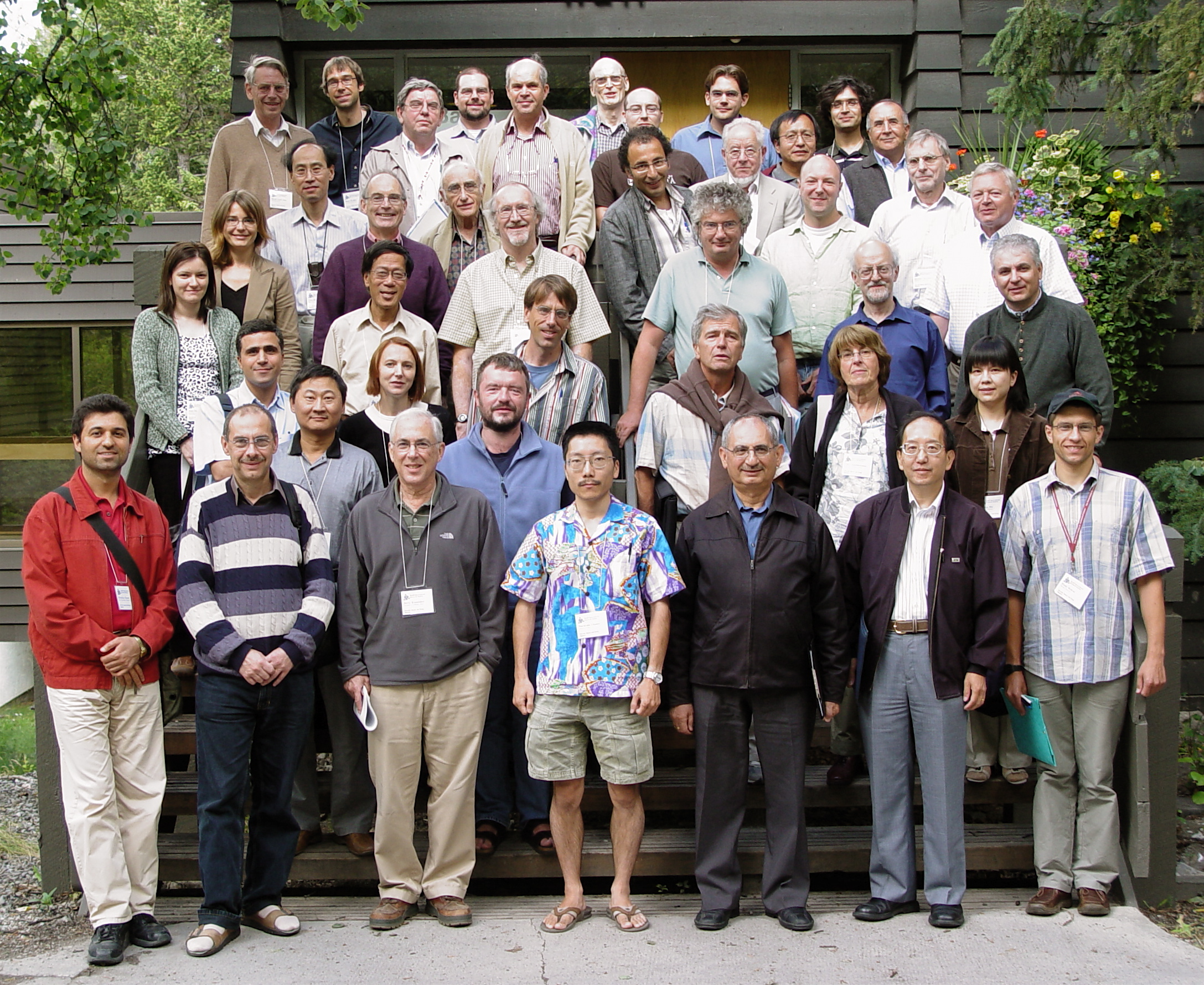
Organizers
Anthony To-Ming Lau (University of Alberta)
Zhong-Jin Ruan (University of Illinois)
Eberhard Kaniuth (University of Paderborn)
Objectives
Operator space theory (or quantized functional analaysis) has played a very significant role in the development of non-commutative harmonic analysis (including the study of the Fourier algebras, group $C^*$ algebras and von Neumann algebras) in recent years. In Canada, the United Sates and around the world, there are extremely active groups in these areas. Our list of invited participants will include many top researchers such as Gilles Pisier (ICM 1998 invited plenary speaker), Eberhard Kirchberg, and Edward G.Effros. It also contains many young promising mathematicians of the field. Among them is Nicolas Spronk, who has recently won the 2004 Canadian Mathematical Society Doctoral Prize.
This workshop is mainly focused on group algebras on locally compact groups. However some problems have potential generalization to Kac algebras and locally compact quantum groups. Besides, QWEP problems originally came from operator algebras and the uniform embeddability
property originated from geometric group theory and is related to non-commutative geometry.
The following is a summary of the significance and recent developments and problems justifying the timeliness of the proposed workshop.
A classical result of B.E.Johnson asserts that a locally compact group is amenable if and only if the group algebra is amenable as a Banach algebra. An analogous result for Fourier algebras has been proved by Z.-J. Ruan, showing that a locally compact group is amenable if and only if its Fourier algebra (being the operator predual of the group von Neumann algebra) is operator amenable as a completely contractive Banach algebra. A characterization of amenability in
terms of a deep combinatorial property of Folner led to a strong relationship to the recent study of amenable unitary representations of locally compact groups and the geometry of the Fourier and Fourier-Stieltjes algebra of a group.
In a very recent paper, Forrest, Kaniuth, Lau and Spronk make use of the operator space strucure of the Fourier algebra $A(G)$ of an amenable group to prove that if $H$ is a closed subgroup of $G$, then the ideal $I(H)$ consisting of all functions in $A(G)$ vanishing on $H$ has a bounded approximate identity. This result allows them to completely characterize the ideals of $A(G)$ with bounded approximate identities. Also Neufang, Ruan and Spronk have recently shown that there is a natural completely isometric representation of the completely bounded Fourier multiplier algebra, which is dual to the measure algebra, on $B(L_2(G))$ and the dual Banach algebra of the $C^*$-algebra $UCB(widehat G)$ (non-commutative analogue of the space of bounded uniformly continuous functions on the dual group $widehat G$ of a locally compact abelian group $G$ in $VN(G).$ Again using some recent developments of operator space theory, Forrest and Runde are able to show that the Fourier algebra $A(G)$ is an amenable Banach algebra if and only if $G$ has an abelian subgroup of finite index, a problem which has been open for some
time. In a recent paper of Dales, Helemskii and Ghahramani, they showed that the measure algebra $M(G)$ is amenable if and only if $G$ is discrete and amenable. Then it is natural to further investigate the ideal and geometric structures of Fourier algebras of non-amenable groups. Operator space theory should again play an important role in the study.
In another front, locally compact groups are also deeply related to their group $C^*$-algebras and group von Neumann algebras. For example, it is known that a discrete group $G$ is amenable if and only if its reduced group $C^*$-algebra $C^*_r(G)$ is a nuclear $C^*$-algebra. This is also equivalent to that the group von Neumann algebra $VN(G)$ is injective (or hyperfinite).
Recently, experts have become more and more interested in a much wider class of groups or $C^*$-algebras, i.e. exact $C^*$-algebras. Roughly speaking a $C^*$-algebra is exact if it can be identified with a $C^*$-subalgebra of some nuclear $C^*$-algebra. The exactness is actually a local operator space notion. More precisely, a $C^*$-algebra (or generally an operator space) A is exact if it is `finitely representable' in ${M_n}$, i.e. for every finite dimensional subspace $E$ in $A$ and $epsilon > 0$, there exist a subspace $F$ of some matrix space $M_n$ and a linear isomorphism $T:E to F$ such that the $cb$-norm $|T|_{cb}|T^{-1}|_{cb} < 1 + epsilon$.
A discrete group $G$ is said to be exact if its reduced group $C^*$-algebra $C^*_r(G)$ is an exact $C^*$-algebra. Then many discrete groups such as amenable groups, weakly amenable groups (for instance, the free group of $n$-generators), groups with the Haagerup-Kraus approximation property (for instance, the semidirect product of $Z^2$ by $SL(2,Z))$, and the
lattice subgroups of connected Lie groups $SL(n,Z)$ are exact groups. Due to the recent work of G. Yu and N. Ozawa, it is known that if a finitely presented discrete group is exact, then it must be uniformly embeddable to Hilbert spaces (in Gromov's notion). Gromov claimed that there exists a finitely presented group which is not uniformly embeddable. This would give an example of non-exact group.
There are some immediate (actually very important and deep) questions related to these topics. For example:
(1) Is exactness equivalent to uniform embeddability?
(2) What are the harmonic analysis (Fourier algebra or Fourier-Stieltjes algebra) characterizations for exact groups and uniformly embeddable groups?
It would be very interesting to investigate whether a discrete group is exact (i.e. $C^*_r(G)$ is finitely representable in ${M_n}$) if and only if its Fourier algebra $A(G)$ is finitely representable in ${T_n}$, where the latter condition is equivalent to saying that $C^*_r(G)$ has QWEP, a very deep open question in operator algebras.
(3) Is there any homological algebra approach to these problems?
We also note that there is another important class of locally compact groups, i.e. groups with the Haagerup Property, which have been intensively studied during recent years. There is a very strong and active group of mathematicians such as Cherix, Cowling, Jolissaint, Julg, and
Valette working on this topic. It is known that the Haagerup property implies the uniformly embeddability for finitely presented groups.
(4) It is natural to ask whether there is any connection between exact groups and groups with the Haagerup property.
(5) We are also interested to know what the Fourier algebra structure of groups with the Haagerup property is.
The progress of this workshop may have broader impact to some other related research fields such as operator algebras, geometric group theory, non-commutative geometry and
locally compact quantum groups.
It should be pointed out that the research areas of the three organizers compliment each other perfectly. We have accumulated quite a bit of experience in organizing conferences. For instance, Eberhard Kaniuth has been organizing the Oberwolfach conference on 'Representation theory and
harmonic analysis' (4 times with Howe (Yale) and Schiffmann (Strassbourg)); Anthony To-Ming Lau (with Runde) organized a large international conference in Banach algebras and harmonic analysis (with 150 participants) in Edmonton in July-August 2003; Zhong-Jin Ruan organized a number of workshops and conferences during the last few years, including `Quantum groups and their connections with quantized functional analysis' at Fields Institute in June 1995 and the `23rd Great Plains Operator Theory Symposium' (about 120 participants) in the University of Illinois in May 2003.