Interactions of Geometry and Topology in Low Dimensions (07w5033)
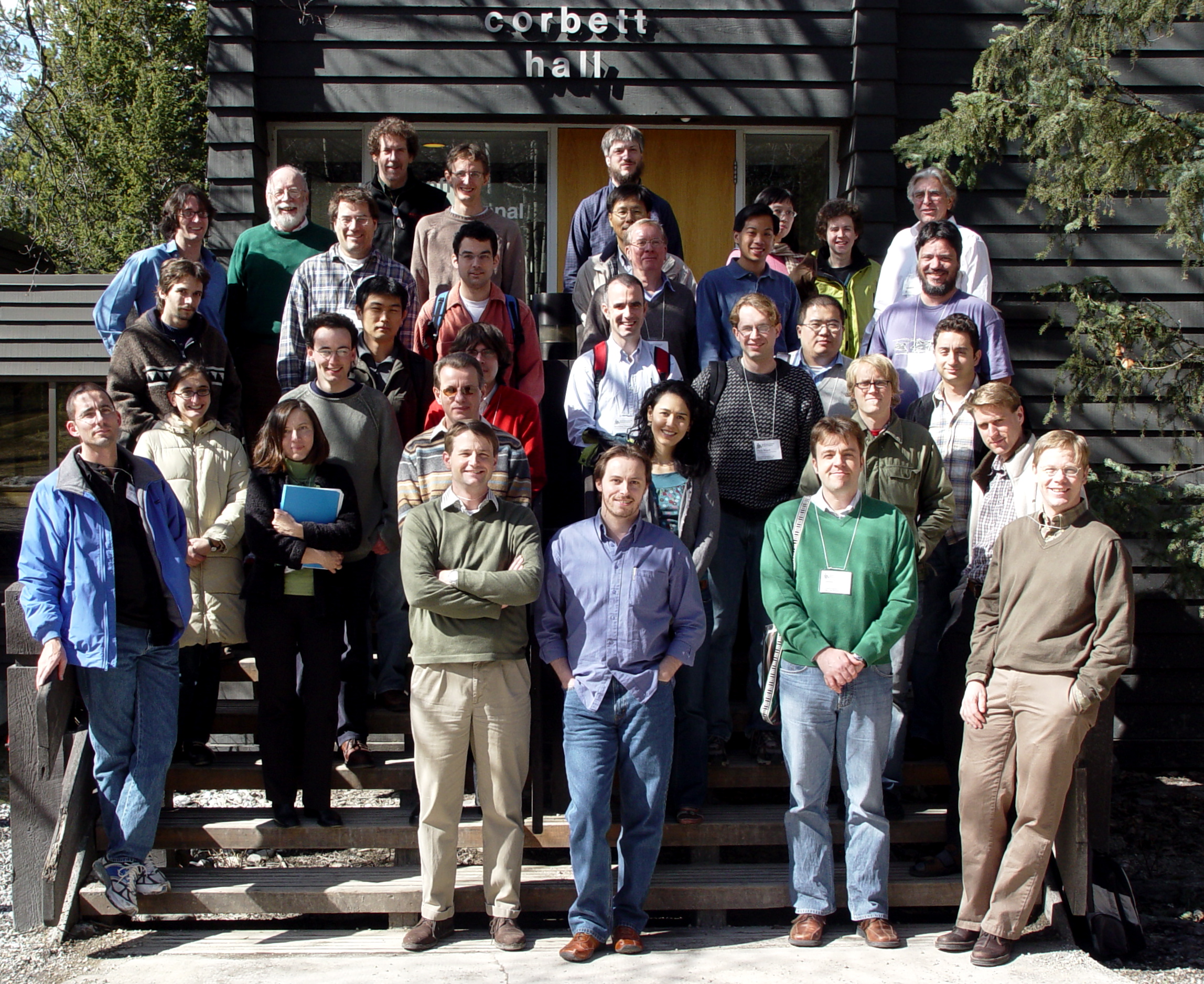
Organizers
Denis Auroux (University of California, Berkeley)
Hans Boden (McMaster University)
Olivier Collin (Université du Quebec à Montréal)
John Etnyre (Georgia Institute of Technology)
Description
An international group of mathematicians will arrive at The Banff Centre next week, March 25 - 30, 2007, where the Banff International Research Station will host a workshop on new results in low-dimensional topology. For topologists, any space with four or fewer dimensions is considered to be low-dimensional. Because high-dimensional space has lots of ``room to move", algebraic techniques can be used to effectively answer many of the fundamental questions in dimensions five and higher. Ironically, in dimensions three and four, including our physical world (space) and Einstein's universe (space-time), these techniques break down and many fundamental questions remain unanswered. For example, four dimensional space supports infinitely many ``exotic" smooth structures, which are self-consistent yet inequivalent ways of interpreting physical laws and understanding particle movement in space-time. The workshop will focus on new discoveries about the shape of space and knotted objects sitting in space. The workshop will feature several talks about new exotic smooth structures on four-manifolds and results on slicing knots. Inspiration for many of these results comes from ideas in mathematical physics such gauge theory, and symplectic and contact geometry. This event is organized by Professors Denis Auroux of Massachusetts Institute of Technology, Hans Boden of McMaster University, Olivier Collin of Université du Québec à Montréal, and John Etnyre of Georgia Institute of Technology.
The Banff International Research Station for Mathematical Innovation and Discovery (BIRS) is a collaborative Canada-US-Mexico venture that provides an environment for creative interaction as well as the exchange of ideas, knowledge, and methods within the Mathematical Sciences, with related disciplines and with industry. The research station is located at The Banff Centre in Alberta and is supported by Canada's Natural Science and Engineering Research Council (NSERC), the US National Science Foundation (NSF), Alberta's Advanced Education and Technology, and Mexico's Consejo Nacional de Ciencia y Tecnología (CONACYT).
The Banff International Research Station for Mathematical Innovation and Discovery (BIRS) is a collaborative Canada-US-Mexico venture that provides an environment for creative interaction as well as the exchange of ideas, knowledge, and methods within the Mathematical Sciences, with related disciplines and with industry. The research station is located at The Banff Centre in Alberta and is supported by Canada's Natural Science and Engineering Research Council (NSERC), the US National Science Foundation (NSF), Alberta's Advanced Education and Technology, and Mexico's Consejo Nacional de Ciencia y Tecnología (CONACYT).