Numerical Analysis of Multiscale Computations (07w5069)
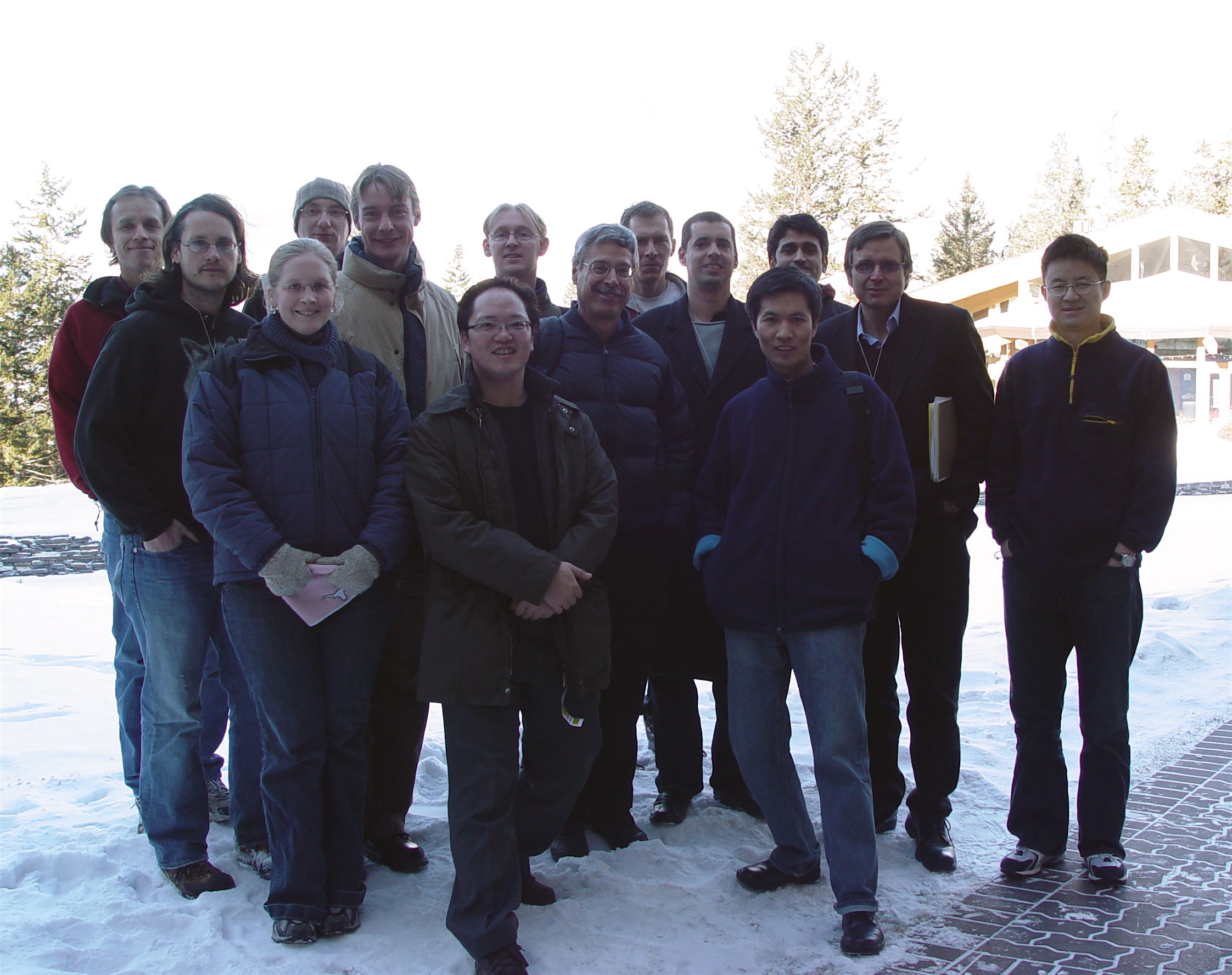
Organizers
Richard Tsai (University of Texas at Austin)
Steve Ruuth (Simon Fraser University)
Bjorn Engquist (University of Texas at Austin)
Olof Runborg (Royal Institute of Technology, Sweden)
Objectives
With the efficiency of modern computers and the maturity of numerical methods for solving differential equations and linear systems, the focus of scientific computation has recently been shifting towards more difficult problems where classical single physics models are not accurate enough, and a coupling of multiple physics models needs to be considered. In particular, there is an emergence of methods that replace heuristics and empirical observations in coarse scale single physics models by direct numerical simulations of more accurate models defined on finer scales. The models describing each scale can be of different types: e.g. PDEs, ODEs, integral equations, or stochastic processes. This workshop will address the numerical analysis of such multiscale approaches.
It is often an impossible task to solve the fine scale equations accurately over the length and time scales of the interesting continuum quantities. The new class of numerical methods typically tackle this difficulty by exploiting separations of scales in the governing physical model. A large class of problems exhibit this separation --- it implies that enough information about the fine scale influence on the coarse scale dynamics can be obtained by performing spatially localized simulations over short times, thus gaining efficiency. The numerical complexity of these methods is therefore much smaller than direct simulation of the full fine scale model. Also other scale structures can be exploited, such as self similarity.
This sort of multiscale approach makes it feasible to treat problems that could not be handled previously and to obtain higher accuracy in the simulation of important physical phenomena. So far the main excitement has been driven by the applications of multiscale mathematical models in applied sciences problems including materials science, chemistry, fluid dynamics, and biology. In this workshop, we are interested in the analysis of the numerical methods motivated by these attempts. Some particular aspects that could be addressed at the workshop are:
1. Under what conditions and in what sense do the multiscale approaches converge (while still having a significantly smaller complexity than that of direct simulation of the fine scale model)? What is the accuracy and what are the stability properties of the methods?
2. Is the coarse system properly closed, i.e. are the chosen coarse variables enough to describe the coarse dynamics that is consistent with the fine scale system? If not, what additional auxiliary coarse variables are needed to close the coarse system?
3. How can we find reasonable coarse models in a systematic way? Can numerical methods be used to automate the process?
These pose challenging computational and analytical problems. Some initial work has been done on Item 1 for some classes of methods, but many open questions remain. Item 2 and 3 have been addressed traditionally by applying empirical rules based on physics, theories developed from mathematical physics, such as statistical mechanics, or by rigorous analytical approaches such as homogenization in simplified settings.