Geometric Inequalities (07w5503)
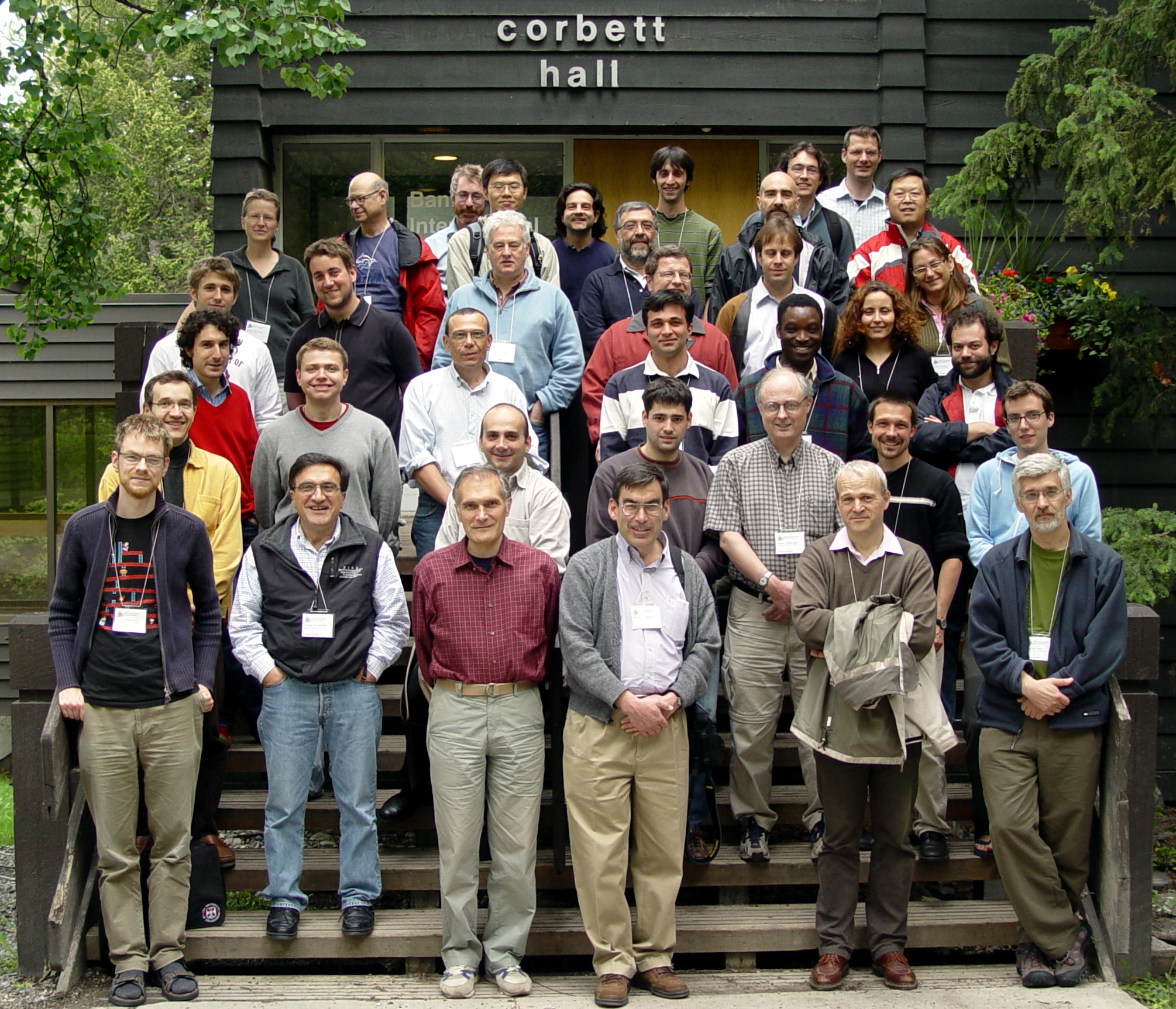
Arriving Sunday, June 17 and departing Friday June 22, 2007

Organizers

Mark Ashbaugh (University of Missouri-Columbia)
Almut Burchard (University of Toronto)
Bernd Kawohl (University of Koeln)
Robert McCann (University of Toronto)

Objectives

The proposed workshop aims to connect mathematicians working on geometric inequalities with each other and with colleagues interested in current and potential applications. For the methods, we will focus on rearrangements, optimal transportation, and nonlinear heat flows. For applications, we will concentrate on a few problems in spectral geometry and statistical mechanics. The possible participants include several subgroups that have worked on closely related problems with different methods, in sometimes with equivalent results. We are also including several experts on geometric eigenvalue inequalities, some researchers interested in applications of optimal transportation to dissipative PDE and statistical mechanics, and a few participants with broader interests in geometric inequalities and geometric flows.

A compelling reason for considering rearrangements, optimal transportation and nonlinear heat flows simultaneously is provided by instances where two, or even all three, have been applied to a given problem or closely related problems, sometimes with equivalent results. Striking example are the generalized Young inequalities on $R^n$ and $S^n$ and the Gagliardo-Nirenberg Sobolev inequalities that were already mentioned above, and a more elementary "Hardy-Littlewood" inequality studied by Brock [2000] and Carlier [2003]. These examples suggest deeper connections waiting to be explored.

The three methods also share an intuitive geometric appeal. A useful property for applications to variational problems is that they demand little a priori regularity, even for the characterization of equality cases. Applying these tools requires no insight into their construction. In particular, though much recent work on rearrangements relies on geometric measure theory, the resulting theorems can be applied naively, and the Brenier-McCann map can be used without expertise in the Monge-Kantorovich theory of optimal transportation. Similarly, heat flows can provide deceptively simple proofs of inequalities; however, finding the right flow can be difficult, and currently no general
construction principle is known.

The proposal is timely, both because of the explosion of interest surrounding the geometric theory of Ricci flow, and because optimal transportation methods are just now becoming accessible to non-experts through Villani's books [2003 and forthcoming, available at www.umpa.ens-lyon.fr/~cvillani). The latter contain entire chapters devoted to geometric inequalities and many geometric results throughout. We expect these books to have an impact at least comparable to the impact that the books by Kawohl [1985] and Lieb and Loss [1997] have had on rearrangements: a specialists' tool becomes available to every working analyst and even to graduate students. The expositions of Perelman's work by Cao and Zhu, Kleiner and Lott, and Morgan and Tian will have a similar effect on the theory of Ricci flows. A meeting between experts in optimal transportation, rearrangements, and geometric analysis is long overdue. Arguably, rearrangements are just particular transportation plans, but the connection with optimal transportation has yet to be made explicit and put to use. For
instance, to our knowledge, optimal transportation methods have not been used in spectral geometry. Connections with the theory of Ricci curvature and Ricci flow, especially in non-smooth settings, have begun to emerge in preprints by Lott and Villani, Sturm, and Topping and McCann, while potential applications for geometric inequalities in statistical mechanics are emerging. The field is ripe for a successful meeting to accelerate the rate of progress and have a lasting impact on new directions for future research.