Topological Methods for Aperiodic Tilings (08w5044)
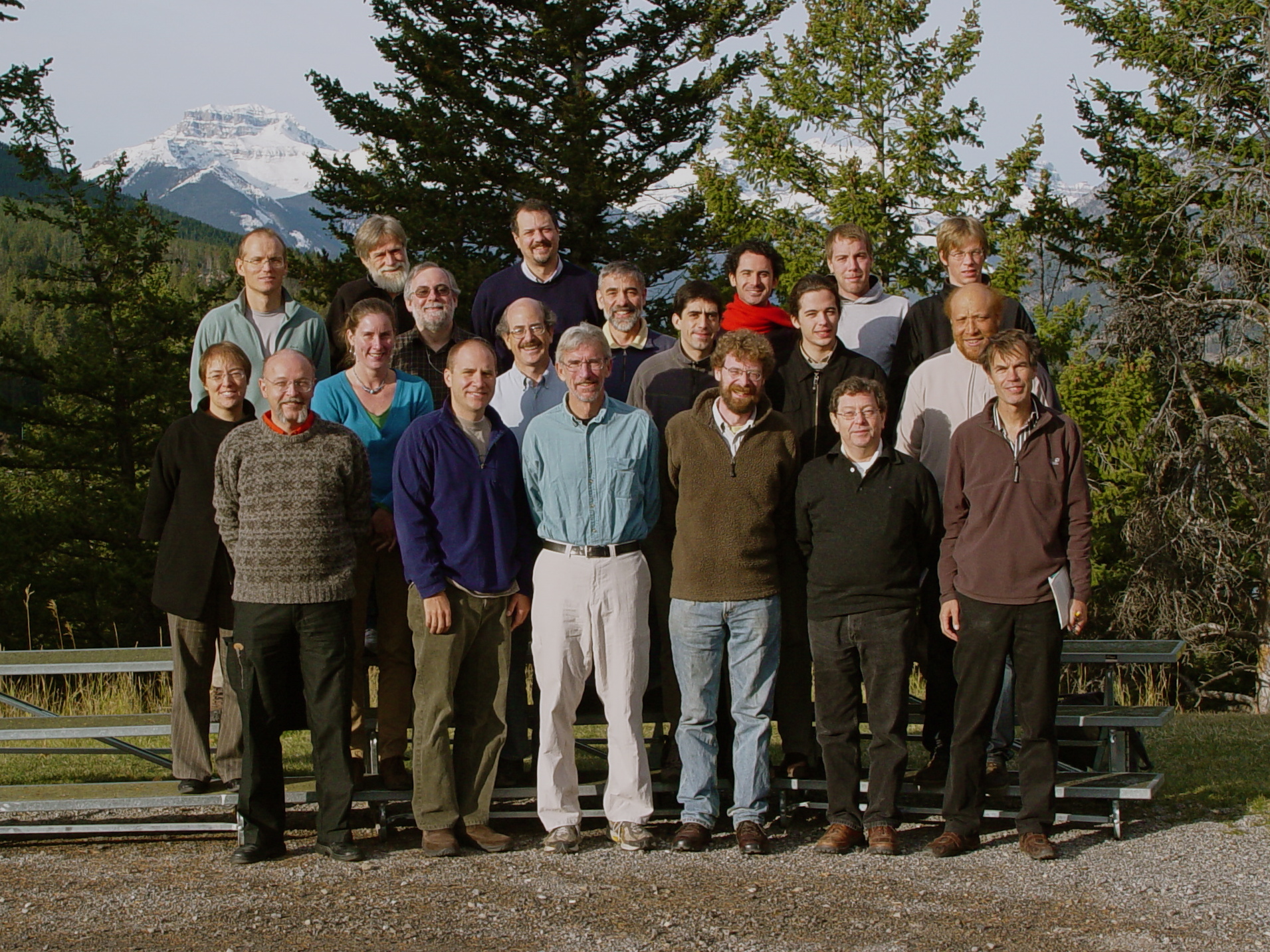
Arriving Sunday, October 12 and departing Friday October 17, 2008

Organizers

Ian Putnam (University of Victoria)
Lorenzo Sadun (University of Texas at Austin)

Objectives

The 2005 FRG on Topological Techniques in Aperiodic Tilings was a phenomenal success. Indeed, many of the advances mentioned above, in which ``wild" tilings came to be understood, were a direct result of that meeting. The 2008 half-workshop is intended as a successor meeting, involving many of the same researchers, to take the next step.

This workshop is NOT intended as a regular conference in which each participant expounds on his or her latest results. Instead, emphasis will be placed on proposing open problems, explaining useful techniques and exploring connections to other fields. Talks will be open-ended. (In 2005, talks scheduled for one hour frequently ran for three, as participants asked questions, proposed ideas, and pursued new directions.) Time will be set aside for participants to break into smaller groups and tackle problems.

The biggest problem we aim to address is one that was only partially answered in 2005: what does tiling cohomology (i.e., the Cech cohomology of the continuous hull of a tiling) really mean?

As noted in our 2005 proposal, the information contained in the cohomology of the hull of an aperiodic tiling is not well understood. For completely periodic systems, the homology (or cohomology) of the hull encodes the periodicity. For aperiodic structures, the homology becomes trivial, but there is a sense in which the ``almost periodicity" is measured by the cohomology. We are still very far from understanding the exact meaning of this.


The connections with C*-algebra theory (a.k.a. non-commutative geometry) have had a large impact on this subject. Indeed, the first realization and computation of the cohomology of the hull as an invariant was in the context of computing the K-theory of the C*-algebras. Important insights have been gained from this viewpoint. As a concrete example, the proof of the gap-labeling theorem given by Benameur and Oyono-Oyono relied on cyclic cohomology. Indeed, all the proofs used Connes index theorem for foliated spaces in a critical way. However, the tools of non-commutative geometry have reached a stage where deeper connections should be developed. In particular, this should help connect conventional topological aspects with applications in physics.

There are several approaches to computing and understanding tiling cohomology. Some utilize inverse limit structures (Anderson-Putnam, Bellissard-Benedetti-Gambaudo, Gahler, Sadun). Others study the geometry of the ``atomic surface" for projection tilings (Forest-Hunton-Kellendonk, Gahler). Kellendonk and Putnam proposed a notion of ``pattern-equivariant cohomology" that expresses the (real) cohomology of the hull in terms of differential forms on a particular tiling. Sadun extended this to integer-valued cohomology, and Rand and Kellendonk each extended the definitions to capture the rotational properties of tilings.


These advances have considerable overlap. By bringing the authors of these advances together in one place, we hope (and, based on our 2005 experience, expect) to achieve breakthroughs. Writing in 2006, it is impossible to predict exactly where these breakthroughs will come; the problems we write down today are likely to be solved by 2008, and still more interesting problems will arise! However, here is a sample of the objectives we might hope for if the meeting were to be held this year.

Barge and Diamond have developed subtle invariants and sophisticated calculational techniques for 1- dimensional substitution tilings. Some of these are intrinsically 1- dimensional, but we can reasonably expect to extend others to higher dimensions.

Little is known about the functorial properties of tiling cohomology, and the possibility of developing surgery formulas. If two tiling spaces X and Y are closely related, with a factor map $f: X to Y$ that is 1:1 almost everywhere and finite:1 over a thin set, what information about the map $f$, the cohomology of Y, and the geometry of the thin set is needed to compute the cohomology of Y? Barge, Diamond, Hunton and Sadun have produced partial answers that address the situation when the thin set is the product of a lower-dimensional tiling space and Euclidean space, but much more needs to be done to understand the problem in general.

Kellendonk and Rand have each defined cohomology theories for pinwheel-like tilings that have tiles pointing in an infinite number of different directions, but we have yet to compute the cohomology of a single space of this type. This lack of worked examples needs to be corrected! Recently, Gahler, Hunton and Kellendonk discovered that the cohomology of some tiling spaces have torsion. An explanation or interpretation of these torsion terms awaits.