Spectral Methods in Representation Theory of Algebras and Applications to the Study of Rings of Singularities (08w5060)
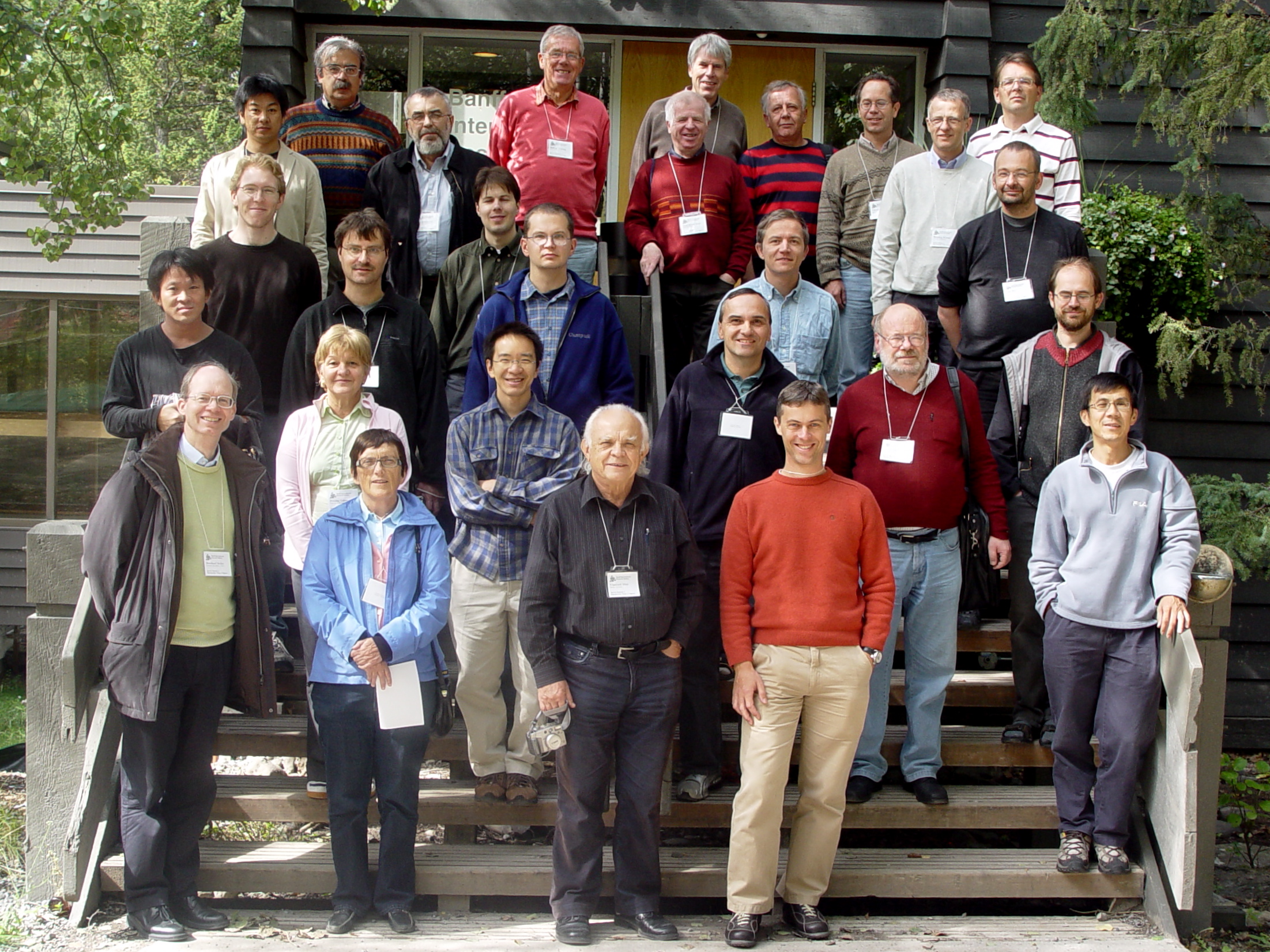
Arriving Sunday, September 7 and departing Friday September 12, 2008

Organizers

Vlastimil Dlab (Carleton University)
Helmut Lenzing (University of Paderborn)
Jose Antonio de la Pena (Universidad Nacional Autonoma de Mexico)

Objectives

The proposed Workshop intends to explore recent developments in the study of Coxeter polynomials and its applications taking into account the following directions:

bigskip
{bf 1. Spectral theory.} Let $A= k Delta$ be an algebra associated to a finite connected quiver without oriented cycles. A fundamental fact in Representation Theory of Algebras is the distinction of the representation type of an algebra A: it is {it representation-finite} exactly when the underlying graph $| Delta |$ of $Delta$ is of Dynkin type; $A$ is tame (that is, for every $d$, the indecomposable $d$-dimensional $A$-modules may be classified in a finite number of one-parameter families of modules) exactly when $| Delta|$ is of {it extended Dynkin type}; in the remaining cases $A$ is {it wild} (that is, the representation theory of $A$ includes the representation theory of the algebra of polynomials in two non-commutative variables). The algebra $A$ is wild exactly when the spectral radius $rho_A$ is bigger than 1, in that case, $rho_A$ is a simple root of $f_A$.

medskip
For a one-point extension $A=B[P]$ with $P$ an indecomposable projective $B$-module associated to a source $b$ of $Delta$, the Coxeter polynomials are related by $f_A(T) = (1 + T) f_B(T) -T f_C(T)$, where $C$ is the quotient of $B$ obtained by killing the extension vertex $b$. Such formulas allow the inductive calculation of Coxeter polynomials of tree algebras and obtain important relations between the spectra of $A$ and $B$.

bigskip
{bf 2. Representation theory of algebras and sheaves.} {it Canonical algebras } $C=C(p,lambda)$ depend on a weight sequence $p=(p_1,...p_t)$ of positive integers and a parameter sequence $lambda =(lambda_3,...,lambda_t)$ of pairwise distinct non-zero elements from the base field $k$. The finite dimensional representation theory of $text{mod}(C)$ is completely controlled by the category $text{coh} (bf{X})$ of coherent sheaves on a non-singular weighted projective line $bf{X}= bf{X}(p,lambda)$, since the bounded derived categories of $text{coh} (bf{X})$ and of $text{mod}(C)$ are equivalent as triangulated categories. The representation type of $C$ is determined by the genus $g_{bf{X}}=1 + frac{1}{2} ((t-2)p - sum p/p_i)$, where $p= l.c.m.(p_1,...,p_t)$. For $g_{bf{X}}=1$, the algebra $C$ is of tubular type, and then the classification problem for $text{coh} (bf{X})$ relates to Atiyah's classification of vector bundles over an elliptic curve.

medskip
For hereditary algebras and canonical algebras $A$ of wild type it is known that the spectral radius $rho_A$ controls the growth of the sequences of dimension of the modules in the Auslander-Reiten orbit $tau_A^n (X)$ ($n in bf{Z}$) of an indecomposable regular module $X$.

bigskip
{bf 3. Surface and Fuchsian singularities.} The link between tame hereditary algebras and simple surface singularities has been known for some time. The link is formally established through the analysis of the behavior of the Auslander-Reiten translation of hereditary algebras. More generally:

medskip
Consider the Auslander-Reiten translation $tau_A$ in the category of finite dimensional $A$-modules and $P$ an indecomposable projective $A$-module. In case $A$ is not representation-finite, we get a well-defined $bf{N}$-graded algebra

$$ R(A,P)=sum_{n=0}^{infty} text{Hom}_A(P,tau_A^{-n}P). $$

For $A={bf C} tilde{Delta}$ a tame hereditary algebra, the algebra $R(A,P)$ is isomorphic to the algebra of invariants ${bf C}[x,y]^G$, where $G subset SL(2,bf{C})$ is a binary polyhedral group of type $Delta$. Accordingly the completion of the graded algebra $R(A,P)$ is isomorphic to a {it surface singularity} of type ${Delta}$. Assuming that $C$ is a canonical algebra of wild representation type a similar construction yields an algebra $R(A,P)$ that is isomorphic to the algebra of entire automorphic forms associated to the action of a suitable {it Fuchsian group} of the first kind, acting on the upper half plane $mathbb{H}_+$.

bigskip
{bf 4. Lie algebras.} {it The Weyl group} $W(Delta)$ associated to the quiver $Delta$ is the subgroup of $GL(R^n)$ generated by the reflections $R_1,...,R_n$ relative to the canonical basis of $R^n$. For $Delta$ of Dynkin type the Weyl group is finite, for $Delta$ of extended Dynkin type, the group $W(Delta)$ is a semidirect product of a finite Weyl group and an infinite abelian group, in the wild case the Weyl group contains a non-abelian free subgroup.

bigskip
{bf 5. Strange duality and mirror symmetries.} The 14 exceptional unimodal hypersurface singularities and the singularities involved in the extension of {it Arnold's strange duality} are examples of Fuchsian singularities. In all those cases, the graded rings associated to the singularities are of the form $R(C,P)$ for a canonical algebra $C$ and an indecomposable projective $C$-module $P$, such that the one-point extension $A=C[P]$ is an extended canonical algebra with spectral radius $rho_A = 1$. There is an interesting relationship between the bounded derived category of $C[P]$ and the triangulated category of singularities (a la Bondal) of the graded algebra $R(C[P])$. Further a duality defined by Saito between cyclotomic polynomials extends to the Coxeter polynomials of the extended canonical algebras yielding Arnold's strange duality between the corresponding singularities. It is well-known that Arnold's strange duality is related to the {it mirror symmetry} of K3-surfaces.

bigskip
There have also been extensive studies of bounds for the spectral radii of the Coxeter transformations for particular classes of valued graphs. These studies lead to development of methods for construction of new classes of interesting algebraic integers, such as Salem, P-V and Perron numbers, that appear naturally as geometric invariants in low-dimensional topology. They have also resulted in effective descriptions of location of the zeroes of reciprocal polynomials.

A comprehensive exposition entitled ``Notes on Coxeter Transformations and the McKay correspondence' with an extensive bibliography on some recent developments related to the concept of a Coxeter transformation has been written by Rafael Stekolshchik, and in an extended version coauthored by Dimitry Leites (as Preprint Nr. 80/2006 of the Max Planck Institute for Mathematics in the Sciences in Leipzig) submitted for publication to Springer. Their presentation underlines not only great importance of the recent developments, but also timeliness for organizing a Workshop devoted to these topics.

{Addendum August 2008}: The book by R. Stekolshchik has meanwhile been published (Springer). For additional information on spectral methods in representation theory and applications to surface singularities we mention further the survey paper by H. Lenzing and J.A. de la Pe~{n}a entitled ``Spectral analysis of finite dimensional algebras and singularities'', texttt{arXiv:math.RT.0805.1019} and the literature quoted there.
end{document}