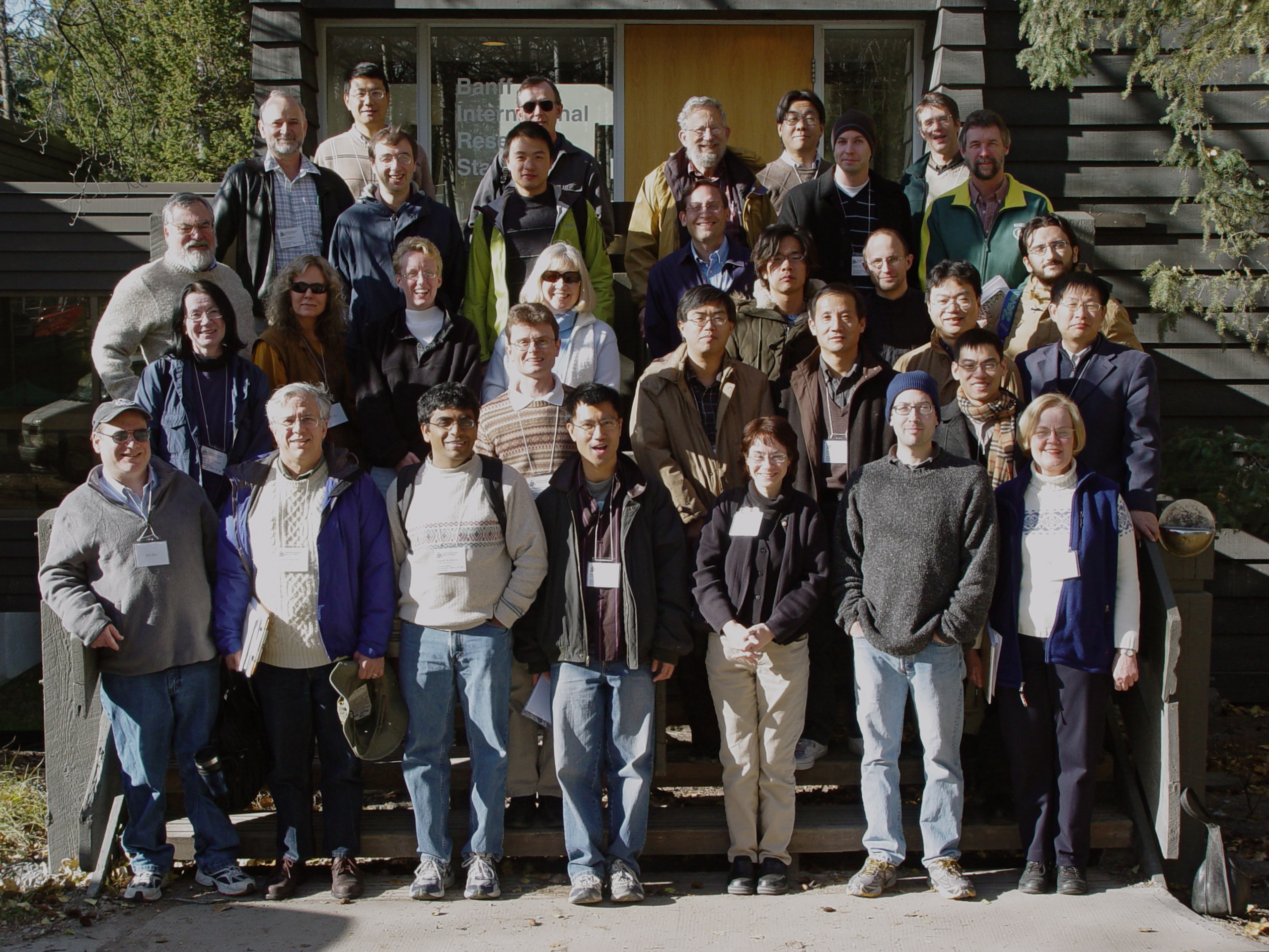
Interactions Between Noncommutative Algebra and Algebraic Geometry (08w5072)

Arriving Sunday, October 26 and departing Friday October 31, 2008

Organizers

Colin Ingalls (University of New Brunswick)
Michael Artin (Massachusetts Institute of Technology)
Lance Small (University of California, San Diego)
James Zhang (University of Washington)

Objectives

The main theme of this workshop is the interplay between noncommutative algebra and algebraic geometry. An important goal is to bring together researchers who use geometric and/or homological methods in different areas of noncommutative algebra (including representation theory of algebras) and algebraic geometers who have an interest in non-commutative phenomena, in order to encourage their interaction and collaboration. This workshop would provide a useful follow-up to a 5-day workshop at Oberwolfach in May 2006, and the 5-day BIRS workshop ``Interaction between noncommutative algebra and algebraic geometry" in September 2005. We intend to have a mix of more algebraically and more geometrically inclined participants (and lecturers). Given the fast pace of research in this area, and the growing number of mathematicians working in it, we expect the proposed workshop to be significantly different from these earlier meetings. We will now describe some of the topics that will be
discussed at the workshop.

(a) Central Simple Algebras and Brauer groups.
The study of central simple algebras was initiated by Wedderburn, Albert and Brauer at the beginning of the 20th century. These algebras, and the closely related notion of the Brauer group of a field, play an important role in several areas of mathematics, such as algebraic geometry, the theory of algebraic groups, algebraic number theory and algebraic $K$-theory. A recurring theme in this area is the use of algebro-geometric techniques, usually via the notion of ramification. Recently Saltman and Krashen has used intersection theory to settle previously unknown cases of Amitsur's conjecture about birational isomorphisms of central simple algebras. Reichstein and Vonessen have used techniques from birational invariant theory to study algebraic group actions on central simple algebras.

(b) Non-commutative Surfaces.
Following work of Artin, Chan, de Jong and Ingalls, there are has been much development of the theory of non-commutative surfaces that are finite over their centers. Large areas of the theory of surfaces have been extended to this case. The birational theory of existence and uniqueness of minimal models was extended by Chan and Ingalls, using ideas of Mori's minimal model program. The study of moduli of vector bundles on surfaces has been extended by Artin and de Jong, yielding results such as a generalization of Bogomolov's inequality and de Jong's exponent equals index theorem (see above). Current work on the explicit construction of del Pezzo and ruled models will yield workable interesting examples. This area has applications to higher dimensional algebraic geometry, in particular the study of threefold conic bundles. An important open problem in threefold geometry is Iskovskih's conjecture on the rationality of conic bundles. Noncommutative surfaces are providing new
methods and results on the study of this difficult conjecture. In particular, Hacking has exhibited local models for terminal conic bundles whose effective threshold is two. Corti suggested the study of these conic bundles as part of a program to attach Iskovskih's conjecture.

(c) Stacks and Mirror Symmetry
Ingalls and Chan defined a noncommutative coordinate ring associated to a Deligne-Mumford stack with a finite flat scheme cover, using the ideas of Connes' noncommutative geometry. This has been extended to the case of Artin stacks by Behrend. Smith has defined a extension of the Cox ring of a toric variety to a Cox ring of a stacky toric variety. Objects such as these often appear in the context of mirror symmetry. In fact, mirrors with non-trivial B-fields can often be modeled by noncommutative varieties. These can be constructed as a component of the category of sheaves on a stack where a generic stabilizer acts with a fixed character. Since the monoidal structure given by tensor product is removed by taking this component it is natural to model it with a noncommutative variety. Also, the study of local noncommutative Calabi-Yau varieties translates into the study of regular three dimensional local Koszul algebras, and yields interesting interactions. Known regular g
raded algebras of dimension three provide examples of such local Calabi-Yau manifolds, and mirror symmetry provides interesting algebraic questions.

(d) Infinite Dimensional Division Algebras.
The study of infinite dimensional division algebras is, compared with the finite dimensional case, much less well-developed. These algebras arise naturally as the quotient division rings of Ore domains like the Weyl algebras, enveloping algebras, etc. Resco, twenty-five years ago, found the transcendence degrees of the maximal subfields of the Weyl division rings and his approach has recently been extended in work of Yekutieli and Zhang. Their work lays the foundations for an appropriately ``noncommutative" transcendence degree. Moreover, they raise interesting questions as to when tensor products of division rings with themselves remain noetherian and when extending the base field preserves ``noetherianity." Other questions of interest focus on the subfield structure of various division ring, for example, are the all the maximal subfields of the division ring of quotients of the quantum plane purely transcendental? This is NOT the case for the Weyl division rings as
a famous example of Dixmier shows. Another interesting question has to do with the minimal number of generators for a division algebra. For finite-dimensional algebras this number has been described by Reichstein, building on earlier work of Procesi. The infinite-dimensional case is still open.

(e) Derived Categories and Algebraic Geometry:
Derived Categories are becoming a fundamental invariant in algebraic geometry. There are many examples of rational varieties who share their derived category with representations of a noncommutative finite dimensional algebra. This is true for many toric varieties. Also, semiorthogonal decompositions of derived categories of varieties may have components which are naturally equivalent to the triangulated category of modules over a noncommutative variety. This is a natural way to study orthogonal components that arise, for example, as the left perpendicular of a Mori fiber space contraction. Hence, once one studies the structure of derived categories of commutative varieties, noncommutative structures appear naturally. Bridgeland and Roquier have recently done pioneering work with derived categories and have defined subtle invariants of triangulated categories. Bridgeland's stability manifolds have rich structure and yields connections with mirror symmetry. Roquier's dim
ension is not easy to compute and is related to the difficult problem of showing a tilting object generates the derived category. An analysis and understanding of these new invariants will yield invaluable information about triangulated categories.

(f) Cluster Categories:
An exciting new development in the theory of representations of finite dimensional algebras is the study of cluster categories started by Buan, Marsh, Reineke, Reiten and Todorov. The combinatorics of clusters is shown to be tightly related to tilting objects in a triangulated category which is a Calabi-Yau quotient (orbit category) of the derived category of the path algebra of a quiver. Clusters, developed by Fomin and Zelevinsky, are a rapidly developing area of algebraic combinatorics. Clusters are appearing in many areas and may eventually provide enrichment to many objects classified by ADE Dynkin diagrams. There have been many questions in algebra motivated by the study of cluster categories, and the study of representations of finite dimensional algebras has provided results in cluster combinatorics. This new interaction is currently very active and more results in this area are sure to follow.

(g) Dualizing complexes over noncommutative algebras and spaces:
Since its introduction in 1992 by Yekutieli, the noncommutative version of the dualizing complex has been becoming a standard and powerful homological tool. There have been a lot of applications in noncommutative algebra. In the noncommutative setting, Van den Bergh introduced the rigid dualizing complex which has many functorial properties. A recent work of Yekutieli and Zhang showed a new approach to Grothendieck duality over commutative rings/schemes. By using rigid dualizing complexes, many of the important features of Grothendieck duality were obtained, yet most of lengthy and difficult compatibility verifications were avoid. There is not theory of Grothendieck duality for stacks so far. The theory of rigid dualizing complexes and perverse coherent sheaves should be useful to develop such a theory for algebraic stacks.

(h) Regular Algebras of Dimension four:
Regular algebras of dimension three were classified by Artin, Tate, Schelter and Van den Bergh, and the resulting algebras have appeared in many contexts. There has been many recent developments in the problem of classification of regular algebras of dimension four, or quantizations of projective three space. Certain classes of algebras have been classified by Lu, Palmieri, Wu and Zhang by using a new technique involving the A-infinity Koszul Dual. Explicit computations of this fairly abstract structure have yielded interesting new objects and solved certain parts of the classification problem. Also, ongoing projects of Shelton, Stephenson, and Vancliff are aimed at the study of potentially the largest class of regular algebras of dimension four. It is likely that these new algebras will play just as an important role as the three dimensional algebras.