Mathematical and Numerical Methods for Free Energy Calculations in Molecular Systems (08w5074)
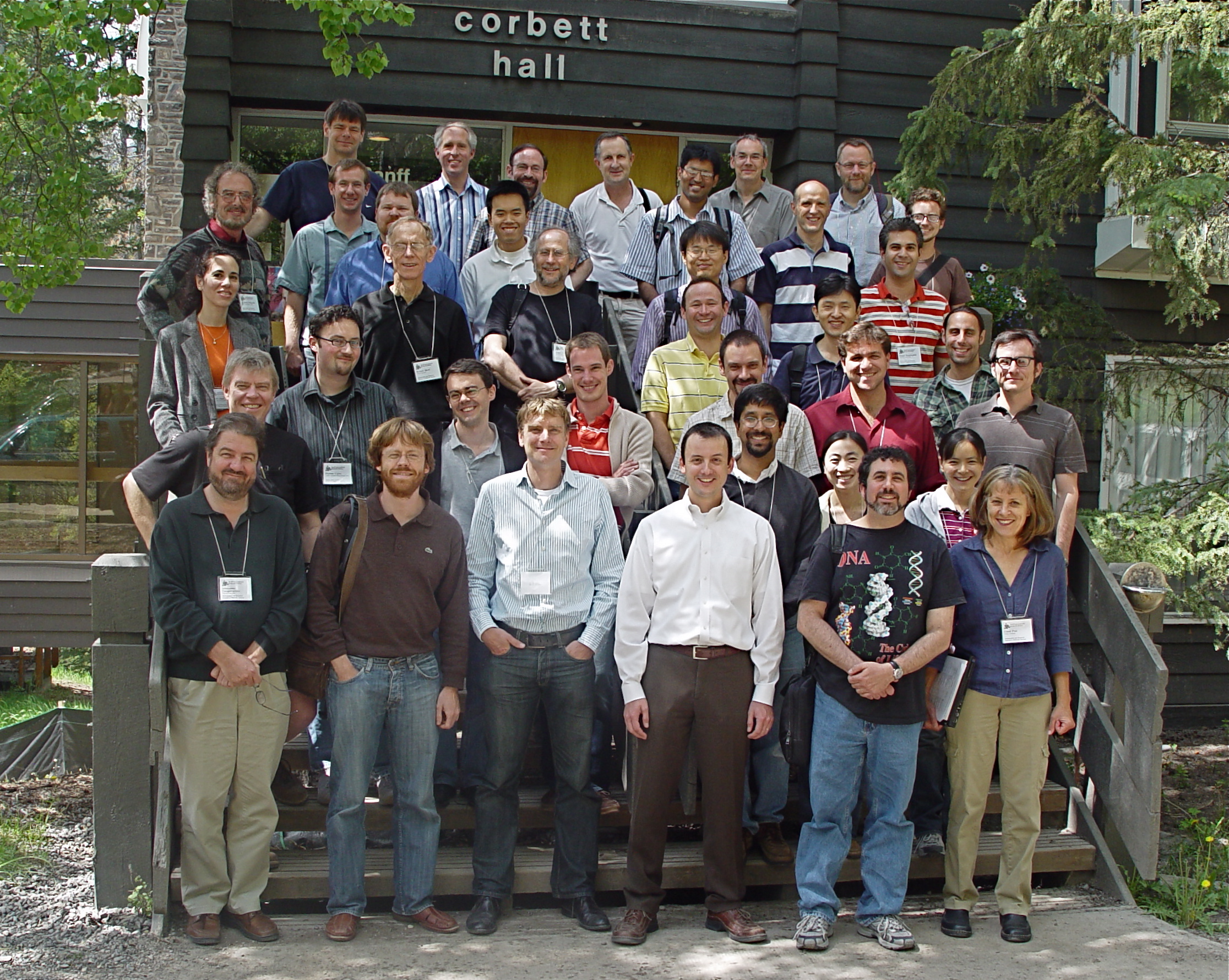
Arriving Sunday, June 15 and departing Friday June 20, 2008

Organizers

Chris Chipot (University of Illinois, Urbana-Champaign)
Eric Darve (Stanford University)

Objectives

We are proposing 5 thrusts, one for each day of the workshop.

Thrust 1: symplectic integrators for improved molecular dynamics
simulations. It is now well established that symplectic integrators
are among the best integrators for molecular dynamics as they
accurately preserve the energy of the system and produce accurate
statistics over long time scales. E. Hairer and others (notably R.
Skeel and J. Izaguirre) have shown that this could be proved
mathematically by considering modified or shadow Hamiltonians of order
N, H^N_h, such that the discrete numerical solution with time step h
coincides nearly exactly with the exact trajectory with H_h^N. However
many issues remain open such as: how can high-order modified
Hamiltonians be numerically computed? Can they be used to study the
stability of numerical methods for non-linear differential equations?

Thrust 2: non-equilibrium methods for equilibrium free energy
calculations. C. Jarzynski recently proposed a new equality to
calculate the equilibrium free energy difference between system A and
B based on non-equilibrium simulations where the system is switched at
constant speed from A to B. Previous methods such as slow growth only
converge when the switching speed is very small, which is
computationally very expensive in some cases. In contrast, Jarzynski's
equality holds for an arbitrary switching speed. However, detailed
mathematical analyses have revealed that in its current implementation
this approach often suffers from a large statistical error.
Consequently, several research questions remain open, such as: what is
the optimal choice of parameters which will minimize this error? Are
there cases in which this approach can be shown to be superior to
equilibrium approaches? How can forward and backward switching
trajectories be used to improve its efficiency?

Thrust 3: Error analysis, estimation of accuracy and modeling of the
density of states. Despite the fact that methods to compute free
energy have been around for decades, the reliability and efficiency of
the approaches have not been considered in depth. A fundamental
understanding of a free energy method's behavior is important not only
for simulation practice but also for the development of new
methodologies and comparison among methodologies. This thrust will
attempt to address the following questions: what are the statistical
error and/or systematic bias of a free energy method? How can the
efficiency and reliability be improved? How is it possible to assess
the quality of a computation when the true answer is unknown?

Thrust 4: Methods for enhanced ergodic sampling. One of the most
important problems faced by free energy calculations is the existence
of a broad range of energy barriers at multiple scales, both lower and
higher than thermal energy. All calculations rely on the assumption
that during the short time span of the simulation, the time average is
close to the thermodynamic ensemble average. In many cases, as a
result of the finite sampling, this assumption is broken and various
regions of the conformational space become disconnected and the system
gets trapped in metastable regions. It is therefore imperative to
design methods which increase the rate of conformational sampling in
such situations.

Thrust 5: Transition path sampling, ordering parameters v. reaction
coordinates. Many important physical, chemical or biological processes
occur on time scales that exceed those accessible by direct
simulation. One approach to deal with this issue is to select a
putative reaction coordinate from which free energy and related
quantities can be obtained. In contrast, the transition path sampling
method is a reaction coordinate-free method in which the ensemble of
transition pathways is sampled using a Monte Carlo procedure. One
obtains a set of dynamical pathways which can then be further analyzed
to obtain information about the reaction mechanism. An interesting
avenue of research is the application of transition pathway techniques
to the non-equilibrium method of C. Jarzynski (see above). In
particular, biased path sampling techniques can overcome some of the
shortcomings of Jarzynski's method. Whether such an approach can yield
a technique competitive with other free energy methods is an open
question of current research.

The focus of the proposed workshop is clearly mathematical and
numerical in nature. Contributions are expected to be presented from a
theoretical perspective, rather than a mere application of an already
well-established and characterized approach. The goal of the workshop
is to provide a much clearer view on the range of applicability of
free energy methods and on their inherent limitations. It is expected
that the workshop will lead to new mathematical insights and methods,
making free energy calculation an important tool for scientific
discovery and allowing computer simulations to keep pace with rapidly
developing experimental methods.