Topics in Von Neumann Algebras (08w5093)
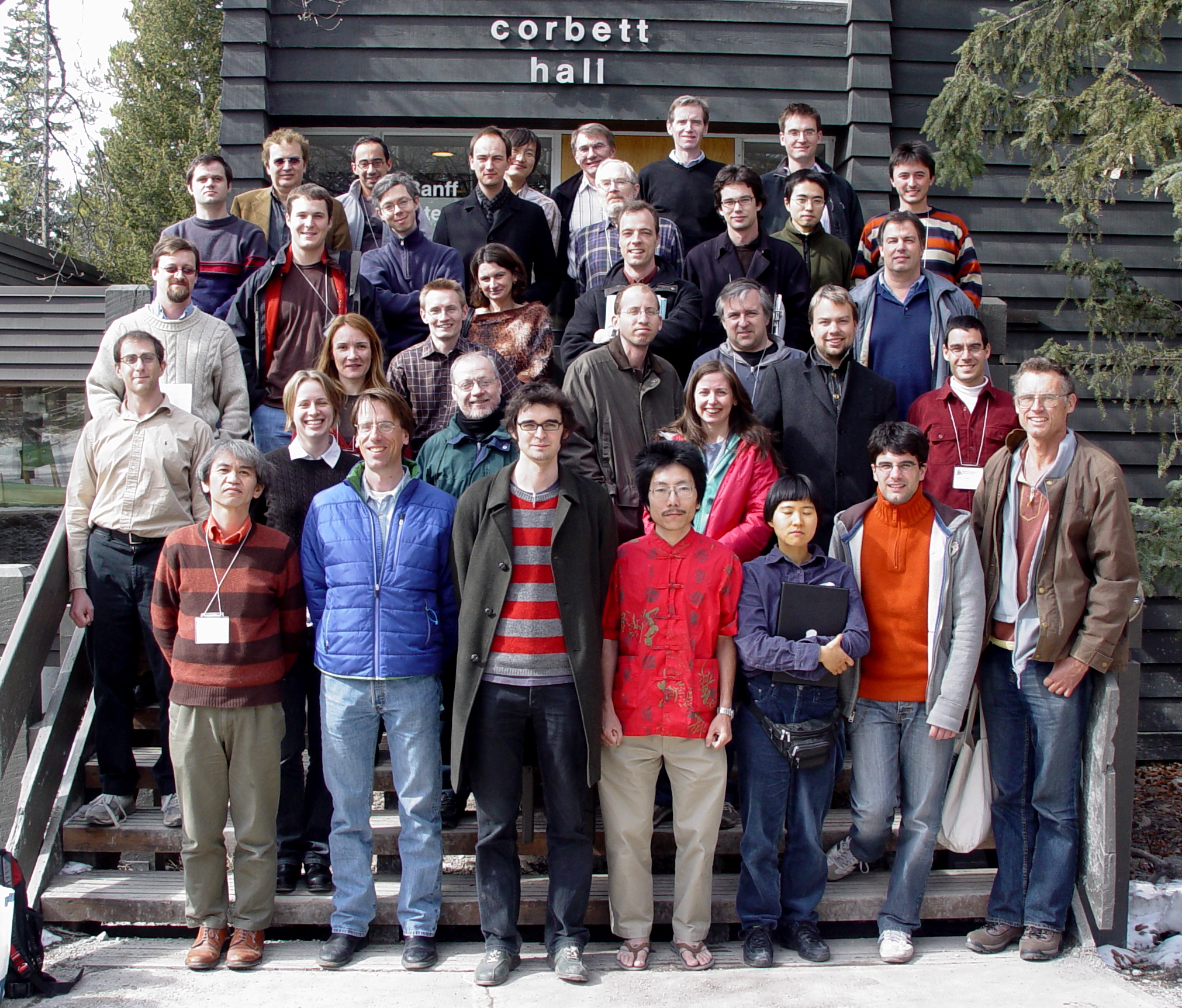
Arriving Sunday, March 23 and departing Friday March 28, 2008

Organizers

Juliana Erlijman (University of Regina)
Hans Wenzl (University of California, San Diego)

Objectives

noindent Our workshop is intended to be a follow-up to the recent successful workshop on von Neumann algebras at the Banff Center. As with the previous workshop, emphasis will be given to active areas in the theory of von Neumann algebras with connections to other fields as well as to these areas themselves. In the recent workshop, we had, besides almost all the leaders in von Neumann algebras, also representatives from goup theory, quantum computing and conformal field theory. The new workshop would follow the same pattern. This time we would also try to include other fields with interesting connections such as topology, which were absent for technical reasons, and we are planning to take into consideration recent developments within von Neumann algebras. This will be discussed in more detail below.

smallskip

noindent {it (I) Comments on achieved goals at the first workshop in 2006:}

smallskip

noindent The first BIRS 5-day workshop `Topics on von Neumann Algebras' that we organized and just ended (September 16-21, 2006) was a tremendous success. Among the participants were one Fields medalist (Jones), two speakers who gave plenary talks at an ICM (Haagerup (2002) and Popa (2006)), and five additional mathematicians who have given invited addresses at ICMs, with two of them at the recent one in 2006 (Ozawa and Monod). Besides these and other well established experts in von Neumann algebras and related fields, there were also many younger participants who had the opportunity to interact with these leaders. Participants expressed in numerous occasions that the workshop was very stimulating and allowed for fruitful discussions and beginnings and conclusions of joint projects. We are glad that the objectives for this workshop were fulfilled, and that they even surpassed our own expectations.

smallskip

noindent We are now working on the report, which is not included here in this proposal, but will be available within the 10-week deadline. There is a general consensus among both the top experts and younger participants that attended this meeting that it is worth organizing another one for the year 2008. We would like to include some of the participants comments that were sent to us:

smallskip

noindent -{it Fred Goodman, The University of Iowa:} ``The theory of von Neumann algebras has seen remarkable, even revolutionary, developments in each of the last several decades in the 70's there was the modular theory of Tomita and Connes's classification of injective factors, in the 80's the subfactor theory of Jones, in the 90's Voiculescu's free probability theory, and in the last five years a renewal of the connection with ergodic theory by Popa, with remarkable consequences for examples of II$_1$ factors. The 2006 Banff conference was scientifically excellent. The organizers managed to attract leaders of the most important developments in the theory. The prospects for another conference in two years are promising. The work of Popa and his school continues to develop at a high speed, while other trends in the theory such as subfactors, free probability, and connections with quantum theory continue to develop, although at a less spectacular pace."

smallskip

noindent -{it Pinchas Grossman, Vanderbilt University:} ``This conference was unique among among those I have been to in having such a strong representation of so many different areas within von Neumann Algebras. I enjoyed the thematic programming in which one could hear each day several related talks on topics such as group von Neumann algebras, free probability, subfactors and planar
algebras and algebraic quantum field theory. As a beginning postdoc, it was eye-opening to see what sorts of problems researchers in the field currently find of interest, and how the various subfields of von Neumann algebras are interrelated. The conference also provided a great opportunity to get to know operator algebraists from around the world. The many interesting talks made clear that von Neumann algebras remains a very active, vibrant and changing field, and it would certainly be excellent to have another meeting soon."

smallskip

noindent -{it Vaughan Jones, University of California, Berkeley:} In his final speech at the closure of the workshop he stated he wanted to be back again at BIRS for such a workshop.

smallskip

noindent -{it Nicolas Monod, University of Geneva:} ``The workshop was especially constructive for me because my research comes from a quite different area of mathematics, yet has evolved to address questions directly related to von Neumann algebras (such as orbit equivalence in ergodic theory). Moreover, my background in geometric group theory and rigidity fits well within one of the current trends in the study of type II$_1$ factors. More specifically, I am expecting to be able to collaborate with e.g. Ozawa in order to study the von Neumann algebras associated to arithmetic groups. I would be thrilled to continue in that direction on the occasion of a similar workshop in the future."

smallskip

noindent -{it V.S. Sunder:} ``I just wanted to put it down, for the record, that the meeting on von Neumann algebras which you and Hans organised at Banff last week was: (a) splendidly and seamlessly organised; (b) the no. of lectures was not too much and it was just right; (c) the level of the talks could not have been much better -- with the different days focused in the different directions -- dynamical systems, subfactors, free probability, and conformal field theory. Of course it could have been that much better if people like Voiculescu and Radulescu had come. Maybe that is reason enough to organise another workshop like this at BIRS."

bigskip

noindent {it (II) Importance and timeliness to organize a second workshop `Topics in von Neumann algebras' during the year 2008:}

smallskip

noindent As mentioned above, the first workshop in 2006 was a success. This workshop was unique in the sense that there have not been many instances of a general conference on von Neumann algebras with experts from interacting areas. There were only two other meetings of this nature in the last eight years: One during the special year on operator algebras at MSRI in 2000/2001, and another meeting in the year 2004 at CIRM, Marseille, France in which specialists in von Neumann algebras met with experts in group theory and topology. Our 2006 workshop workshop helped fill this gap and another one in 2008 will further continue the progress. As well, the location is ideal for the many researchers in North America.

smallskip

noindent There are fairly new results and fresh ideas involving young mathematicians, which will be mentioned below in point (III)(and some of it will also be in our report). It would be optimal to hold another workshop of this nature within the next two years in order to maximize the exposure and discussion of these ideas, to stimulate further progress, and to maximize the impact of the recent workshop in 2006. Also, the new workshop would allow us to emphasize areas within and outside von Neumann algebras which have been underrepresented in the 2006 workshop.

smallskip

noindent {it (III) Scientific content:}

smallskip

noindent As in our 2006 workshop, the emphasis will be on recent developments in the theory of von Neumann algebras concentrating on topics with connections to other areas as well as those areas themselves. We will first present the scientific background for our intended conference in some detail. This will to some extent follow the set-up of our previous workshop. We will then indicate some of the differences and novel features. It will be convenient for our exposition to roughly divide the recent activities in von Neumann algebras into the study of subfactors and the study of factors.

smallskip

noindent 1. {it Subfactors.} The study of subfactors was initiated by V.~Jones in the 1980's by introducing an important invariant for them called the index. Moreover, he proved a surprising and fundamental theorem on the set of possible index values and he produced an important class of examples called the Jones subfactors. This class of examples carried a representation of braid groups, and was later used to define link invariants. This in turn led to invariants of 3-manifolds, topological quantum field theories and connections to conformal field theories, representations of loop groups and quantum groups and fusion categories. Some of these connections will be discussed below.

smallskip

noindent An important classification result for amenable subfactorsof the hyperfinite II$_1$ factor was proved by S.~Popa. He showed that they can be reconstructed by what he calls the standard invariant; it is, however, still a wide open problem what values this standard invariant can take in general. The following topics are still very active areas in connection with subfactors which we plan to cover in our workshop.

smallskip

noindent (a) {it Fusion}. A.~Wassermann's construction was in part inspired by results in algebraic quantum field theory, where von Neumann algebras have played an important role for a long time. His crucial result in this context was the definition and explicit computation of a highly nontrivial tensor product between two representations of loop groups of the same level, which is usually called the fusion tensor product. A.~Wassermann's fusion can be considered a limiting case of a fusion proposed by G. Segal in connection with conformal field theory. The latter fusion still has not been mathematically rigorously established. This is also closely connected to the program by Stolz and Teichner (see (f)). Wassermann is currently working on these problems, which he has discussed in his talk in the Banff workshop. In a related development, relative tensor products of bimodules are also investigated by Jones, who gave a talk on his current progress in the Banff workshop. Questions involving such tensor products are expected to be of interest in years to come, with interesting connections to other important areas.

smallskip

noindent (b) {it More examples of subfactors}. As already mentioned Wassermann's work established a useful link between conformal field theory and von Neumann algebras: As an application, he obtained examples of subfactors, which could also be constructed on the type II$_1$ level via quantum groups. However, the conformal field theory approach also yields additional constructions which, at least so far, can not be done via technically less demanding approaches. More progress in the construction of new examples has been achieved in recent works by F.~Xu by his own and also in joint work with V.~Kac and R.~Longo. Additional constructions are to be expected from the machinery of conformal field theory.

smallskip

noindent (c) {it Other constructions.} There are also constructions of subfactors via other methods. One of these yields the famous Haagerup subfactor, the irreducible subfactor of the hyperfinite II$_1$ factor of smallest known index $>4$. This subfactor was obtained from a list of possible standard invariants provided by Haagerup. There has been recent progress in showing that these other candidates for possible standard invariants probably do not give subfactors by M.~Asaeda, about which she gave a talk in the Banff workshop. Her proof uses results by T. Gannon coming from his algebraic/combinatorial studies of conformal field theory related topics, and by P.~Etingof, D.~Nikshych and V.~Ostrik.

smallskip

noindent Another interesting project is Ocneanu's program of classifying quantum subgroups of quantum $SU(N)$ type subfactors which again has connections to work by Gannon. In view of this recent progress further results are to be expected involving algebraic and combinatorial tools.

smallskip

noindent (d) {it Further examples/counterexamples.} Popa's recent results (see part 2) have also had consequences for the study of subfactors. In particular, Bisch, R.~Nicoara, and Popa have recently constructed a continuous family of mutually non-isomorphic irreducible finite-index subfactors of the hyperfinite type II$_1$ factor with the same standard invariant. Also S.~Vaes recently showed the existence of type II$_1$ factors whose only finite-index subfactors are the trivial ones, and using techniques by Popa, A.~Ioana and J.~Peterson (of the type described in 2.(b)).

smallskip

noindent (e) The above mentioned fusion tensor categories also play an important role in Michael Freedman's approach towards building a quantum computer. This is done in the context of topological quantum field theory, with positivity and unitarity questions playing a crucial role. Von Neumann algebras provide a perfect framework in which to study this questions. Indeed there has already been some interaction, where subfactor related results played a useful role.

smallskip

noindent (f) Von Neumann algebras also appear as a tool in the work of S.~Stolz and P.~Teichner. Their project is to find a geometric interpretation of elliptic cohomology in the context of conformal field theory. In their approach they use bimodules of type III$_1$ factors. Not only do they need results by Wassermann; their approach also opens new question within von Neumann algebras, some of which have been solved by Wassermann.

smallskip

noindent 2. {it Factors and free probability.} One of the big problems in von Neumann algebras is the classification of II$_1$ factors. One can define an important class of examples of such factors from the group von Neumann algebras of infinite discrete groups for which all nontrivial conjugate classes are infinite. However, it is very difficult to decide when these factors are isomorphic. Various invariants for II$_1$ factors have been introduced by A.~Connes and several deep results have been proved by him. So he showed all the factors obtained from amenable groups are isomorphic to the hyperfinite II$_1$ factor. It is known that this factor is not isomorphic to the one obtained from a free group with $n$ generators.

smallskip

noindent (a) It has been a longstanding unsolved problem to decide whether the factors obtained from the free groups with $n$ and $m$ generators respectively are isomorphic if $n$ is not equal to $m$ with both $n,m >1$. This problem was one of the inspirations for Voiculescu's theory of free probability. While this has not led to a solution of the original problem yet, it produced many interesting results in its own right as well as surprising applications to the theory of von Neumann algebras such as e.g. Voiculescu's proof of the absence of Cartan subalgebras for free group factors. Voiculescu and his school have achieved amazing analogs in free probability of well-known phenomena in classical probability, such as e.g. free Fisher information and free entropy. Questions involving these concepts have been discussed in talks in the Banff 2006 workshop.

smallskip

noindent (b) The most exciting developments in the theory of von Neumann algebras in the last few years undoubtedly took place in connection with group theory. D.~Gaboriau defined a notion of $ell^2$ Betti numbers for countable measure preserving equivalence relations in a Borel space. This proved a crucial tool in Popa's proof of a long-standing problem in von Neumann algebras, the construction of a II$_1$ factor with trivial fundamental group. In addition Popa has continued proving exciting (super)rigidity results concerning group actions on probability spaces. More precisely, he shows for certain groups acting on probability spaces that an equivalence between their orbits already induces an equivalence between the groups themselves. These results, among others, strongly contributed to the fact that Popa was an invited plenary speaker at the ICM 2006.

smallskip

noindent There have been similar superrigidity results within geometric group theory by Y.~Shalom, N.~Monod and Furman, with the first two researchers also honored at the recent ICM. From our 2006 workshop, Monod and Ozawa expect to collaborate on the study of von Neumann algebras associated to arithmetic groups. This is a very active area, with interesting new results also coming from young people such as A.~Ioana and J.~Peterson who also spoke at our workshop.

smallskip

noindent Additional interesting results were recently obtained by N.~Ozawa: based on his notion of solid von Neumann algebras he obtained many examples of prime factors (i.e. II$_1$ factors which are not the tensor product of two II$_1$ factors); moreover, in collaboration with Popa, they prove unique prime factorization results for tensor products of factors coming from subgroups of hyperbolic groups.

smallskip

noindent While there has been contact between these different research groups, it would seem that the potential for future exciting results is still far from being exhausted. It is hoped that the proposed conference will contribute to further progress in these areas.

smallskip

noindent (c) In another interesting development Haagerup talked about his recent work with M.~Musat on classification of hyperfinite factors up to completely bounded isomorphism of their preduals. The probably most interesting result in this work is that they can distinguish between various hyperfinite III$_0$ factors. This is an important class of factors which still are not well understood. So this is an important result whose details have not appeared yet. The Banff workshop turned to be useful for both Haagerup and Musat to continue their collaboration.

smallskip

noindent {it 3. Intended changes from previous workshop} We are planning to adapt the new workshop to current developments and also to exploit the experience gained from our first workshop. This time we would try to emphasize more the connections to topology such as the program of S.~Stolz and P.~Teichner (see points 1.(a) and 1.(f) above) as well as to the group of W.~Lueck, who study $ell^2$-Betti numbers within topology. Unfortunately, there was an Oberwolfach workshop organized by Lueck at the same time as our meeting. We hope to be able to avoid such overlaps this time.

smallskip

noindent Another slight thematic change in comparison to the 2006 workshop would be to emphasize even more the section related to free probability, given the rapid progress in this area. In the 2006 workshop we only dedicated a bit less than a half day, with talks by D.~Shlyakthenko, K.~Dykema and K.~Jung. This was mainly due to the fact that there was a Banff workshop in that particular area not so long before our workshop.

smallskip

noindent As well, for 2008 we will also try to emphasize more the interaction with quantum computing. (See point 1.(e) above). For the 2006 workshop, both Z.~Wang and M.~Freedman had to cancel their attendance at the last moment for personal reasons. Fortunately however, E.~Rowell gave a very good expository talk on algebraic problems arising in topological quantum computing. We hope that we will be able to have them all for 2008.

smallskip

noindent Of course, we also plan to take into account recent developments, such as e.g. the new results by Asaeda, Haagerup and Musat, and by Popa and his collaborators and (former) students (see 2(b) above).