Rigidity, Flexibility, and Motion: Theory, Computation and Applications to Biomolecules (08w5104)
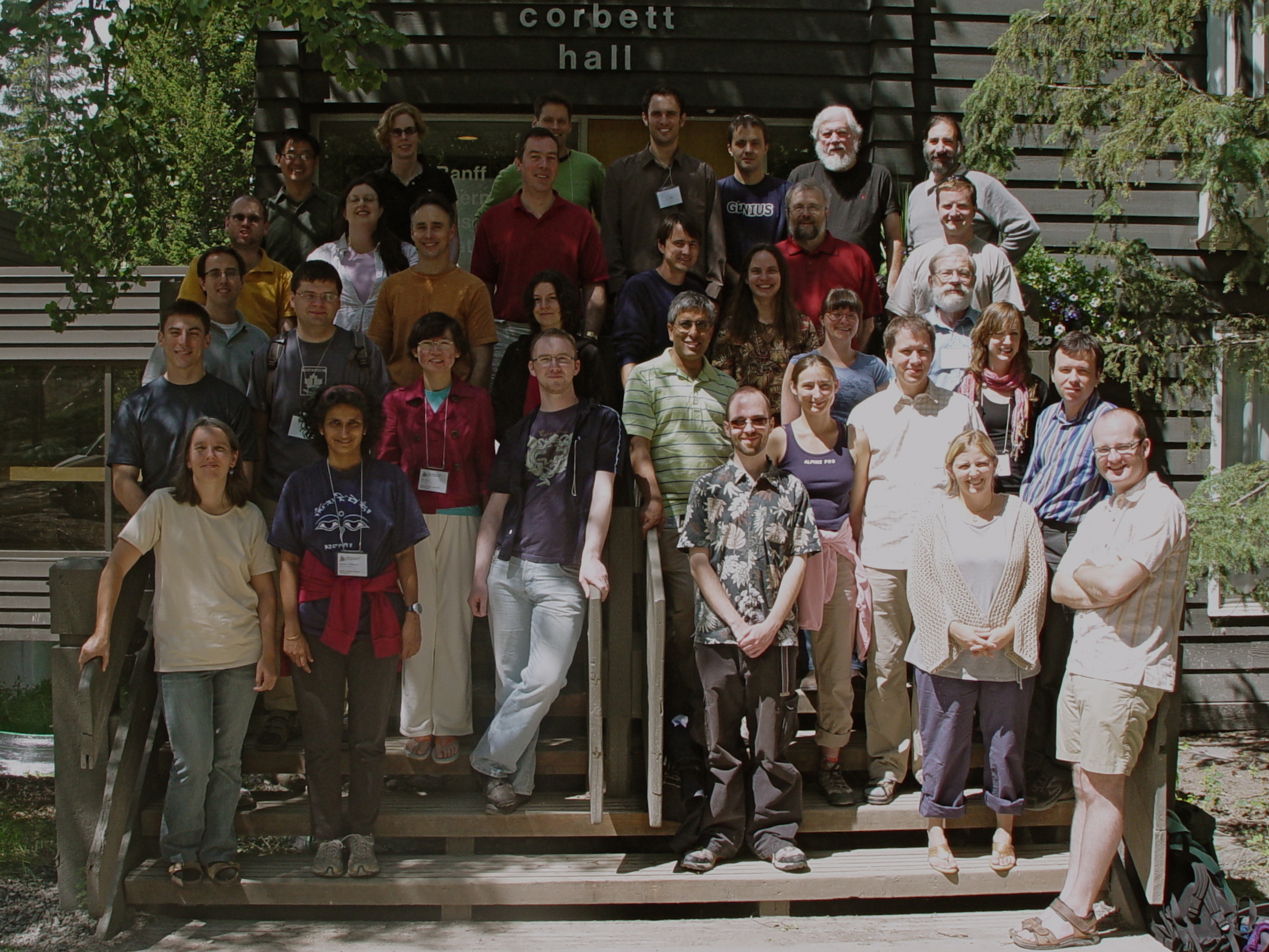
Arriving Sunday, July 6 and departing Friday July 11, 2008

Organizers

Walter Whiteley (Department of Mathematics and Statistics York University)
Maria Kurnikova (Carnegie Mellon University)
Michael Thorpe (Arizona State University)
Jack Snoeyink (University of North Carolina, Chapel Hill)
David Richardson (Duke University Medical Center)

Objectives

The initial workshop brought together people with common interests from diverse disciplines to share approaches, and sparked important debates, and new lines of research, strengthened some collaborations, and initiated new collaborations. To sustain and enlarge this community, and this work, this workshop has two primary objectives:
(i) to gather core members of this interdisciplinary community to review current progress on the theory, the models, the computations, and the experimental comparisons for rigidity, flexibility, and motions of biomolecules;
(ii) to draw in new researchers with an expertise in at least one of these areas;
(iii) to propose directions for future collaborative work: new questions, ways to solve critical current questions and support implemented techniques of value to the larger community.

In form, the program (modeled on the successful 2004 workshop) will include:
(a) surveys of underlying methods, their contributions and their difficulties;
(b) recent new results, and current questions arising in collaborations;
(c) comparisons of results from multiple methods and from experiment;
(d) Recent progress on theoretical work, and new priority questions;
(e) Challenge examples and unsolved problems;
(f) Demonstration of software and web sites for community use.

We will use a mix of invited plenary lectures, planned shorter presentations (often jointly given by participants in a collaboration), thematic half-days collecting short contributions with a moderated discussion of challenge examples in the area, and open problem sessions. All participants will be encouraged to bring along material suitable for informal discussion and presentation, as portions of the workshop will be set as the workshop evolves. For the July 2004 workshop, we found that the Web Comptes Rendu format, combined with the excellent wireless access, worked well for providing advance materials to all participants, for posting problems and solutions in the lead up, during, and after the workshop, and sharing the presentations and progress with the wider community.

Relevance and Timeliness

The initial workshop brought together people with common interests from diverse disciplines to share approaches, and sparked important debates, and new lines of research, strengthened some collaborations, and initiated new collaborations. To sustain and enlarge this community, and this work, this workshop has two primary objectives:
(i) to gather core members of this interdisciplinary community to review current progress on the theory, the models, the computations, and the experimental comparisons for rigidity, flexibility, and motions of biomolecules;
(ii) to draw in new researchers with an expertise in at least one of these areas;
(iii) to propose directions for future collaborative work: new questions, ways to solve critical current questions and support implemented techniques of value to the larger community.

In form, the program (modeled on the successful 2004 workshop) will include:
(a) surveys of underlying methods, their contributions and their difficulties;
(b) recent new results, and current questions arising in collaborations;
(c) comparisons of results from multiple methods and from experiment;
(d) Recent progress on theoretical work, and new priority questions;
(e) Challenge examples and unsolved problems;
(f) Demonstration of software and web sites for community use.

We will use a mix of invited plenary lectures, planned shorter presentations (often jointly given by participants in a collaboration), thematic half-days collecting short contributions with a moderated discussion of challenge examples in the area, and open problem sessions. All participants will be encouraged to bring along material suitable for informal discussion and presentation, as portions of the workshop will be set as the workshop evolves. For the July 2004 workshop, we found that the Web Comptes Rendu format, combined with the excellent wireless access, worked well for providing advance materials to all participants, for posting problems and solutions in the lead up, during, and after the workshop, and sharing the presentations and progress with the wider community.

Relevance and Timeliness
As indicated above in the Overview, protein motions and flexibility is a 'hot area' connected in important ways to data from the human genome projects as well as important theoretical and medical problems. The areas covered by this workshop have expanded in participation and impact, over the past three years, and will expand again in the next two years.

The July 2004 BIRS workshop initiated vital contacts and supported further collaborations. Significant work initiated there is continuing. There was a related workshops in Tempe (May 2005, May 2006) that gathered the biochemistry and biophysics side of this workshop, with some computer scientists. Several papers in those proceedings flowed directly from topics at the last workshop. Another Tempe workshop is planned for May 2007 to continue the discussions. However, the Banff setting is ideal, and this mathematics center offers a critical opportunity for a full engagement of a range of mathematicians in this developing field – something that is not happening in biophysics and biochemistry workshops. Clear theoretical challenges have been issued to the mathematicians and the computational modelers, and we have both progress and new questions to discuss. The unanimous conclusion from our original workshop was – we should meet again at Banff in a few years. The proposed invitation list has a substantial overlap with participants at the 2004 workshop, which is an important step in building this interdisciplinary community (our informal assurance of ‘acceptance to participate’). We have also added some key people who were unable to attend the first workshop, and left room for a new generation of graduate students.