Random Fields and Stochastic Geometry (09w5040)
Organizers
Robert Adler (Technion - Israel Institute of Technology)
Jonathan Taylor (Stanford University)
Description
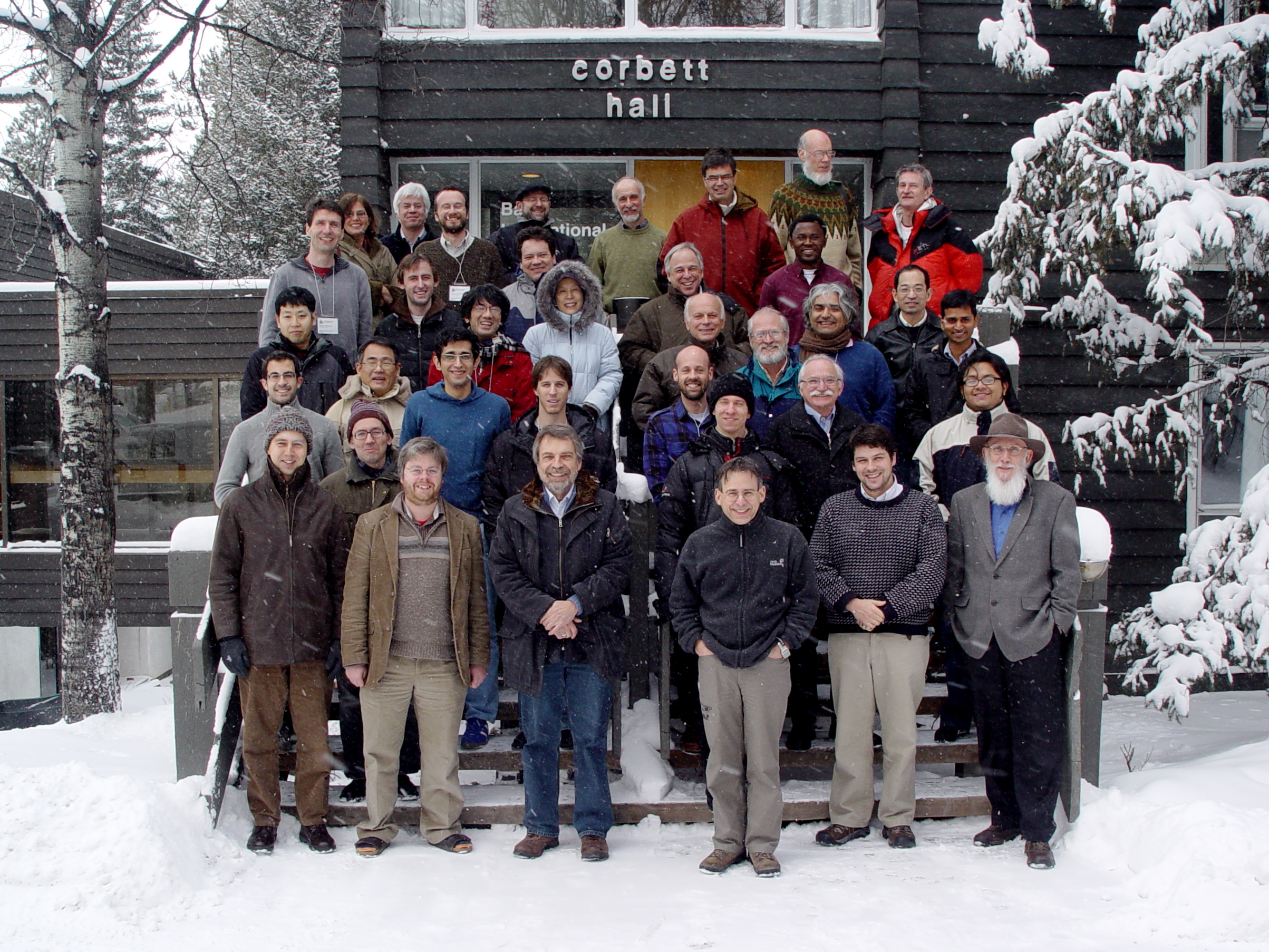
The Banff International Research Station will host the "Random Fields and Stochastic Geometry” workshop next week, February 22 - February 27, 2009.
Of the various terms in the title of this workshop, Geometry, as perhaps the oldest of all mathematical disciplines, needs no introduction. Stochastic Geometry, which dates back to the 18th century, is young by comparison, and studies the geometry of structures produced in a random fashion.
The study of random surfaces and functions (or "random fields," as they are known technically) is but an infant compared to these, with a history of less than a century. It draws from classic Geometry, from Stochastic Geometry, and from Random Process theory. Over the past three decades, major advances have been made in developing this theory, with significant applications of the results to areas as widespread as Medical Imaging and Cosmology. In particular, over the last 5 years, some quite major breakthroughs in the theory have occurred. The aim of this workshop is to both investigate their potential for yet further advances in the theory and, just as importantly, in applications to non-mathematical problems.
Of the various terms in the title of this workshop, Geometry, as perhaps the oldest of all mathematical disciplines, needs no introduction. Stochastic Geometry, which dates back to the 18th century, is young by comparison, and studies the geometry of structures produced in a random fashion.
The study of random surfaces and functions (or "random fields," as they are known technically) is but an infant compared to these, with a history of less than a century. It draws from classic Geometry, from Stochastic Geometry, and from Random Process theory. Over the past three decades, major advances have been made in developing this theory, with significant applications of the results to areas as widespread as Medical Imaging and Cosmology. In particular, over the last 5 years, some quite major breakthroughs in the theory have occurred. The aim of this workshop is to both investigate their potential for yet further advances in the theory and, just as importantly, in applications to non-mathematical problems.
The Banff International Research Station for Mathematical Innovation and Discovery (BIRS) is a collaborative Canada-US-Mexico venture that provides an environment for creative interaction as well as the exchange of ideas, knowledge, and methods within the Mathematical Sciences, with related disciplines and with industry. The research station is located at The Banff Centre in Alberta and is supported by Canada's Natural Science and Engineering Research Council (NSERC), the US National Science Foundation (NSF), Alberta's Advanced Education and Technology, and Mexico's Consejo Nacional de Ciencia y Tecnología (CONACYT).