Noise, Time Delay and Balance Control (09w5052)
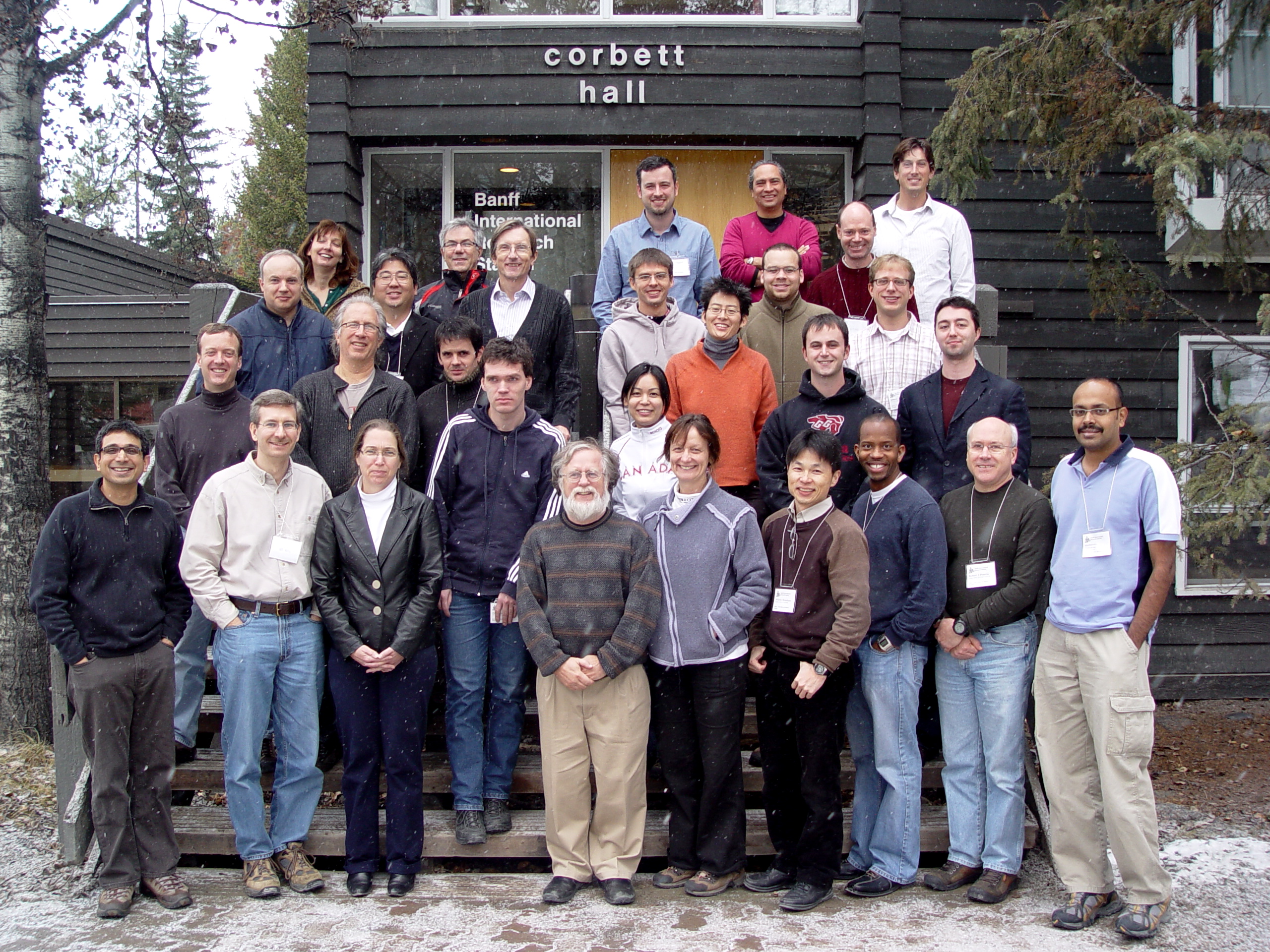
Organizers
Sue Ann Campbell (University of Waterloo)
John Milton (The Claremont Colleges)
Toru Ohira (Nagoya University)
Minoru Shinohara (Georgia Institute of Technology)
Gabor Stepan (Budapest University of Technology and Economics)
Description
What can stick balancing at the fingertip, buckling springs, and walking two-legged robots tell us about balance and falling in adults? World-famous mathematicians and motion scientists will investigate this and more during a workshop to be held at The Banff Centre.
The workshop is designed to bring together applied mathematicians and motion scientists in at atmosphere that promotes interactive and thought provoking discussion. This is an ideal forum for mathematicians to introduce results concerning the use of delay and stochastic delay differential equations for the study of balance to the motion science community. In turn, motion scientists will have a chance to introduce observations at the cutting edge of human and two-legged balance control to the mathematics community. The hope is to use mathematical insight to identify a set of workable strategies that can help improve balance control in humans and in two-legged robots.
Falls are the most common cause of trauma, and the single largest cause of accidental death among the elderly. This workshop will go a long way towards uniting the efforts of mathematicians and motion scientists towards solving this problem.
The Banff International Research Station for Mathematical Innovation and Discovery (BIRS) is a collaborative Canada-US-Mexico venture that provides an environment for creative interaction as well as the exchange of ideas, knowledge, and methods within the Mathematical Sciences, with related disciplines and with industry. The research station is located at The Banff Centre in Alberta and is supported by Canada's Natural Science and Engineering Research Council (NSERC), the US National Science Foundation (NSF), Alberta's Advanced Education and Technology, and Mexico's Consejo Nacional de Ciencia y Tecnología (CONACYT).