Multiscale Analysis of Self-Organization in Biology (09w5070)
Organizers
Thomas Hillen (University of Alberta)
Benoit Perthame (Laboratoire J. L. Lions, University Pierre et Marie Curie)
Description
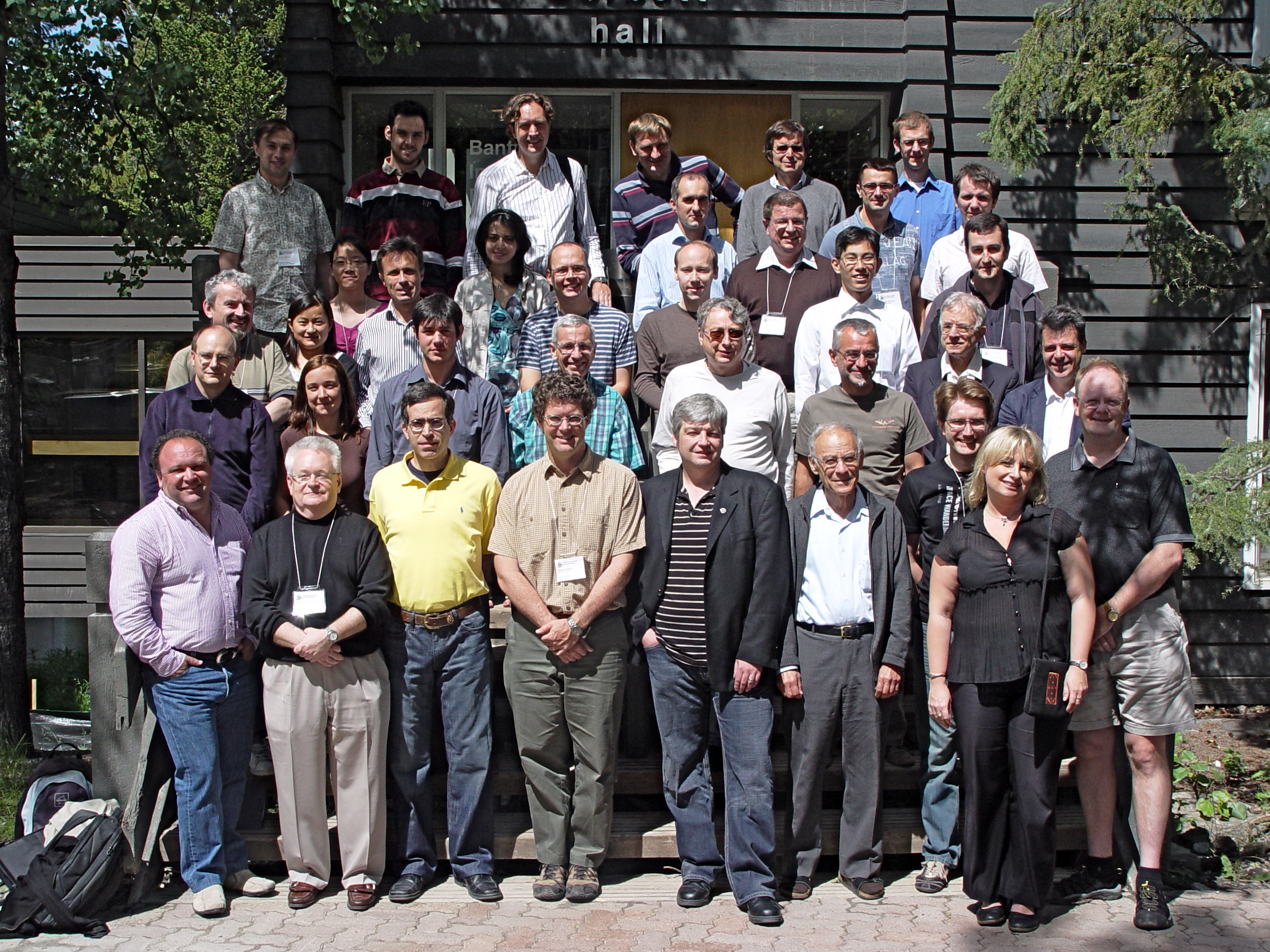
The Banff International Research Station will host the "Multiscale Analysis of Self-Organization in Biology" workshop next week, July 12 - July 17, 2009.
Partial Differential Equations are a unique tool to derive proper models in biology and health sciences. Molecular motion within cells, cells' self-organization, and tissue growth are fields where PDEs are established tools.
In major health issues such as cancer developments, PDEs are one of the tools allowing for a better understanding and replacing experiments by numerical simulations.
Partial Differential Equations are a unique tool to derive proper models in biology and health sciences. Molecular motion within cells, cells' self-organization, and tissue growth are fields where PDEs are established tools.
In major health issues such as cancer developments, PDEs are one of the tools allowing for a better understanding and replacing experiments by numerical simulations.
The Banff International Research Station for Mathematical Innovation and Discovery (BIRS) is a collaborative Canada-US-Mexico venture that provides an environment for creative interaction as well as the exchange of ideas, knowledge, and methods within the Mathematical Sciences, with related disciplines and with industry. The research station is located at The Banff Centre in Alberta and is supported by Canada's Natural Science and Engineering Research Council (NSERC), the US National Science Foundation (NSF), Alberta's Advanced Education and Technology, and Mexico's Consejo Nacional de Ciencia y Tecnología (CONACYT).