Interactions of Geometry and Topology in dimensions 3 and 4 (09w5095)
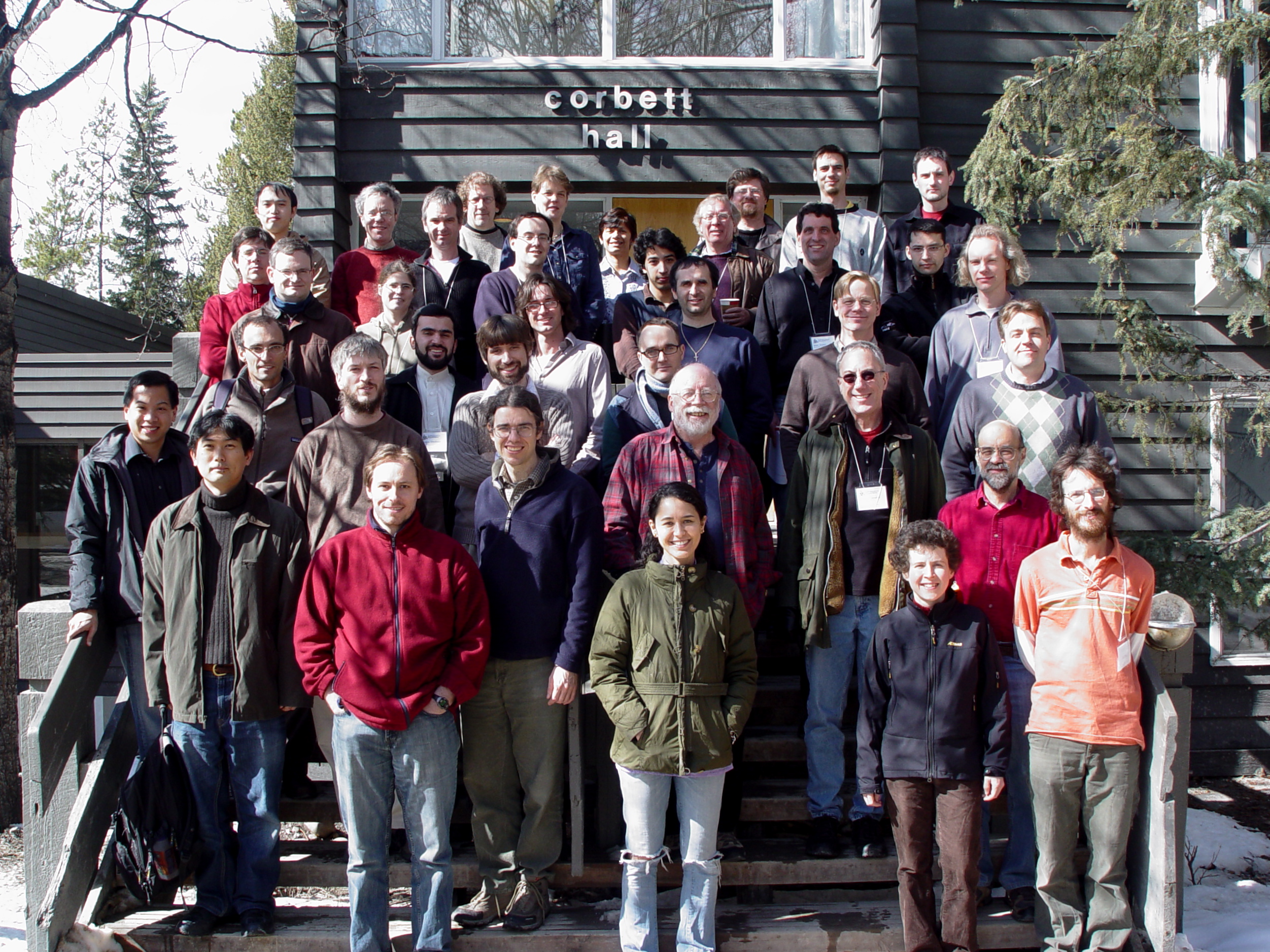
Organizers
Denis Auroux (University of California, Berkeley)
Hans U. Boden (McMaster University)
Olivier Collin (Université du Quebec à Montréal)
John Etnyre (Georgia Institute of Technology)
Objectives
It has now been well over 20 years that collaborations between researchers coming from contact and symplectic geometry, gauge theory and low-dimensional topology have brought a deeper understanding of the nature of low-dimensional manifolds. Through the interaction of these areas, the mathematical community has witnessed the emergence of solutions to long-standing conjectures in topology. Among the many spectacular results, one should mention the understanding of exotic smooth and symplectic structures on 4- manifolds, the proof of Property $P$ for knots in $S^3$ and solutions to other 3-manifold fundamental group questions, and the recent proof of the Weinstein conjecture in dimension 3. In all these developments, the role of various invariants inspired by gauge theories and topological quantum field theories has been of paramount importance. These invariants -- Donaldson-Floer, Seiberg-Witten, Ozsv'ath-Szab'o, Khovanov homology, and embedded contact homology to name a few -- have intriguing relations among them, and a better understanding of these will lead to significant progress in the field. An even more promising direction is the interplay between these invariants and more constructive approaches to low-dimensional manifolds -- open book decompositions of contact 3-manifolds, symplectic fillings, Lefschetz fibrations, knot surgery constructions among many others. This interplay between powerful invariants and constructive methods is now more than ever one of the driving forces in this subject. Below we will review some of the most active branches of low-dimensional topology, thereby outlining natural directions and objectives for the workshop.
In the Fall of 2006, Cliff Taubes gave a positive answer to the Weinstein conjecture in dimension 3 : for any compact oriented 3-manifold $M$ and $alpha$ a contact 1-form on $M$, the vector field that generates the kernel of the 2-form $dalpha$ has at least one closed integral curve. The proof involves a come-back of the Seiberg-Witten invariants, in a relative version due to Kronheimer and Mrowka, as well as their relation to holomorphic curves in a symplectic manifold. Perhaps more importantly for the future, the development of embedded contact homology by Hutchings and Taubes should provide much more refined information concerning these periodic orbits.
Most of the topological invariants arising from gauge theory and contact / symplectic topology rely extensively on analytical tools, which makes explicit computations particularly difficult since information about spaces of solutions to such PDE problems is scarce. In the last year there has been dramatic progress in combinatorial approaches to Ozsv'ath-Szab'o theory. Indeed, the problem of combinatorially constructing Heegaard-Floer groups without resorting to counting pseudo-holomorphic curves has taken a very promising turn as knot Floer homology was given a purely combinatorial interpretation by Manolescu, Ozsv'ath and Sarkar. This has already led to progress in the classification of transverse knots in contact manifolds as well as work by Ng on bounds for the Thurston-Bennequin invariant of Legendrian knots. It is expected that the theory will progress greatly over the course of the next few years thanks to the combinatorial set-up.
Another current trend in the area is the understanding of the relationship between the various invariants of Floer type for knots and 3-manifolds and Khovanov homology. Khovanov homology was constructed as a categorification of the Jones polynomial of knots and its nature is very algebraic and combinatorial. Ozsv'ath and Szab'o derived a spectral sequence whose $E^2$ term is a suitable variant of Khovanov's homology for a link, converging to the Heegaard Floer homology of the double branched cover of the link. The progress described above in combinatorial Heegaard-Floer homology has already enabled Manolescu and Ozsv'ath to explore further the relationship between the two theories, through the notion of homological thinness. There are good reasons to believe that this will be an active area of research for the coming years, as this should also be related to the link invariant constructed by Seidel and Smith using the the symplectic geometry of nilpotent slices. In another direction, current work of Kronheimer and Mrowka, going back to their foundational work on singular instanton connections over 4-manifolds, suggests another relationship between Khovanov homology and the original instanton Floer homology developed almost 20 years ago.
The emergence of invariants of embeddings from contact homology is also one of the promising avenues of research in the area. Given a manifold embedded in Euclidean space, one can look at its unit conormal bundle in the unit cotangent bundle of Euclidean space to get a Legendrian submanifold. Computing the contact homology of this Legendrian gives an invariant of the original embedding. Ekholm, Etnyre, Ng and Sullivan have recently rigorously computed this invariant for knots in 3-space and shown it is equal to a very powerful combinatorial invariant defined by Ng. This invariant has surprising connections with many classical invariants of knots and seems quite strong. Exploring this new invariant of knots and extending it to other situations should be a fruitful line of research for years to come. Moreover, contact homology is only the tip of the iceberg of Symplectic Field Theory. This theory, introduced by Eliashberg and Hofer, has been an inspirational and driving force in symplectic geometry for over a decade now, and recent advances in its rigorous definition suggest that a precise formulation of the relative version should emerge in the coming years. It appears there will still be much work to do to extract computable and meaningful pieces that one can use in applications. In the end though, it is expected that the theory will be invaluable in symplectic and contact geometry and will provide more invariants, not only for Legendrian knots in contact 3-manifolds and Lagrangian cobordisms between them, but also for topological knots by considering the conormal construction mentioned above.
The existence of tight contact structures on 3-manifolds has been an important subject of investigation for a long time and, since the year 2000, significant progress has been made in our understanding of which 3-manifolds admit tight contact structures. This fundamental question has potential applications not only to contact geometry but also low-dimensional topology and dynamics. It also illustrates very well the natural interactions between the invariants described above and constructive methods. After many incremental steps by several mathematicians, Lisca and Stipsicz have completely classified -- in a preprint issued on ArXiv in September 2007 -- which Seifert fibered 3-manifolds admit a tight contact structure. Their approach relies heavily on Heegaard-Floer homology through a non-vanishing criterion for the contact invariant of Ozav'ath and Szab'o for Seifert fibred manifolds. On the other hand, geometric methods reminiscent of the theory of normal surfaces of Haken and Kneser have led Colin, Giroux and Honda to general results such as: (1) Every 3-manifold has only finitely many homotopy classes of 2-plane fields which carry tight contact structures. (2) Every closed atoroidal 3-manifold carries finitely many isotopy classes of tight contact structures, vastly improving the results of Kronheimer and Mrowka using Seiberg-Witten invariants. One of the outstanding and fundamental questions here is the understanding of tight contact structures on hyperbolic 3-manifolds. Work of Kazez, Honda and Mati'c has led to a characterization of tight 3-manifolds in terms of right-veering diffeomorphisms, a step which should make calculations in contact homology and Heegaard Floer homology manageable, but thus far the condition of a manifold being hyperbolic has not been properly understood in this context. It is hoped that the latest advances will help elucidate the problem of tight structures on 3-manifolds.
In one dimension higher, one of the driving questions in 4-dimensional topology is the smooth Poincare conjecture and its symplectic analogue. It is rather unbelievable that topologists still don't know how many smooth structures there are on the 4-sphere or the complex projective 2-space, and which ones admit symplectic structures. One approach to such problems is to try to build exotic smooth structures on "smaller and smaller" 4-manifolds. Early work of Freedman and Donaldson addressed this problem for $CP^2# noverline{CP^2}$ for $ngeq 9$, and Kotschick's 1989 paper dealt with the case $n=8$. Since that time, there had been little progress until J. Park's breakthrough a few years ago. Park's result sparked a flurry of activity on existence of exotic smooth structures on small symplectic 4-manifolds by different teams of researchers (Akmedov-D.Park, Baldridge-Kirk, and Fintushel-Stern-D.Park). The advances are made by exploiting a certain tension between constructions and invariants. Using clever new cut-and-paste constructions such as knot and rim surgery, together with an intimate understanding of their effect on invariants such as the Seiberg-Witten invariants, one can often deduce the presence of several (generally infinitely many) exotic smooth structures. The constructions ideally involve modifying the 4-manifold so as to alter the invariants without destroying the symplectic structure or homeomorphism type.This requires one to perform surgeries along particularly well-chosen surfaces embedded in the 4-manifold. It is reasonable to expect further progress on this important problem for some additional small symplectic 4-manifolds (e.g. ${mathbb C}{mathbb P}^2$, ${mathbb C}{mathbb P}^2# overline{{mathbb C}{mathbb P}}^2$, ${mathbb C}{mathbb P}^2# 2overline{{mathbb C}{mathbb P}}^2$, or $S^2times S^2$) via the various approaches that have been developed and the continued influence of the powerful 4-manifold invariants arising from gauge theory and symplectic geometry.
Statement of Objectives
The proposed workshop is designed as a continuation of the one held in March, 2007 (BIRS 07w5033). That event was hugely successful in many respects, as discussions among participants were not only informative but also led to new results and fruitful collaborations. Many participants as well as other mathematicians who could not come to that event have expressed their interest in attending a sequel event. The rapid pace at which these fields are progressing leads us to believe that significant progress will be made on some of the outstanding problems described above, setting the stage for an important meeting in 2009. The scientific depth of the area enabled us to draw up a list of about 80 potential participants which we had to narrow down to 42. The resulting list of participants strikes a delicate balance between a diverse range of interests, and among them are many leading experts in 3-and 4-manifold topology and their invariants arising from gauge theory, contact and symplectic topology, as well as post-doctoral researchers and some outstanding Ph.D. students. The schedule will feature up to five or six talks each day -- except for Wednesday where only half a day will be scheduled -- with time in the late afternoons and evenings left open for informal discussions, collaborations, and problem sessions.