Applications of Matroid Theory and Combinatorial Optimization to Information and Coding Theory (09w5103)
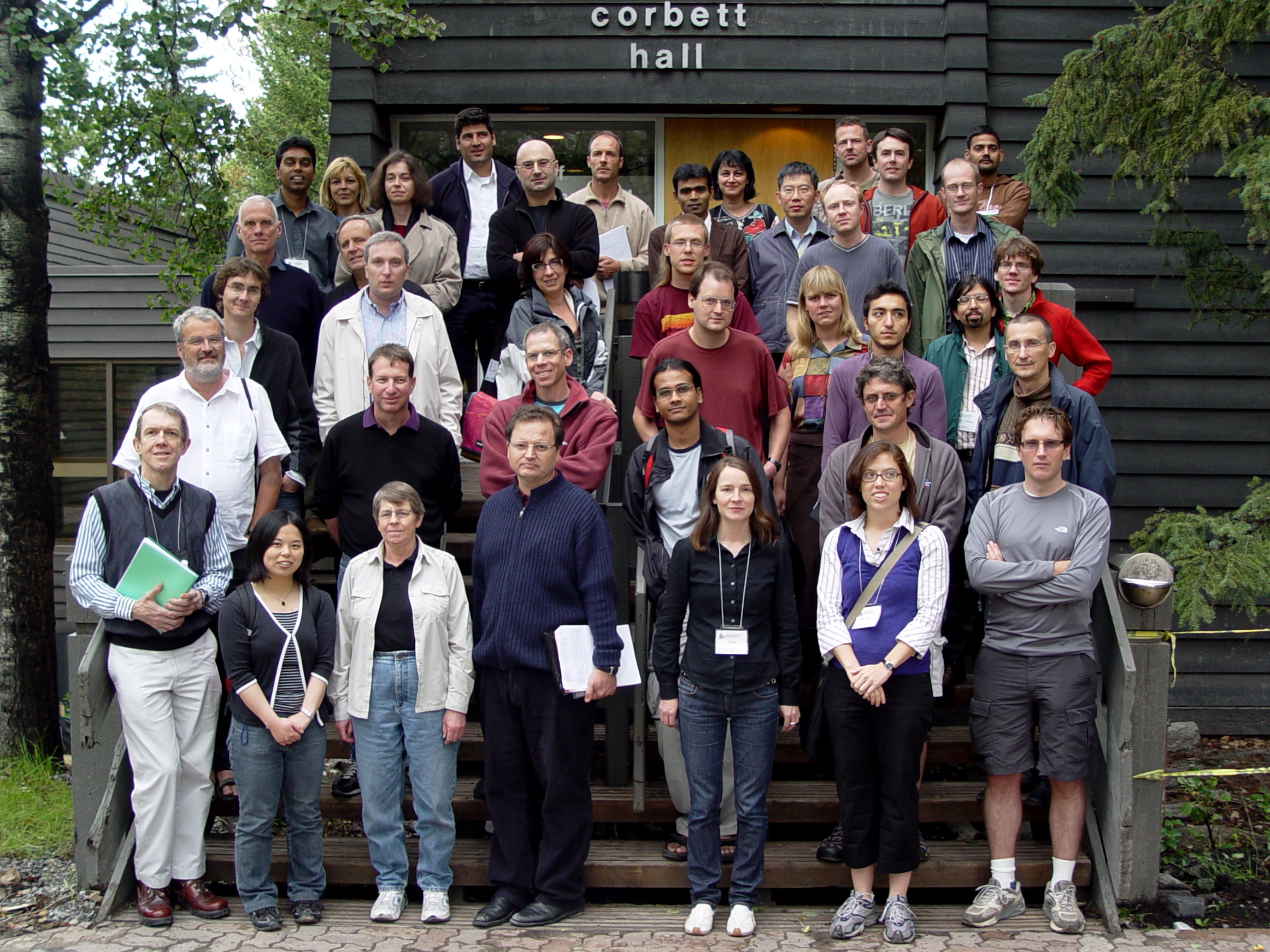
Organizers
Navin Kashyap (Queens University)
Emina Soljanin (Bell Labs Research)
Pascal Vontobel (The Chinese University of Hong Kong)
Description
The Banff International Research Station will host the "Applications of Matroid Theory and Combinatorial Optimization to Information and Coding Theory" workshop next week, August 2 - August 7, 2009.
This workshop will bring together experts from pure and applied mathematics, computer science, and electrical engineering, to tackle problems of central importance in digital communications and information theory. The problems that this workshop will focus on are of enormous practical significance to digital communications and Internet technology, as they are directly motivated by the need to find increasingly efficient and robust coding schemes for reliable transmission and storage of data.
The necessity of such coding schemes cannot be over-stressed, given the ever-increasing pressure on network resources with the need for transmitting, storing and processing ever-larger amounts of data. These practical motivations give rise to difficult and deep theoretical problems that require the use of tools from the mathematical theories of matroids and combinatorial optimization. The aim of the workshop is to provide an environment within which mathematicians and computer scientists with expertise in matroid theory and optimization can interact and exchange ideas with experts from digital communications and information theory.
This workshop will bring together experts from pure and applied mathematics, computer science, and electrical engineering, to tackle problems of central importance in digital communications and information theory. The problems that this workshop will focus on are of enormous practical significance to digital communications and Internet technology, as they are directly motivated by the need to find increasingly efficient and robust coding schemes for reliable transmission and storage of data.
The necessity of such coding schemes cannot be over-stressed, given the ever-increasing pressure on network resources with the need for transmitting, storing and processing ever-larger amounts of data. These practical motivations give rise to difficult and deep theoretical problems that require the use of tools from the mathematical theories of matroids and combinatorial optimization. The aim of the workshop is to provide an environment within which mathematicians and computer scientists with expertise in matroid theory and optimization can interact and exchange ideas with experts from digital communications and information theory.
The Banff International Research Station for Mathematical Innovation and Discovery (BIRS) is a collaborative Canada-US-Mexico venture that provides an environment for creative interaction as well as the exchange of ideas, knowledge, and methods within the Mathematical Sciences, with related disciplines and with industry. The research station is located at The Banff Centre in Alberta and is supported by Canada's Natural Science and Engineering Research Council (NSERC), the US National Science Foundation (NSF), Alberta's Advanced Education and Technology, and Mexico's Consejo Nacional de Ciencia y Tecnología (CONACYT).