Integrable and stochastic Laplacian growth in modern mathematical physics (10w5019)
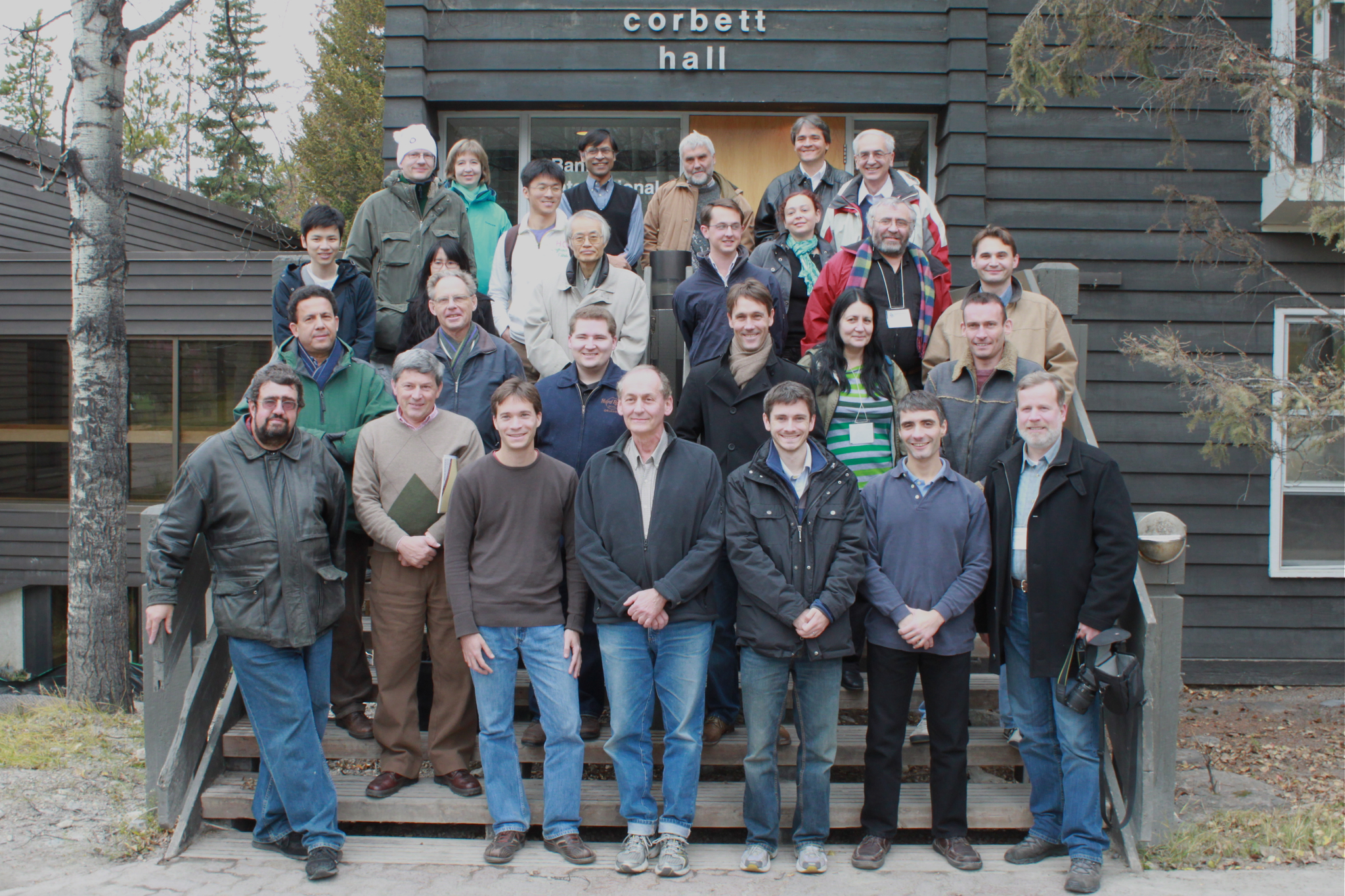
Arriving Sunday, October 31 and departing Friday November 5, 2010

Organizers

Mihai Putinar (University of California at Santa Barbara)
Darren Crowdy (Imperial College London)
Bjorn Gustafsson (Royal Institute of Technology, Stockholm)
John Harnad (Concordia University and Centre de Recherche Mathematique)
Mark Mineev (Max Planck Institute for the Physics of Complex Systems)

Objectives

Integrable and stochastic Laplacian growth in modern mathematical physics

Profound results, unexpected new applications and ramifications of the study of Laplacian Growth in 2D were unveiled since the Banff meeting of 2007, devoted to
the subject. Several international groups of physicists and mathematicians have been formed as a result of this meeting. The following publications reflect, if only partially, the most recent progress in the field obtained in a few fresh collaborations started at the BIRS 2007 workshop: cite{AHM,BT,CM,GT,KMP,LY}, see also the volume cite{CAOT} and the survey cite{MPT}.

The planned workshop will bring together pure and applied mathematicians, theoretical and mathematical physicists, and numerical analysts working in various aspects of complex moving boundaries governed by Laplacian growth. The main themes of the meeting are described below.

1. Potential theory and Riemann surfaces.

Laplacian growth is an interface dynamics where the boundary velocity equals the
normal derivative of the Green function of the moving domain. Remarkably, this non-linear complex dynamics with infinitely many degrees of freedom possesses a complete set of conserved quantities (namely, the Richardson harmonic moments). Consequently, wide classes of generalized quadrature domains are preserved during the evolution.

This implies in particular that so-called algebraic domains ("classical quadrature domains") remain algebraic. By a doubling procedure such domains can be identified with a class of symmetric Riemann surfaces. Thus, Laplacian growth corresponds to certain kinds of dynamics of Riemann surfaces or, equivalently, of algebraic curves. From this point of view, Laplacian growth is far from being fully understood. Neither, it is not known how the associated exponential transform (discovered by one of the writers of this proposal) develops under Laplacian growth.

Under "negative" Laplacian growth the bounded domain either shrinks down to a potential theoretic skeleton of its original configuration, or breaks down due to singularity development on the interface. This process has a common fluid dynamics interpretation, namely a water/oil interface motion in a Hele-Shaw cell, where a fingering instability discovered by P.G. Saffman and G.I. Taylor in 1958, occurs. Despite hard efforts during many years there is still no complete mathematical model for it. The "positive" Laplacian growth has constantly received attention due to universal patterns observed in physics (growth of crystals, electron configurations in quantum Hall cells, etc.) and mathematics (DLA, asymptotic distribution of zeros of orthogonal polynomials, etc.).

2. Elliptic growth and the Beltrami operator.

The occurence of the Laplace operator in mentioned above physical processes stems from the continuity and incompressibility conditions satisfied by a fluid involved in the potential flow. Specifically ${bf v} = -lambda nabla p$, where ${bf v}, lambda$, and $p$ are the fluid velocity vector field, conductivity, and scalar velocity potential, respectively.

%$$nabla cdot {bf v} = -nabla cdot lambdanabla p = -lambdanabla^2 p = 0.$$

As a first approximation, the conductivity $lambda$ was supposed to be constant, while generally it is not; therefore the major equation for growth has to be reconsidered as $ nabla cdot lambda({bf x})nabla p = 0.$

It was recently revealed in cite{KMP} that this {it elliptic growth} process hides remarkable mathematical structures which extend those related to the Laplacian growth. In particular, an infinite number of conservation laws, expressed in terms of the Schwarz function singularities, intimately linked with the refined theory of the Beltrami equation, were singled out. This extension is very promising for further research and will be part of the organized discussions within the workshop.

3. Stochastic analysis and fractal growth.

During the last year one of the writers of this proposal built up an integrable model for the stochastic Laplacian growth with finite-size deposited particles within the framework of so-called "Loewner chains". As a consequence, it is expected to recover universal geometric characteristics, such as the multifractal spectrum of the growing clusters. Notably, this process retains integrability, despite of randomness.

In another important work combining stochasticity with integrability cite{Harnad}, the authors have obtained a list of surprising results connecting random entities and the tau-function - a powerful concept in the theory of integrable systems. Taken together with the above mentioned results in Laplacian growth, such nontrivial interconnections between integrability and randomness will be central for the planned meeting.

4. Laplacian growth as a large $N$ limit of random matrices spectra.

Some deep links between the stochastic Laplacian growth and the theory of random matrices are discussed in the surveycite{MPT}. As it is often the case for other applications of random matrices, this connection sheds a new light on old classical problems. In short, an important observation was made in cite{KKMWWZ} and developed in cite{TBAWZ05} (see also review cite{Z06}) that the Laplacian growth can be simulated by the evolution of an averaged spectrum of normal random matrices as a function of a re-scaled size of matrices from the statistical ensemble, when the size of a matrix, $N$, goes to infinity.

The main observation is surprising: the evolution of the support of the eigenvalues can be treated as the Laplacian growth of the domain. Namely, it behaves exactly as an air bubble in the Hele-Shaw cell (with zero surface tension). Considering random matrices and the more general 'beta-ensembles' with the probability measure

$$
prod _{j<k}^{N}|z_j - z_k |^{2beta}prod_{l=1}^{N}
dmu (x_l , y_l),
$$

(here $dmu (x,y)$ is a smooth measure in the plane), a natural framework is calling to be developed, with the aim at solving the stochastic version of Laplacian growth.

Clearly, the large $N$ approximation is by no means enough for this purpose, so one should properly take into account $1/N$-corrections and understand the structure of the whole $1/N$-expansion. This direction is now under intense development by several groups proposed to attend the meeting and is expected to be one of the 'hot' topics for interactions and discussions.

5. Complex orthogonal polynomials.

As mentioned above, the eigenvalues of ensembles of random normal matrices constrained by simple external field potentials fill in the limit generalized quadrature domains. Statistical analysis meets on this territory function theory and approximation theory, with very surprising new turns, cf. cite{AHM,MPT}.

Specifically, it was proved that the geometry of the limiting domain, encoded in its Schwarz function, determines the cluster of zeros of some canonically associated complex orthogonal polynomials. The resulting potential theoretic skeleton of a domain remains quite mysterious.

It is expected that this direction of research will flourish during the next years.

6. Applications to classical physics.

The same mathematics of Laplacian growth, involving conformal mapping theory, analytical/numerical uniformization and function theory on compact Riemann surfaces, also arises in a rich array of quite separate problems in classical physics: in fluid mechanics, for example, it arises in the study of free surface Stokes flows and in vortical solutions of the Euler equations; most recently, Laplacian growth models have been found to be relevant to describing ionization processes in electrical streamers. Such cross-disciplinary applications of the mathematics of Laplacian growth are many and varied.

7. Numerical simulations and industrial applications.

Owing to the ill-posed nature of the unregularized problem, when small regularization effects 'are' included, any numerical method for resolving the subsequent dynamics encounters a variety of challenges and much research has gone into resolving these numerical issues over recent years. Many challenges remain and this is the subject of ongoing work.

Bibliography

{AHM} Y. Ameur, H. Hedenmalm, N. Makarov, Fluctuations of eigenvalues of random normal matrices (arXiv 0807.0375v1)

{BT} F. Balogh, R. Teodorescu, Optimal approximation of harmonic growth clusters by orthogonal polynomials, arXiv:0807.1700.

{CAOT} Special anniversary volume, dedicated to Bjorn Gustafsson's 60th birthday,
Complex Analysis and Operator Theory, Birkhauser, to appear.

{CM} D.G. Crowdy, J.S. Marshall
Uniformizing the boundaries of multiply connected quadrature domains using Fuchsian groups,
Physica D, {bf 235}(2007), 82-89.

{CS} D.G. Crowdy, A. Surana,
Contour dynamics in complex domains,
J. Fluid Mech. {bf 593}(2007), 235-254.

{GT} B. Gustafsson, V. Tkachev, The resultant on compact Riemann surfaces,
arXiv:math.CV/0710.2326. Comm. Math. Phys., to appear.

{GV} B. Gustafsson, A. Vasilev, Conformal and Potential Analysis in Hele-Shaw Cells, Birkhauser Verlag, 2006.

{Harnad} J. Harnad and A. Yu. Orlov, Fermionic Construction of Tau Functions and Random Processes, Physica D, {bf 235}, 1-2 (2007), 168-206.

{KMP} D. Khavinson, M. Mineev-Weinstein,
M. Putinar, Planar elliptic growth, Complex Analysis Operator Theory, to appear.

{LY} I. Loutsenko, O. Yermolayeva, Non-laplacian growth: exact results, Physica D: Nonlinear Phenomena
Volume 235, Issues 1-2, November 2007, Pages 56-61.

{MPT} M. Mineev-Weinstein, M. Putinar and R. Teodorescu,
Random matrices in 2D, Laplacian growth and operator theory,
J. Phys. A: Math. Theor. 41 No 26 (4 July 2008) 263001 (74pp)

{KKMWWZ} I. Kostov, I. Krichever, M. Mineev-Weinstein,
P. Wiegmann and A. Zabrodin,
$tau$-function for analytic curves, in: Random Matrix Models
and Their Applications, Math. Sci. Res. Inst. Publ. vol. 40,
Cambridge University Press, pp. 285-299, e-print archive:
hep-th/0005259.

{TBAWZ05}
R. Teodorescu, E. Bettelheim, O. Agam, A. Zabrodin
and P. Wiegmann,
Normal random matrix ensemble as
a growth problem,
Nucl. Phys. {bf B704} (2005)
407-444

{Z06}
A. Zabrodin, {it Matrix models and growth processes: from viscous flows
to the quantum Hall effect}, hep-th/0412219, in: "Applications of
Random Matrices in Physics", pp. 261-318, Ed. E.Brezin et al,
Springer, 2006