Nonstandard Discretizations for Fluid Flows (10w5041)
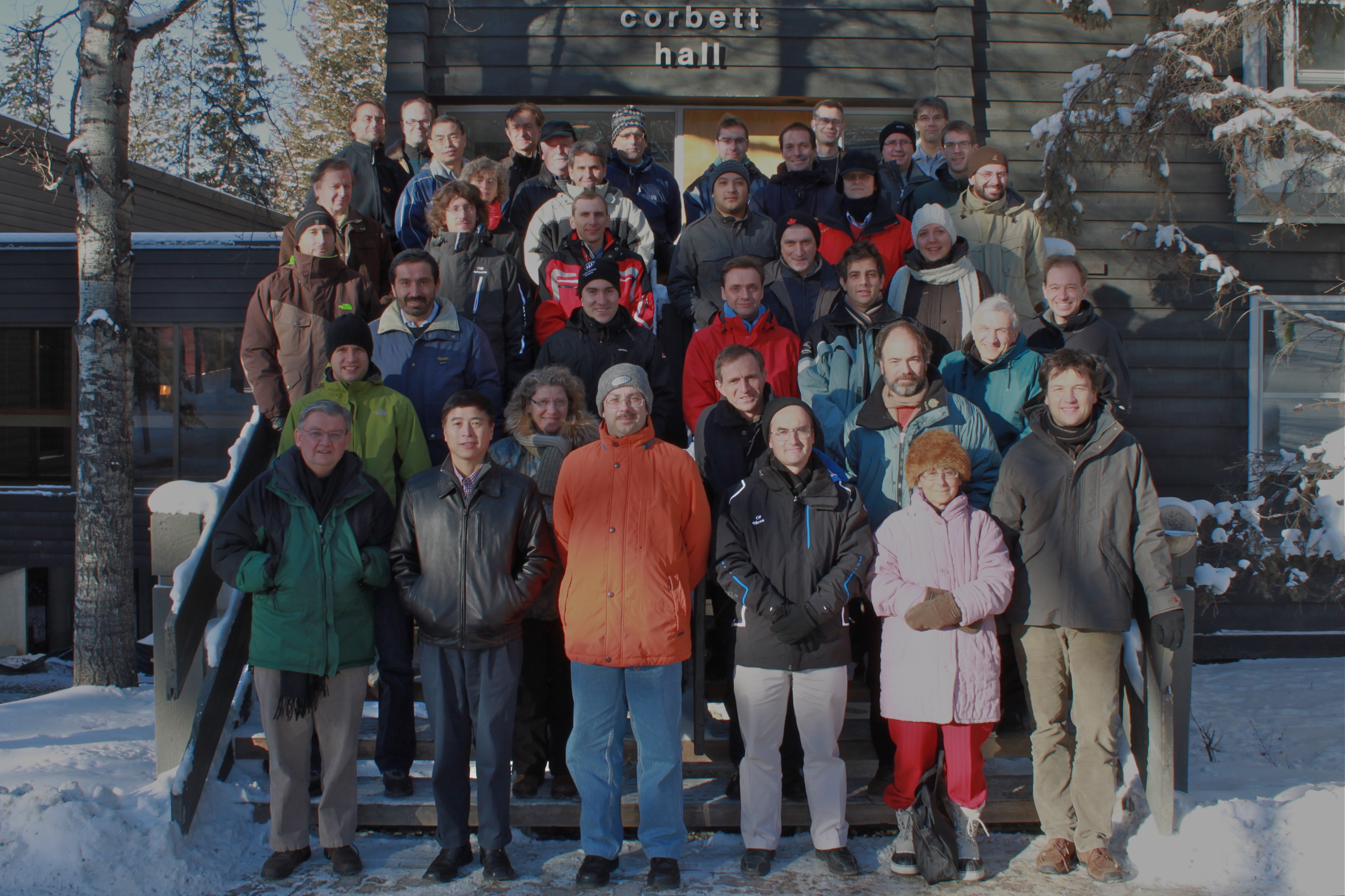
Organizers
Vivette Girault (University of Paris VI)
Jean-Luc Guermond (Texas A&M University)
Guido Kanschat (Texas A & M University)
Peter Minev (University of Alberta)
Description
The Banff International Research Station will host the "Nonstandard Discretizations for Fluid Flows" workshop from November 21st to November 26th, 2010.
Simulating fluid flows numerically is a common practice nowadays. For instance weather prediction, car and airplane aerodynamics, ground water management, or oil production depend to a certain extent on computer simulations. All these computations rely on sophisticated mathematical algorithms and the goal of this workshop is to bring together applied mathematicians to discuss and exchange new techniques which should make numerical simulations faster, more accurate, and more reliable.
The Banff International Research Station for Mathematical Innovation and Discovery (BIRS) is a collaborative Canada-US-Mexico venture that provides an environment for creative interaction as well as the exchange of ideas, knowledge, and methods within the Mathematical Sciences, with related disciplines and with industry. The research station is located at The Banff Centre in Alberta and is supported by Canada's Natural Science and Engineering Research Council (NSERC), the US National Science Foundation (NSF), Alberta's Advanced Education and Technology, and Mexico's Consejo Nacional de Ciencia y Tecnología (CONACYT).