Nonlinear Diffusions and Entropy Dissipation: From Geometry to Biology (10w5054)
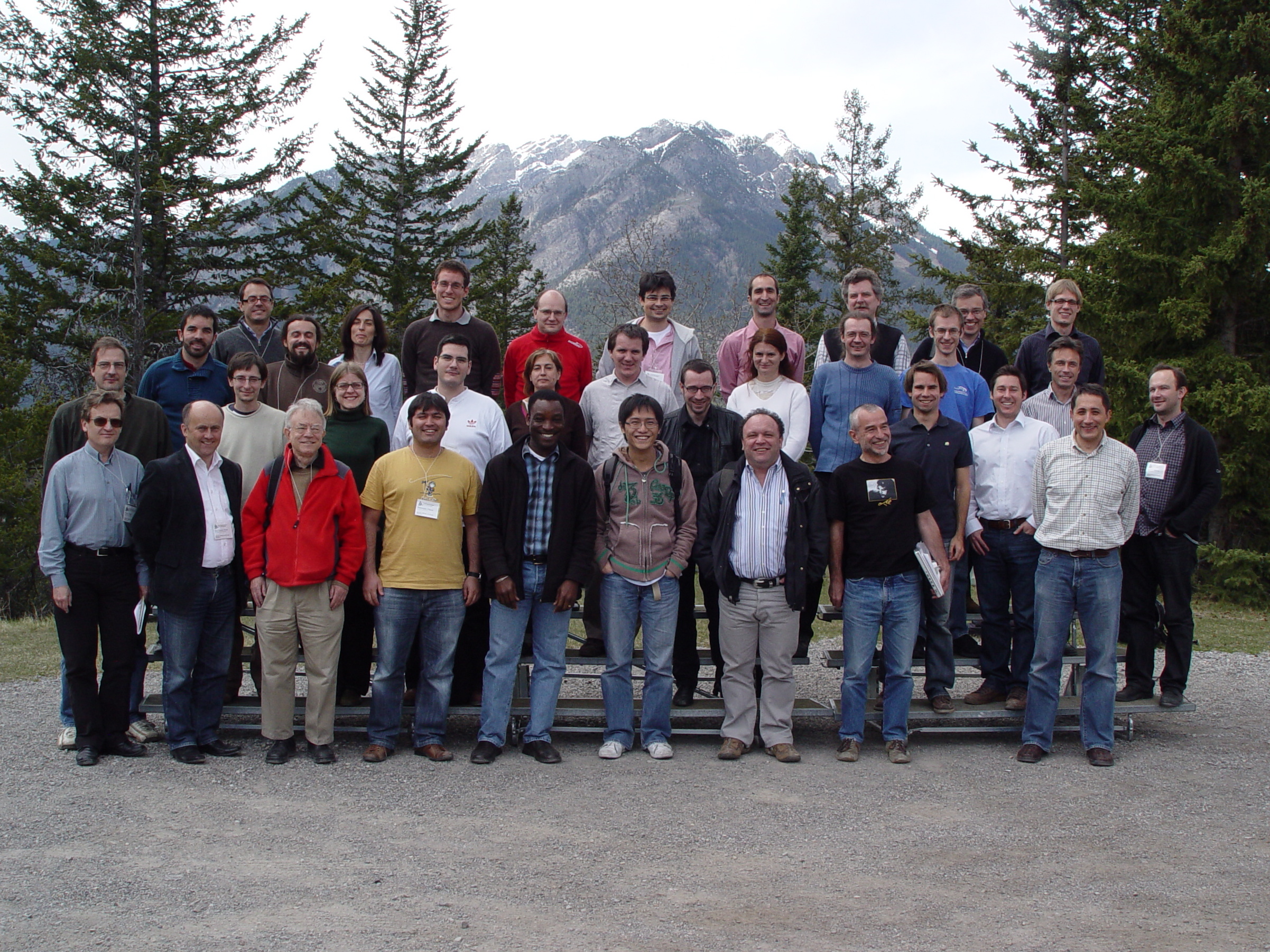
Organizers
Eric Carlen (Rutgers University)
Jose Antonio Carrillo (Imperial College, London, GB)
Jean Dolbeault (CNRS & Université Paris-Dauphine)
Dejan Slepcev (Carnegie Mellon University)
Description
The Banff International Research Station will host the "Nonlinear Diffusions and Entropy Dissipation: From Geometry to Biology" workshop from May 9 to 14, 2010.
Nonlinear diffusions and other irreversible phenomena are present in many processes important for our daily lives such as traffic flow, production of semiconductors, and spreading of pollutants through the ground. They appear in fields as diverse as population biology, microfluidics, and differential geometry.
Entropies measure how far, in a certain sense, is a system from the equilibrium configuration. As the system evolves the entropy is being dissipated. Understanding the relation between the entropy and its dissipation forms the foundation for investigating many diffusive systems and is the overarching theme of this workshop.
The workshop will bring together experts from variety of fields connected by the common mathematical structure of the models studied. Researchers using a range of techniques, from numerical experiments and asymptotic expansions to theoretical analysis will come together to discuss challenging problems that the applications have set forth. This variety will foster the transfer of knowledge and techniques between diverse areas of science.
The Banff International Research Station for Mathematical Innovation and Discovery (BIRS) is a collaborative Canada-US-Mexico venture that provides an environment for creative interaction as well as the exchange of ideas, knowledge, and methods within the Mathematical Sciences, with related disciplines and with industry. The research station is located at The Banff Centre in Alberta and is supported by Canada's Natural Science and Engineering Research Council (NSERC), the US National Science Foundation (NSF), Alberta's Advanced Education and Technology, and Mexico's Consejo Nacional de Ciencia y Tecnología (CONACYT).