Sparse Statistics, Optimization and Machine Learning (11w5012)
Organizers
Francis Bach (Inria - Ecole Normale Supérieure)
Alexandre d'Aspremont (CNRS - ENS)
Martin Wainwright (UC Berkeley)
Description
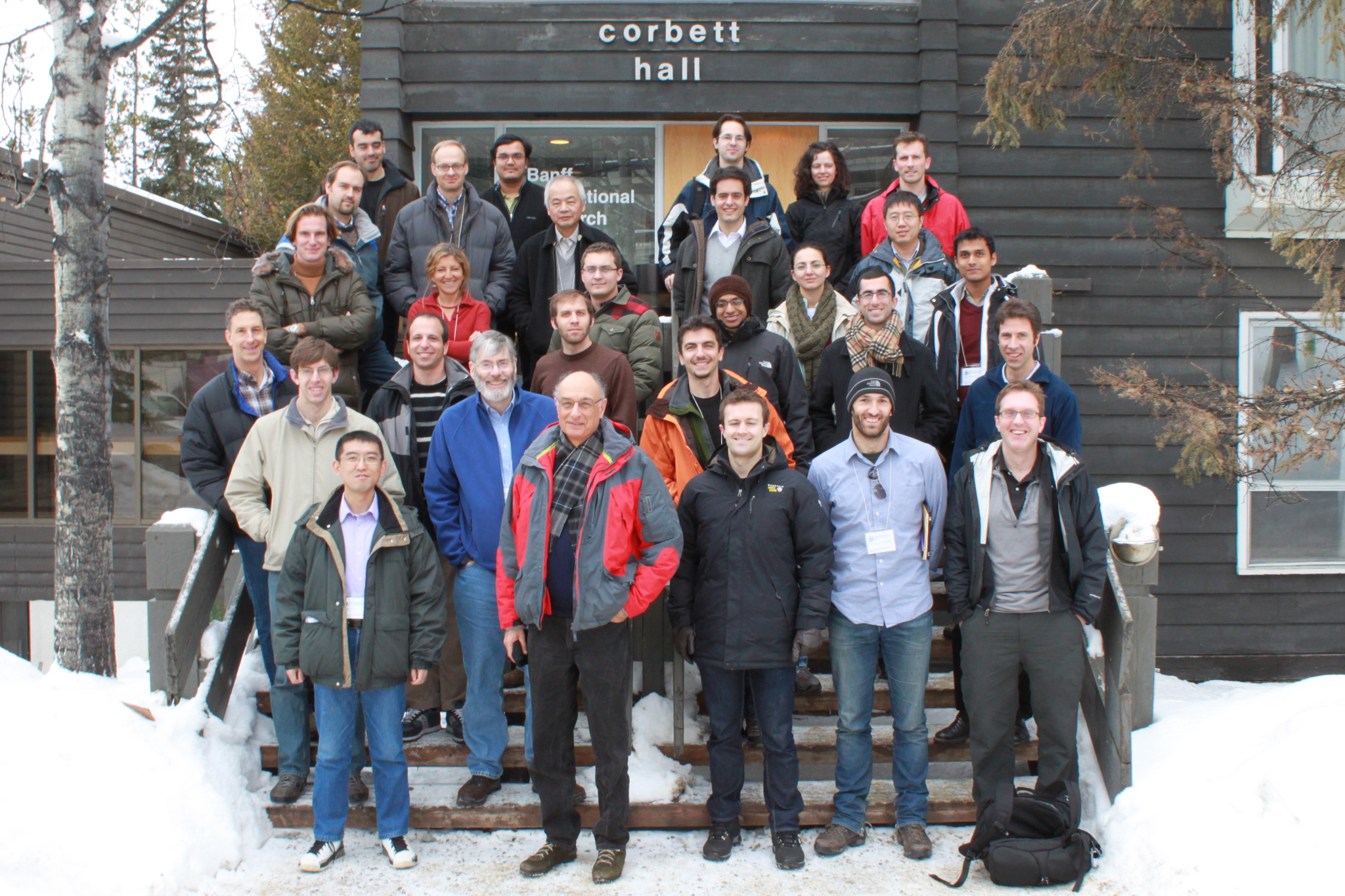
The Banff International Research Station will host the "Sparse Statistics, Optimization and Machine Learning" workshop from January 16th to January 21st, 2011.
A small revolution has recently started brewing in statistics and information theory, with a stream of consistency or "truth-discovery" results on sparse model identification and decoding being produced in the last few years, together with efficient large-scale numerical algorithms to identify these models. Many intensely active research topics such as sparse recovery in coding theory, compressed sensing and basis pursuit in signal processing, lasso and covariance selection in statistics, feature selection in machine learning, all revolve around the core idea that seeking sparse models is a meaningful way of simultaneously stabilizing inference procedures, and highlighting structure in the underlying data.
These results have immediate applications in signal or image processing among other fields. Some have already yielded spectacular improvements, e.g. a tenfold speedup of MRI scanners or a cheap 1 pixel infrared camera. Sparse models show up everywhere in nature (as power laws) and we can expect the range of such applications to expand considerably. The goal of this workshop is to study the performance and numerical cost of sparse statistical methods in depth.
The Banff International Research Station for Mathematical Innovation and Discovery (BIRS) is a collaborative Canada-US-Mexico venture that provides an environment for creative interaction as well as the exchange of ideas, knowledge, and methods within the Mathematical Sciences, with related disciplines and with industry. The research station is located at The Banff Centre in Alberta and is supported by Canada's Natural Science and Engineering Research Council (NSERC), the U.S. National Science Foundation (NSF), Alberta's Advanced Education and Technology, and Mexico's Consejo Nacional de Ciencia y Tecnología (CONACYT).