Stochastic Multiscale Methods: Bridging the Gap Between Mathematical Analysis and Scientific and Engineering Applications (11w5120)
Organizers
Guillaume Bal (University of Chicago)
Roger Ghanem (University of Southern California)
Wing Liu (Northwestern University)
George Papanicolaou (Stanford University)
Boris Rozovsky (Brown University)
Description
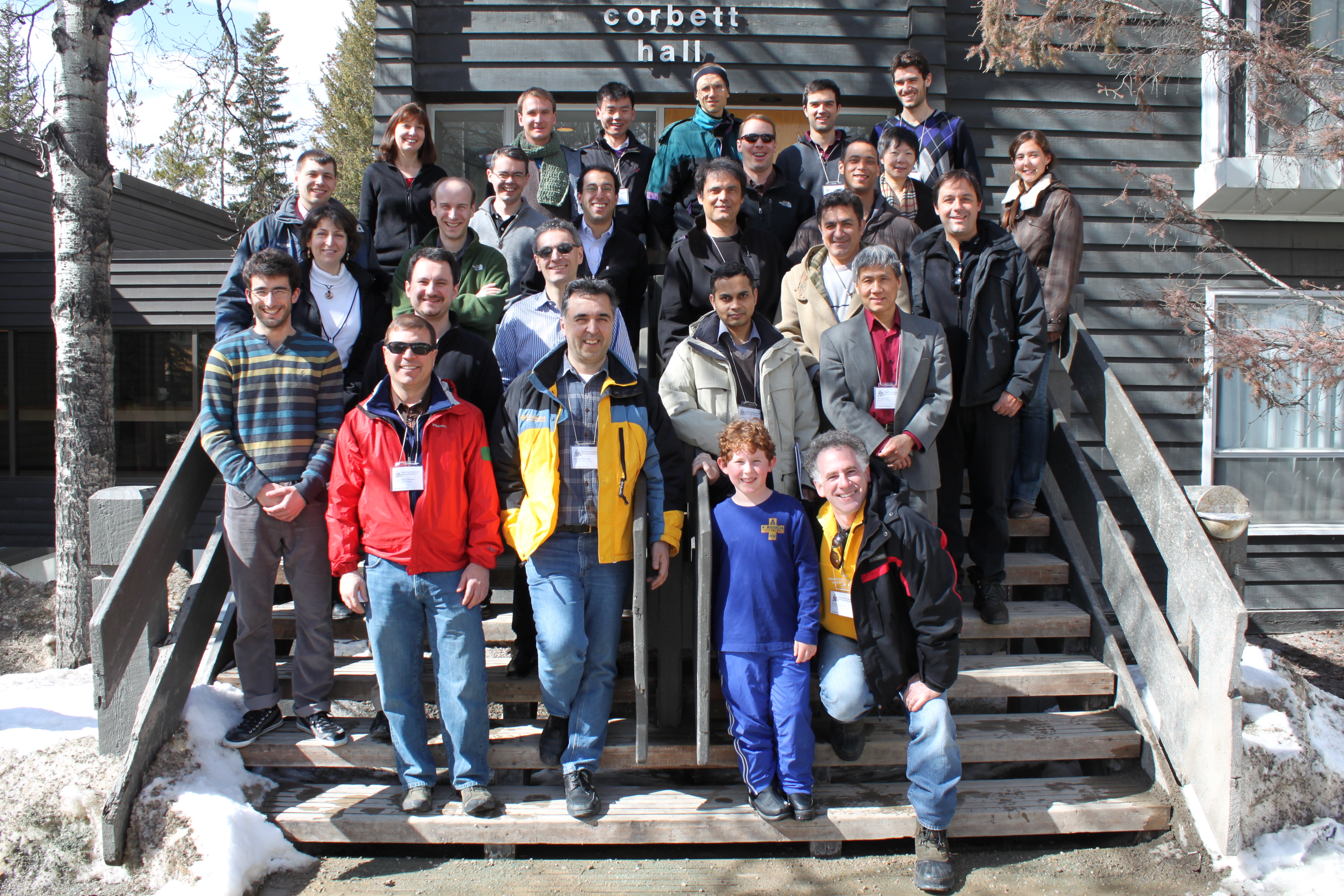
The Banff International Research Station will host the "Stochastic Multiscale Methods: Bridging the Gap Between Mathematical Analysis and Scientific and Engineering Applications." workshop from March 27th to April 1st, 2011.
The communities of stochastic analysis and computational science have evolved essentially along separate paths. The path forward, however, in the direction of disruptive scientific impact, requires significant exchange and collaboration. It is the intent of this Workshop ``Stochastic Multiscale Methods: Mathematical Analysis and Algorithms'' to bring together leading researchers in these two fields with view to delineate new horizons and forge new synergies that will accelerate the evolution of multiscale capabilities to become an enabler of scientific and economic progress.
The Workshop will bring together researchers from academia, government labs, and industry in an effort to identify technical challenges and research opportunities in the treatment of multiscale problems. The Workshop will have participation from computational science, mechanics and mathematics. We aim to provide the scientific community at large with an expert summary in which we will delineate the current challenges and opportunities associated with a very rapidly growing scientific area. We will take steps to ensure a significant participation by younger members of academia and the national labs.
The Banff International Research Station for Mathematical Innovation and Discovery (BIRS) is a collaborative Canada-US-Mexico venture that provides an environment for creative interaction as well as the exchange of ideas, knowledge, and methods within the Mathematical Sciences, with related disciplines and with industry. The research station is located at The Banff Centre in Alberta and is supported by Canada's Natural Science and Engineering Research Council (NSERC), the U.S. National Science Foundation (NSF), Alberta's Advanced Education and Technology, and Mexico's Consejo Nacional de Ciencia y Tecnología (CONACYT).