Time-frequency analysis and nonstationary filtering (05w5026)
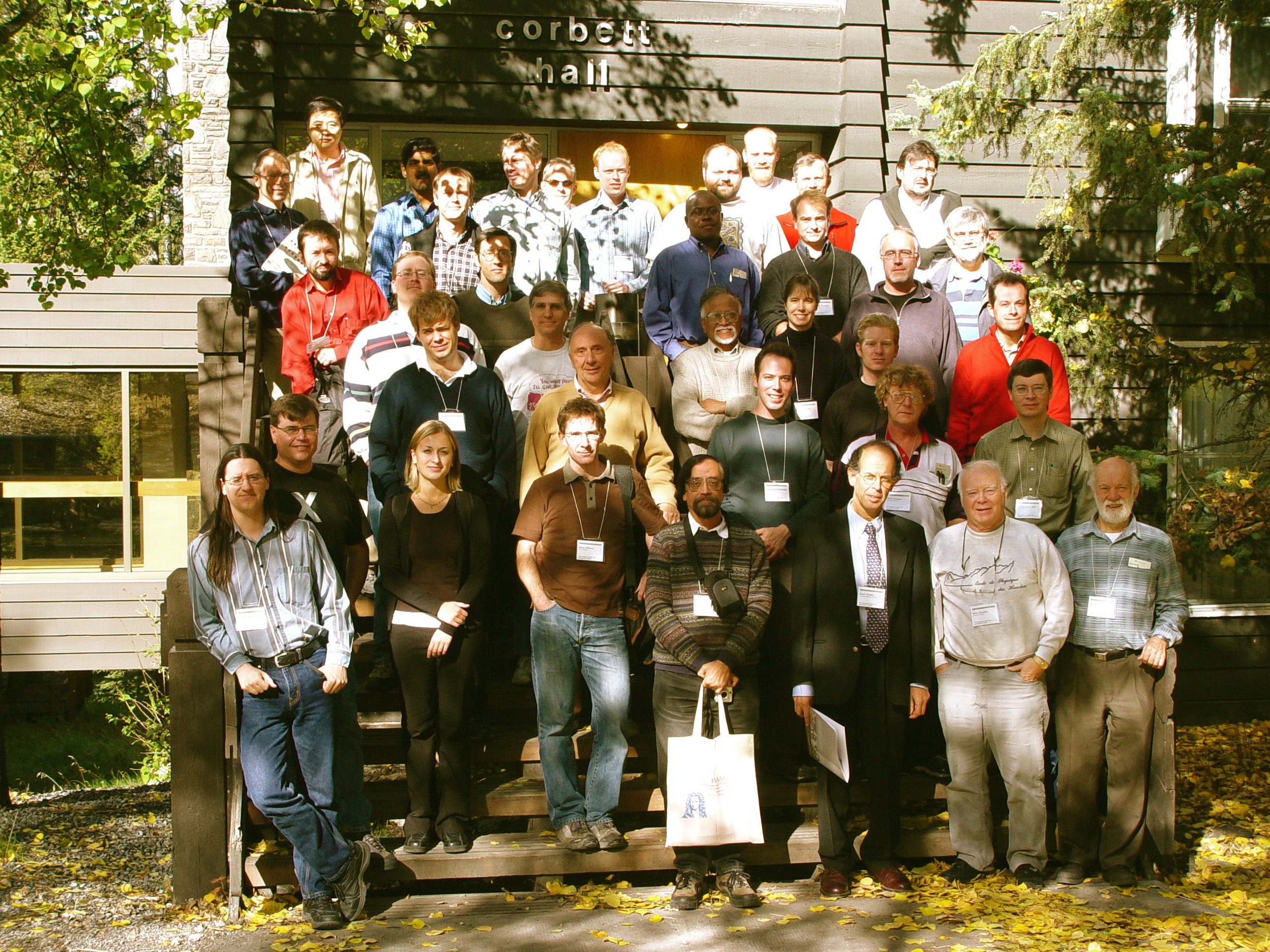
Arriving Saturday, September 24 and departing Thursday September 29, 2005

Organizers

Gary Margrave (University of Calgary)

Karlheinz Groechenig (Institute of Biomathematics and Biometry)

Objectives


The primary objective of this workshop is to bring together both theoretical researchers and the more applied practitioners in time-frequency analysis for a constructive exchange of ideas. There are many very advanced concepts in the recent theoretical publications in this field but most of these have had little impact to date upon applications to real world signals. We will invite some of the top theoreticians in time-frequency analysis to interact with mathematical physicists and engineers, particularly such as those in geophysics and communications engineering where nonstationary filtering is a fundamental tool. We envision a workshop format with time for formal presentations as well as unstructured time for interaction and collaboration.

This workshop is intended as a capstone for the special semester “Modern Methods of Time-Frequency Analysis” to be held at the Erwin Schrodinger Institute in Vienna during spring 2005. The ESI session will attract a wide spectrum of scientists from Europe, while the following BIRS workshop will mix some of these top researchers with the North American contingent. The ESI special semester is organized by Feichtinger, Groechenig, and Benedetto; two of whom are also organizers for this proposal.

A secondary objective is to encourage long-term collaboration between the theoreticians and the applied researchers. While the former often have a deeper understanding of the potential of time-frequency analysis, the latter have access to physical data and are in touch with practical necessities such as computational limitations.

This is an exciting moment in time-frequency analysis as the theory is evolving rapidly while new applications are also constantly emerging. Similar to the trend from linear to nonlinear problems, the move from stationary to nonstationary leads to a richer solution set but at the expense of greater mathematical and computational complexity. Stationary filtering has been an important signal processing tool in industry for many years but today we have an emerging understanding of nonstationary filtering that promises to have a immense impact on signal processing as well as the associated modelling of the real world. The rapid increase of available computing power makes the implementation of complex nonstationary filters possible today where they were only concepts a short while ago. This workshop will capitalize on these converging trends and is therefore particularly timely in 2005.

The development of Fourier analysis and exploitation of the factorization of translation-invariant linear systems (convolution integrals) by the Fourier transform has lead to a rich field with many practical applications. However, there is growing recognition that the ever more complex applications absolutely necessitate the inclusion of nonstationary systems in analysis and filtering techniques. Extensions of Fourier’s concepts to the nonstationary setting are numerous and include: the Gabor transform, the wavelet transform, the Wigner transform, pseudodifferential operators, Fourier integral operators, and more. While most of these extensions have origins within quantum theory, it is now true that applications abound in many other fields such as geophysics and engineering.

Examples of recent concrete applications in nonstationary filter theory include the development of Gabor deconvolution and Gabor wavefield extrapolation for seismic imaging, nonstationary filtering in cell phone networks, nonstationary noise reduction, modelling of spatially variable quantum systems, coherent state techniques, and filtering and analysis in commercial music production. In addition, any physical system that can be modeled as a variable coefficient partial differential equation can be re-expressed as an equivalent nonstationary filter problem.