Interactions between noncommutative algebra and algebraic geometry (05w5035)
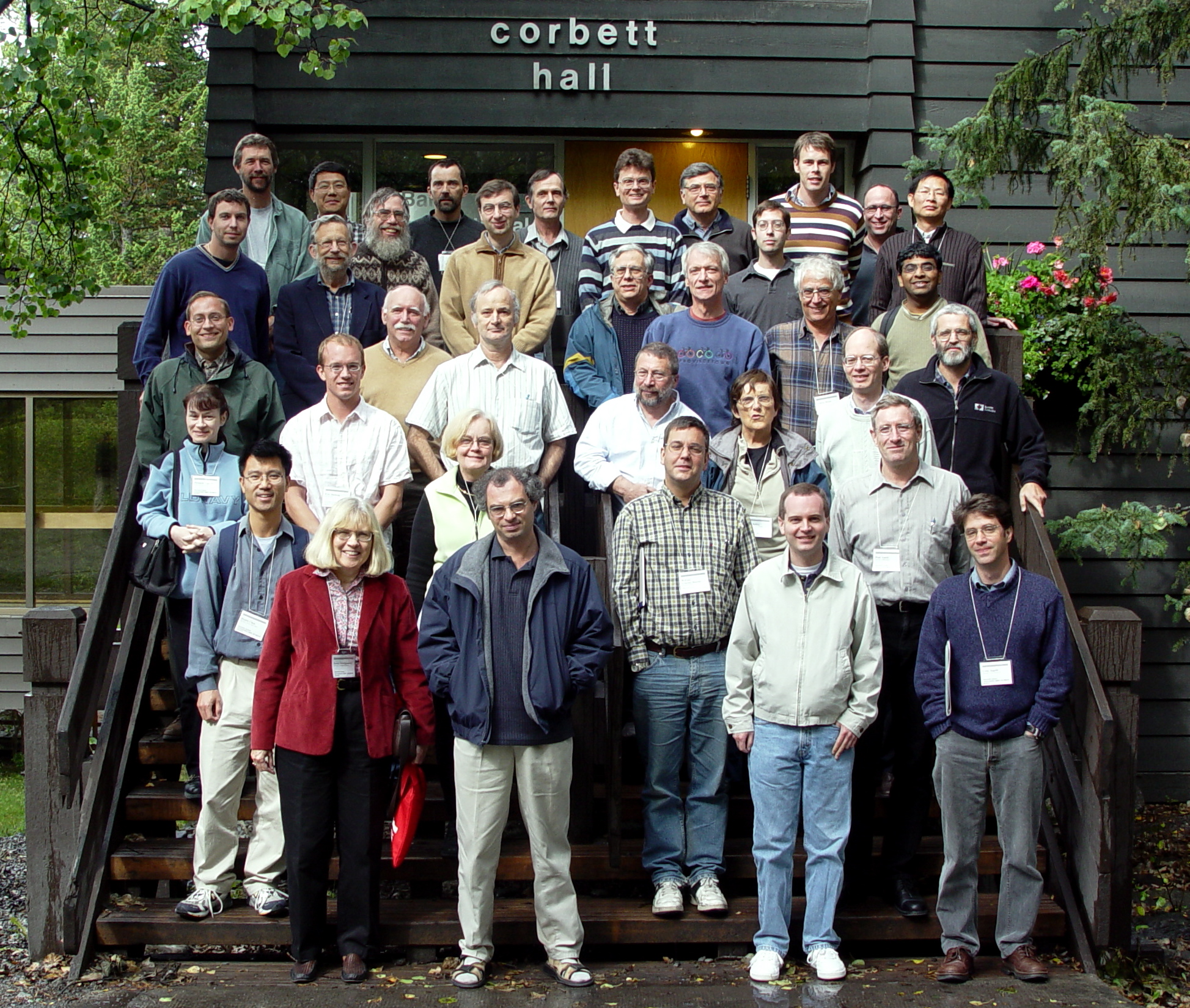
Arriving Saturday, September 10 and departing Thursday September 15, 2005

Organizers

Objectives


The main theme of this workshop is the interplay between noncommutative algebra and algebraic geometry. An important goal is to bring together researchers who use geometric methods in different areas of noncommutative algebra, in order to encourage their interaction and collaboration. We also hope to attract new Ph.D.s to this area, and encourage women researchers and researchers from underrepresented groups. This workshop will provide a useful follow-up to the highly successful noncommutative algebra program at MSRI 1999/2000, a week-long workshop at Oberwolfach in April 2002, and two ongoing year-long programs: Symposium 2003/2004 on Noncommutative Algebra and its Applications at Warwick and the Noncommutative Geometry program 2003/2004 at Institut Mittag-Leffler. This workshop will be the first such meeting in North America in over four years.

We will now describe some of the topics that will be discussed at the workshop.

A. The classification of noncommutative algebras of low dimension.

Geometric invariants are used in the classification of noncommutative algebras of low dimension. For example, the classification due to M. Artin, J. Tate and M. Van den Bergh of regular algebras of dimension three is in terms of an elliptic curve with a line bundle and an automorphism. The birational classification of orders due to M. Artin, D. Chan, A.J. de Jong and C.Ingalls describes orders in terms of a curve in a surface with a cyclic cover of the curve.

The classification of graded domains of Gelfand-Kirillov dimension three is an important problem. There is a conjectured list of division algebras of transcendence degree two due to M. Artin (or equivalently, of noncommutative algebraic surfaces, up to birational isomorphism.) Z. Reichstein showed in the finite-dimensional case division algebras of transcendence degree 2 can always be generated by two elements; it general, the minimal number of generators for these algebras is not known.

Another important classification problem is the study of graded regular algebras of dimension four. These include, but are not limited to, quantizations of projective three space. There are many partial results due to B. Shelton, K. Van Rompay, M. Vancliff, etc. The classification of Poisson brackets on projective three space by A. Bondal will also be an important component in a final classification. Many families of regular algebras of dimension four have been found, and there are various geometric structures attached to them. It is quite reasonable to expect a classification to exist. Some of the geometry that appears includes pencils of quadrics, or pencils of cubic surfaces with a triple plane in projective three space, and Enriques surfaces. Recent work of D.-M. Lu, Q.-S. Wu and J.J. Zhang proposes a promising way of classifying non-Koszul regular algebras of dimension four by using an A-infinity algebra technique.

B. Applications of noncommutative algebra to algebraic geometry.

There are many recent applications of noncommutative algebra to algebraic geometry. The birational classification of orders provides a birational classification of Mori fibre spaces over surfaces with a projective space general fibre (the work of D. Chan and C. Ingalls). Quaternion maximal orders appear as a component in the semi-orthogonal decomposition of the derived category of the corresponding conic bundle. Classification of orders of finite representation type provides a classification of certain singularities of conic bundles. The McKay correspondence has recently evolved into an equivalence of derived categories by work of M. Kapranov and E. Vasserot. The work of A. King, T. Bridgeland and M. Reid shows a derived equivalence between a noncommutative algebra and a crepant resolution of Gorenstein three fold quotient singularity. T. Bridgeland has shown that some flops are derived equivalent, and M. Van den Bergh has extended his result by proving that they are also derived equivalent to a noncommutative algebra. There is much recent interest in such noncommutative resolutions of singularities. These and other applications of noncommutative algebra to problems in algebraic geometry will be discussed at the workshop.

C. Homological aspects.

Derived categories, dualizing complexes and Serre duality play a very important role in noncommutative projective geometry. Indeed, A. Bondal defines a noncommutative smooth proper variety as a triangulated category with Serre Duality. Combining methods from representation theory and algebraic geometry, I. Reiten and M. Van den Bergh have classified hereditary categories with Serre duality. The result is described by hereditary orders over smooth curves and path algebras of quivers.

A-infinity algebras and A-infinity spaces were introduced by the topologist J. Stasheff in the 1960s. These concepts are new to many algebraists, though B. Keller has written several introductory papers on the subject. During the last 10 years, A-infinity structures have arisen in many areas other than topology, including algebra, combinatorics, and mathematical physics. B. Keller, D.-M. Lu, J. Palmieri, and Q.-S. Wu have obtained results in ring theory by using A-infinity algebras. A-infinity algebras are likely to become an important homological tool.

D. Geometric methods in the theory of central simple algebras.

The theory of central simple algebras goes back to the work of Albert in the 1930s. Important advances in this area were made by Amitsur and Procesi in the 1960s and 1970s; the Merkurjev-Suslin Theorem, proved in the early 1980s, was a major break-through. Nevertheless, many natural questions remain unsolved. In particular, the rationality problem for the centres of universal division algebras (posed by Procesi) and the cyclicity problem for algebras of prime order (posed by Albert) are among the most important open questions in ring theory, as well as in the theory of algebraic groups. These questions (and many others, involving central simple algebras) admit natural geometric interpretations. We plan to focus on recent progress in applying geometric methods in this area, including the above-mentioned results of A.J. de Jong and D.J. Saltman on the period-index problem.