Hochschild Cohomology of Algebras: Structure and Applications (07w5075)
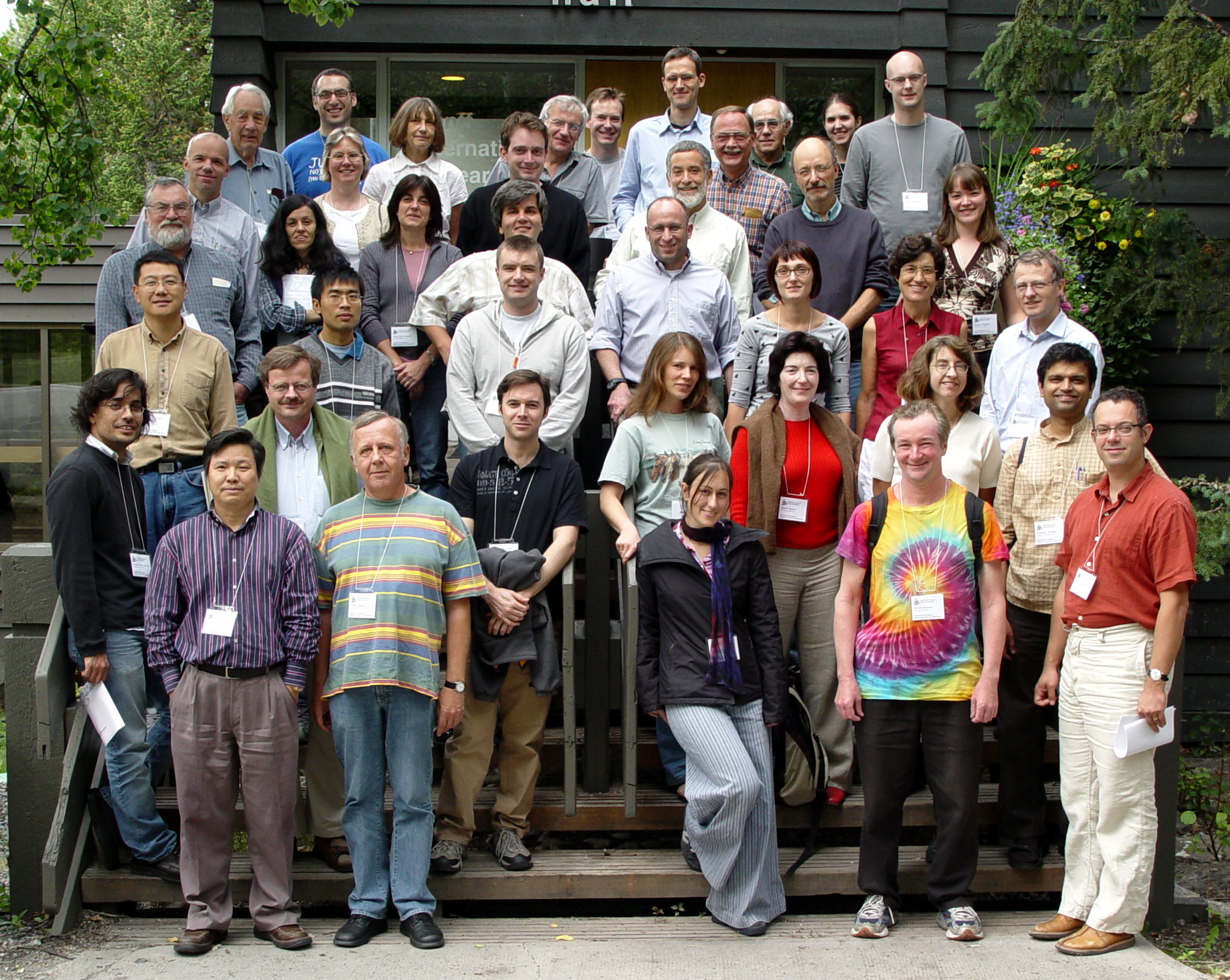
Arriving Sunday, September 2 and departing Friday September 7, 2007

Organizers

Ragnar-Olaf Buchweitz (University of Toronto Scarborough)
Luchezar Avramov (University of Nebraska)
Karin Erdmann (University of Oxford)
Jean-Louis Loday (Institut de Recherche Mathématique Avancée)
Sarah Witherspoon (Texas A&M University)

Objectives

(1) Scope and timeliness; target group of potential participants:

This workshop will give the opportunity for interaction among mathematicians from different fields who use or explore Hochschild cohomology. Participants will have the chance to get new insight into known results, explain questions pertinent to their area to nonspecialists, to consult with experts from other areas, and so prepare the ground for the transfer of ideas and new discoveries that would be difficult to obtain in isolation.

On the other hand, it is crucial to restrict the scope: Searching for 'Hochschild cohomology' on MathSciNet brings up 24 pages and more than 470 items, with classification numbers ranging from homological algebra, ring theory (and variations) to representations of groups, to Hilbert spaces, homotopy theory, symplectic geometry. Thus, focus is needed, and we propose to emphazise the study of the algebraic aspects, limiting the additional complications in algebraic or complex geometry, the operadic approach that originated in topology, or the specifics of Hochschild cohomology in functional analysis and operator algebras.

Even restricting to the more algebraically inclined researchers, the participants of the proposed workshop would come by necessity from several continents, with a high percentance of female researchers working in the area. While it is impossible even in this restricted group to bring together all the experts, the proposers believe firmly that it is crucial to invite a significant number of young researchers, close to or past their thesis defense, as those represent the future of the field.

A first instalment of such an interdisciplinary meeting focussed on algebraic aspects of Hochschild theory took place in Leicester in 2003. It was well received by those attending with much interest from varying fields and achieved its purpose well. To continue this initiation of the dialogue is one of our basic aims, and to hold a conference with similar focus in 2007 would be good timing.

(2) The research objectives, their importance and relevance:

The workshop will concentrate on several algebraic aspects on Hochschild cohomology, reflecting connections between homological algebra, commutative algebra, representation theory, group theory. It will bring together experts from several of these fields, promoting an exchange of ideas and potentially new collaborations. Specifically, mathematicians using Hochschild cohomology will present recent results, techniques and open problems from their fields. This will take stock of progress achieved and lead to discussing possible solutions to open problems.

In addition a few mathematicians will present applications of Hochschild cohomology in fields outside of algebra proper, encouraging potentially useful interaction within a wider group of users of Hochschild cohomology, and broadening our understanding of the context to which the theory applies and what it all means.

(a) What does it mean if Hochschild (co)homology vanishes in high degrees? For projective commutative algebras of finite type, eventual vanishing of either series of invariants is equivalent to the geometric notion of smoothness, and to finite projective dimension over the enveloping algebra (Avramov, Iyengar, Rodicio, Vigu'e-Poirrier). However, vanishing of cohomology does not imply vanishing of homology (Han) nor finite global dimension (Buchweitz, Green, Madsen, Solberg). The discovery of very small self-injective algebras with finite-dimensional Hochschild cohomology ring was a great surprise, and clearly, this is a very interesting avenue for further research.

The condition of finite projective dimension has been proposed as a definition for smoothness of noncommutative algebras (van den Bergh), but its properties are largely unknown and its relation to other generalizations of smoothness are not yet completely understood. The joint expertise of the participants of the workshop should provide a good setting for discussing smoothness and other geometrically motivated properties of commutative algebras, such as being locally complete intersection, in the context of more general associative algebras.

(b) One would like to understand the ring and the Lie algebra structure of the Hochschild cohomology. Ideally one might aim for a presentation by generators and relations, though this appears to be a very difficult problem in general.

There is recent progress, and various groups of researchers have developed completely different methods. For example, the ring structure of Hochschild cohomology of certain path algebras and related algebras were determined using quiver techniques (Erdmann, Holm, Snashall). A computation of the Hochschild cohomology ring of a finite group algebra used group cohomology (Siegel-Witherspoon proved a conjecture originally due to Cibils). The Hochschild cohomology rings of invariant subalgebras of Weyl algebras and generalizations were found by adapting techniques from commutative homological algebra (Alev, Farinati, Lambre, Solotar, Suarez-Alvarez). These are just a few examples of computations of the ring structure of Hochschild cohomology completed within the past ten years. It is always difficult to explain a computation, but different notation and specialized techniques have led to an unusually high number of cases of duplication of efforts and to rediscovery of earlier result. A focussed workshop could go a long way towards eliminating obstacles to communication, thus enhancing research in several fields.

(c) In group representation theory, the support variety of a module is a powerful invariant, for example its dimension is equal to the complexity of the modules, and it encapsulates many of its homological properties. It has found many applications, and has subsequently been extended, first to restricted enveloping algebras but more recently support varieties have also been studied for modules of finite group schemes and quantum groups (Bendel, Friedlander, Ostrik, Pevtsova, Suslin), their very definition depending on the difficult results that their cohomology algebras are finitely generated (Friedlander, Ginzburg, Kumar, Suslin).

One would like to have some analogue for more general associative algebras. Recently much work has been done, showing that Hochschild cohomology, which is graded commutative, can serve as a substitute for group cohomology; and it was shown that at least for self-injective algebras, many properties of support varieties for group representations have analogues in this more general setting (work by Snashall, Solberg, joined by Erdmann, Holloway, Taillefer). This however needs suitable finite generation properties. The required condition that the quotient of Hochschild cohomology by a nilpotent ideal be finitely generated is conjectured to be true for artinian algebras (Snashall, Solberg), and known to be true in some cases. It would be very interesting to establish this conjecture for classes of algebras, especially finite-dimensional Hecke algebras. For these, some more information is available via rank varieties, and some analogue of 'Quillen stratification' might be true. In the context of more general associative algebras, such properties are even less well understood. A live exchange of information among experts in different fields may be needed to formulate plausile conjectures.

(d) For some algebras, all representations or modules have periodic projective resolutions; these include modular group algebras of finite groups with cyclic p-Sylow or quaternion Sylow subgroups on one end of the spectrum, but also, apart from self-injective algebras of finite type, all finite-dimensional preprojective algebras that are of interest for quiver varieties and quantizations of singularities. In all cases known, this phenomenon is explained by periodicity of the Hochschild complex --- and then one has in particular finite generation of cohomology.


(3) Broadening the scope of the research:

In addition to the above algebraic directions of research, there are many questions arising from the use of Hochschild cohomology in fields less related to algebra. Geometric applications of Hochschild homology and cohomology play a significant role in work of Barannikov, Kontsevich, Markarian and Tsygan. One instance would be the connection with the graph-complexes a la Kontsevich. There are attempts to define more generally Hochschild theory for abelian, exact, or triangulated categories.

As a specific example of a geometric application, mathematicians studying orbifolds have looked at Hochschild cohomology of the bounded derived category of equivariant sheaves (Baranovsky, Caldararu, Kaledin) or their quantizations (Etingof, Ginzburg, Kaledin); in case of C*-algebras this work centers on the celebrated Baum-Connes conjecture. In the case of an affine space, this Hochschild cohomology ring is simply the Hochschild cohomology of an extension of a function algebra by the group, and thus it may be studied algebraically. We plan to invite a few active researchers using Hochschild cohomology in geometry or topology to present current applications such as these.