Quantum Chaos: Routes to RMT Statistics and Beyond (08w5091)
Organizers
Gregory Berkolaiko (Texas A&M University)
Uzy Smilansky (Weizmann Institute of Science, Israel)
Robert Whitney (Institut Laue-Langevin, Grenoble)
Description
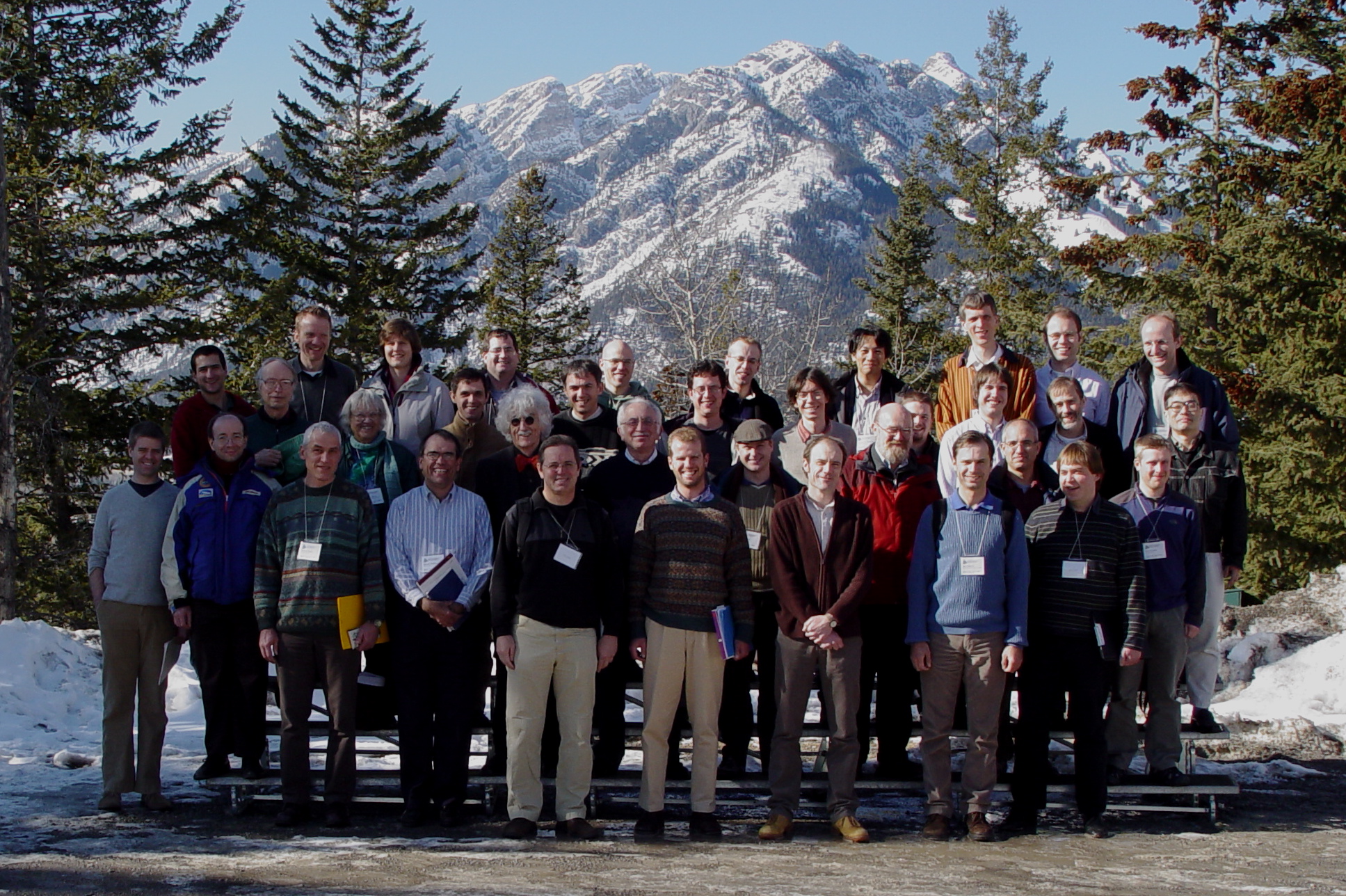
There are several outstanding conjectures in this area, for example it has been observed numerically that many classically chaotic systems have spectra that resemble (in a statistical sense) spectra of large random matrices. There are two major approaches used to treat such problem, one using expansions over periodic orbits of the classical system and one using field-theoretical methods. It is the aim of the conference at BIRS, February 24-29, 2008, to, on one hand, bring together scientists that use the two approaches and, on the other hand, bring together physicists and mathematicians to heighten awareness of the recent major developments in the said approaches.
The Banff International Research Station for Mathematical Innovation and Discovery (BIRS) is a collaborative Canada-US-Mexico venture that provides an environment for creative interaction as well as the exchange of ideas, knowledge, and methods within the Mathematical Sciences, with related disciplines and with industry. The research station is located at The Banff Centre in Alberta and is supported by Canada's Natural Science and Engineering Research Council (NSERC), the US National Science Foundation (NSF), Alberta's Advanced Education and Technology, and Mexico's Consejo Nacional de Ciencia y Tecnología (CONACYT).